00 Foundations
Photon energy and wavelength
E = hc/λ for x-ray and γ photons. hc ≈ 1.240 keV·nm.
Listen
Listen · English
Simulation
Photon energy and wavelength — Change the numbers; the scene follows.
Where it works
Radiography room
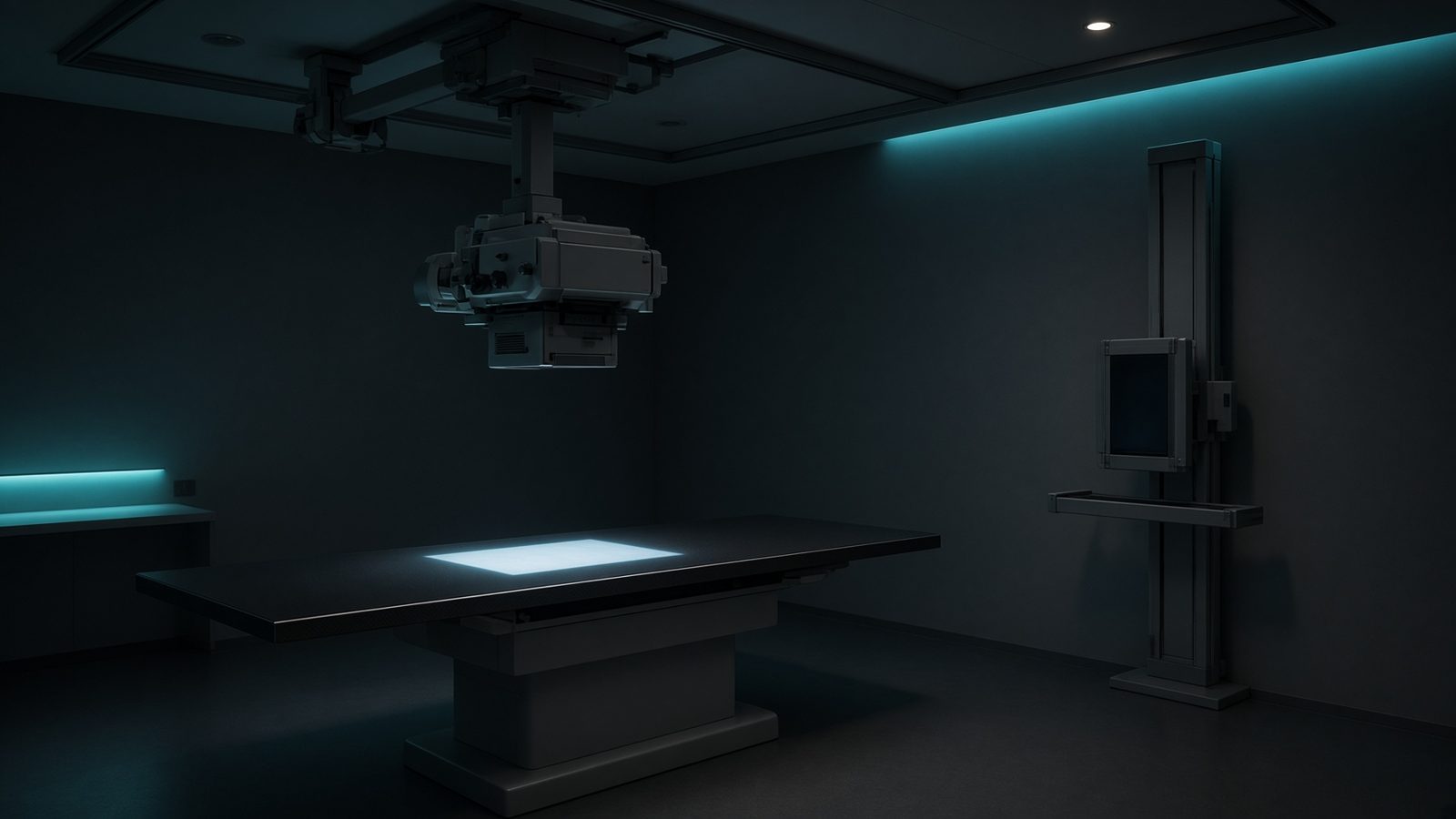
X-ray tube
At the focal spot in the tube housing — spectrum, output, SID geometry, and unsharpness start here.
Open this machineFormula
Variables
Results
E
Photon energy
99.9873keV
E
Photon energy
0.09999MeV
f
Frequency
24.1768×10¹⁸ Hz
Curve
Explanation
What it means
A photon’s energy is Planck’s constant times its frequency, or hc divided by wavelength. In radiology we use E (keV) = 1.240 / λ (nm), so a 0.1 nm x-ray is 12.4 keV and a 12.4 pm γ-ray is 100 keV. Frequency follows from f = c/λ with c = 3×10⁸ m/s. This is a working relation in Radiation physics.
Where it is used
Clinically it sits on the Radiography room — X-ray tube. At the focal spot in the tube housing — spectrum, output, SID geometry, and unsharpness start here. Radiation physics lives at the x-ray target, the linac head, and inside the patient: how a photon is born, how it scatters, and how it dies. Use these relations before you trust a spectrum, a wall, or a kV-versus-MV contrast argument.
Radiography room · Open this machineHow to use it
Enter wavelength in nm (or energy in keV — leave the other as a check). Use it to convert kVp-related spectra, characteristic lines (W Kα ≈ 59 keV), and PET annihilation photons (511 keV → 2.43 pm). Change one input and watch the curve and the simulation follow.
Symbols
- λWavelength0.0124 nm
Worked example
A typical case from the default values: λ = 0.0124 nm (Wavelength). Substituting into the relation gives E = 99.9873 keV; E = 0.09999 MeV; f = 24.1768 ×10¹⁸ Hz. These are teaching numbers — align them with your machine.
Typical values give
- E = 99.9873keV
- E = 0.09999MeV
- f = 24.1768×10¹⁸ Hz
Where it comes from
The displayed formula is the working relation. E = hc/λ for x-ray and γ photons. hc ≈ 1.240 keV·nm. Usual reference: Attix / NIST. Derive it in the specialty lesson, then return here to pin the numbers.
Reference: Attix / NIST
Assumptions & limits
Treats a monochromatic photon in vacuum. Spectra, filtration, and refractive index in tissue are not included. hc is the CODATA value 1.23984193 keV·nm, rounded to 1.240 in the formula display.
Pitfalls
Do not mix free-electron Compton kinematics with photoelectric-dominated kV imaging. Check keV versus MeV, and never treat a spectrum as one photon. Treats a monochromatic photon in vacuum. Spectra, filtration, and refractive index in tissue are not included. hc is the CODATA value 1.23984193 keV·nm, rounded to 1.240 in the formula display.
Keep this
Photons do not deposit dose; the electrons they set in motion do. Treats a monochromatic photon in vacuum. Spectra, filtration, and refractive index in tissue are not included. hc is the CODATA value 1.23984193 keV·nm, rounded to 1.240 in the formula display.
In this specialty