00 Foundations
Moseley Kα characteristic energy
Kα x-ray energy from Moseley’s law: E ≈ 10.2 (Z−1)² eV.
Listen
Listen · English
Simulation
Moseley Kα characteristic energy — Change the numbers; the scene follows.
Where it works
Radiography room
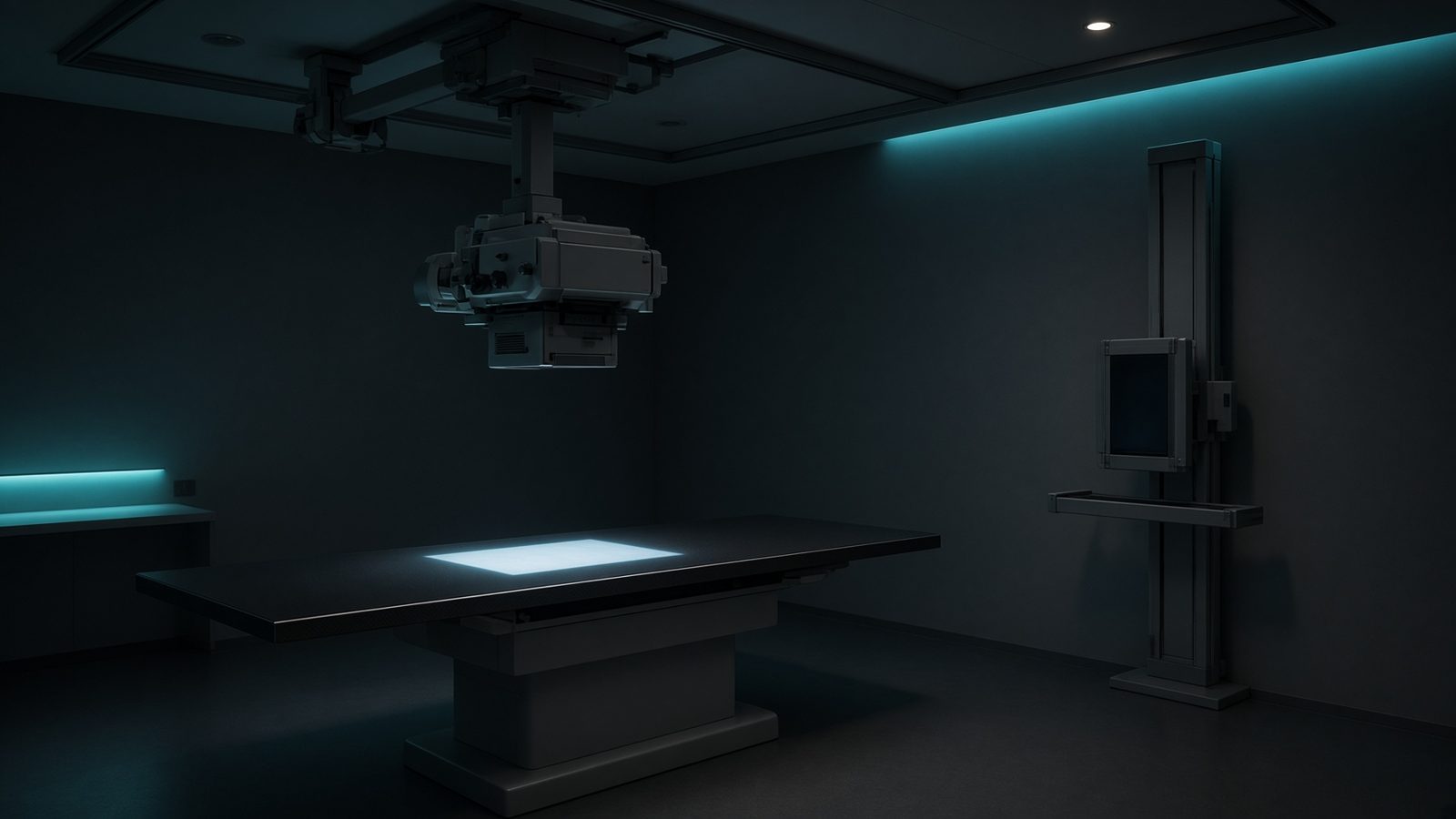
X-ray tube
At the focal spot in the tube housing — spectrum, output, SID geometry, and unsharpness start here.
Open this machineFormula
Typical values
Variables
Results
E_Kα
Kα energy
54.3558keV
≈K-edge
Approx. K-edge
63.5963keV
kVp_min
Minimum kVp to produce Kα
63.5963kV
Curve
Explanation
What it means
Characteristic x-rays are emitted when an outer electron fills a K-shell vacancy. Moseley treated the K-shell as hydrogen-like with screening constant 1, so E_Kα = 13.6 (Z−1)² (1 − 1/4) eV. Tungsten (Z=74) predicts ~54 keV; the measured Kα is 59.3 keV. Molybdenum Kα is 17.5 keV — the reason Mo anodes are used in mammography. This is a working relation in Radiation physics.
Where it is used
Clinically it sits on the Radiography room — X-ray tube. At the focal spot in the tube housing — spectrum, output, SID geometry, and unsharpness start here. Radiation physics lives at the x-ray target, the linac head, and inside the patient: how a photon is born, how it scatters, and how it dies. Use these relations before you trust a spectrum, a wall, or a kV-versus-MV contrast argument.
Radiography room · Open this machineHow to use it
Enter atomic number Z of the anode (or contrast agent). Read Kα in keV and the tube kVp that just produces it (must exceed the K-edge, slightly above Kα). Presets cover W, Mo, Rh, Cu, I, Ba. Change one input and watch the curve and the simulation follow.
Symbols
- ZAtomic number74
Worked example
A typical case from the default values: Z = 74 (Atomic number). Substituting into the relation gives E_Kα = 54.3558 keV; ≈K-edge = 63.5963 keV; kVp_min = 63.5963 kV. These are teaching numbers — align them with your machine.
Typical values give
- E_Kα = 54.3558keV
- ≈K-edge = 63.5963keV
- kVp_min = 63.5963kV
Where it comes from
Bohr: E = 13.6 Z_eff² (1/n₁² − 1/n₂²) eV. For Kα, n₁=1, n₂=2, Z_eff = Z−1 (the remaining K electron screens one charge).
Reference: Moseley 1913 / Bushberg
Assumptions & limits
Screening constant is 1; L-lines and Kβ (≈1.1 Kα) are omitted. Real K-edges are a few keV above Kα (W K-edge 69.5 keV). Not valid for Z < ~10.
Pitfalls
Do not mix free-electron Compton kinematics with photoelectric-dominated kV imaging. Check keV versus MeV, and never treat a spectrum as one photon. Screening constant is 1; L-lines and Kβ (≈1.1 Kα) are omitted. Real K-edges are a few keV above Kα (W K-edge 69.5 keV). Not valid for Z < ~10.
Keep this
Photons do not deposit dose; the electrons they set in motion do. Screening constant is 1; L-lines and Kβ (≈1.1 Kα) are omitted. Real K-edges are a few keV above Kα (W K-edge 69.5 keV). Not valid for Z < ~10.
In this specialty