00 Foundations
Mean life and decay constant
τ = 1/λ = T½ / ln 2 ≈ 1.443 T½. Mean life, not half-life.
Listen
Listen · English
Simulation
Mean life and decay constant — Change the numbers; the scene follows.
Where it works
Hot lab
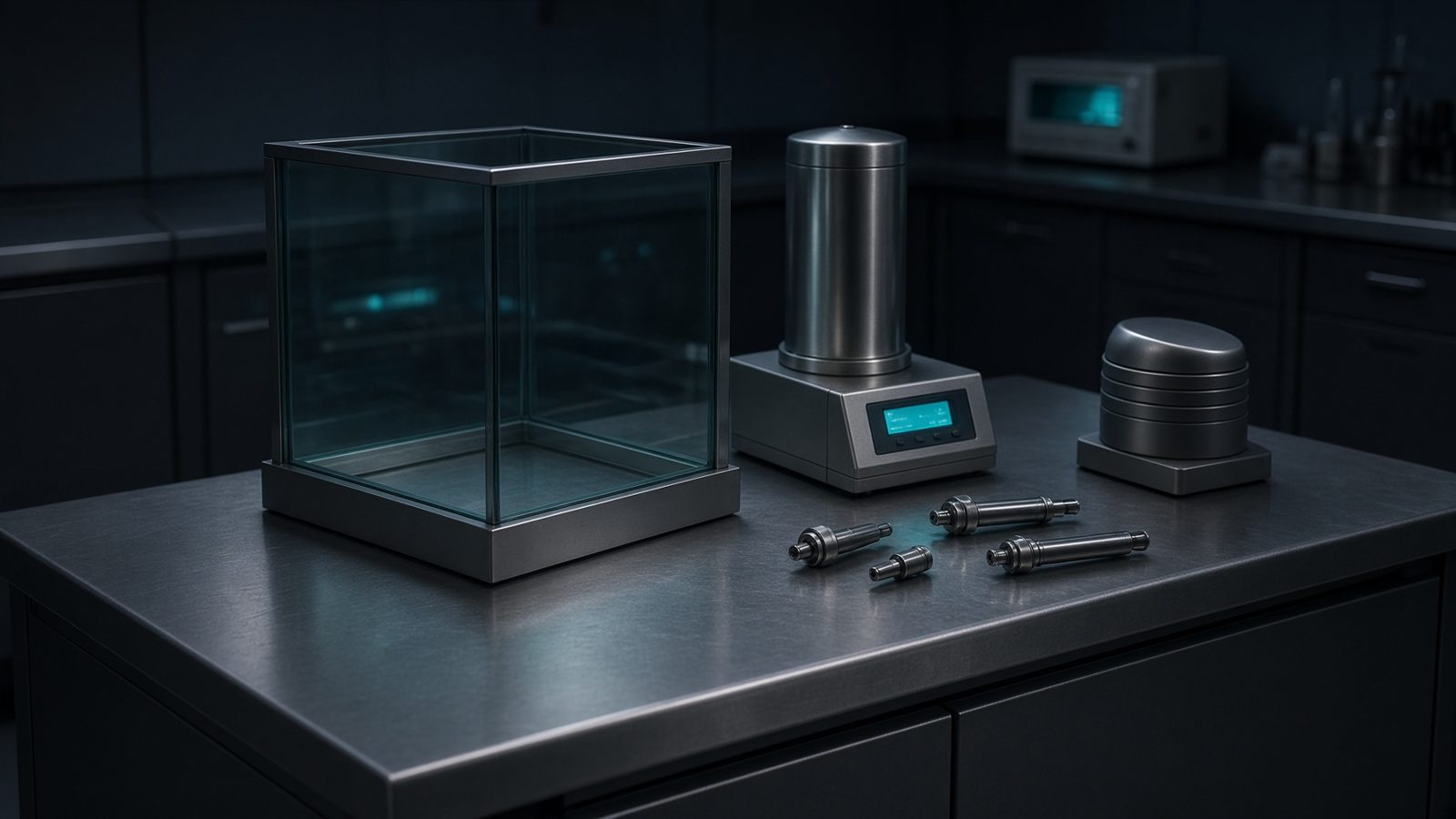
Dose calibrator
In the dose calibrator well — assayed activity, decay between two times, Marinelli.
Open this machineFormula
Variables
Results
τ
Mean life
8.685h
λ
Decay constant
0.115141h⁻¹
Explanation
What it means
Half-life is the time for activity to fall to 50%. Mean life τ is the average lifetime of an atom, equal to 1/λ, and is about 44% longer than T½. Cumulated activity for a pure exponential is A₀τ = 1.443 A₀ T½ — the factor that appears in MIRD. This is a working relation in Radiation physics.
Where it is used
Clinically it sits on the Hot lab — Dose calibrator. In the dose calibrator well — assayed activity, decay between two times, Marinelli. Radiation physics lives at the x-ray target, the linac head, and inside the patient: how a photon is born, how it scatters, and how it dies. Use these relations before you trust a spectrum, a wall, or a kV-versus-MV contrast argument.
Hot lab · Open this machineHow to use it
Enter T½ in hours. Use τ when integrating activity to infinity (Ã = A₀ τ) or converting a decay constant from a tabulated half-life. Change one input and watch the curve and the simulation follow.
Symbols
- T½Half-life6.02 h
Worked example
A typical case from the default values: T½ = 6.02 h (Half-life). Substituting into the relation gives τ = 8.685 h; λ = 0.115141 h⁻¹. These are teaching numbers — align them with your machine.
Typical values give
- τ = 8.685h
- λ = 0.115141h⁻¹
Where it comes from
The displayed formula is the working relation. τ = 1/λ = T½ / ln 2 ≈ 1.443 T½. Mean life, not half-life. Usual reference: Cherry. Derive it in the specialty lesson, then return here to pin the numbers.
Reference: Cherry
Assumptions & limits
Applies to a single exponential (one radionuclide, no biological clearance). For effective decay, replace T½ by T_e.
Pitfalls
Do not mix free-electron Compton kinematics with photoelectric-dominated kV imaging. Check keV versus MeV, and never treat a spectrum as one photon. Applies to a single exponential (one radionuclide, no biological clearance). For effective decay, replace T½ by T_e.
Keep this
Photons do not deposit dose; the electrons they set in motion do. Applies to a single exponential (one radionuclide, no biological clearance). For effective decay, replace T½ by T_e.
In this specialty