00 Foundations
Activity from mass
A = λN with N from mass and molar mass. Carrier-free specific activity.
Listen
Listen · English
Simulation
Activity from mass — Change the numbers; the scene follows.
Where it works
Hot lab
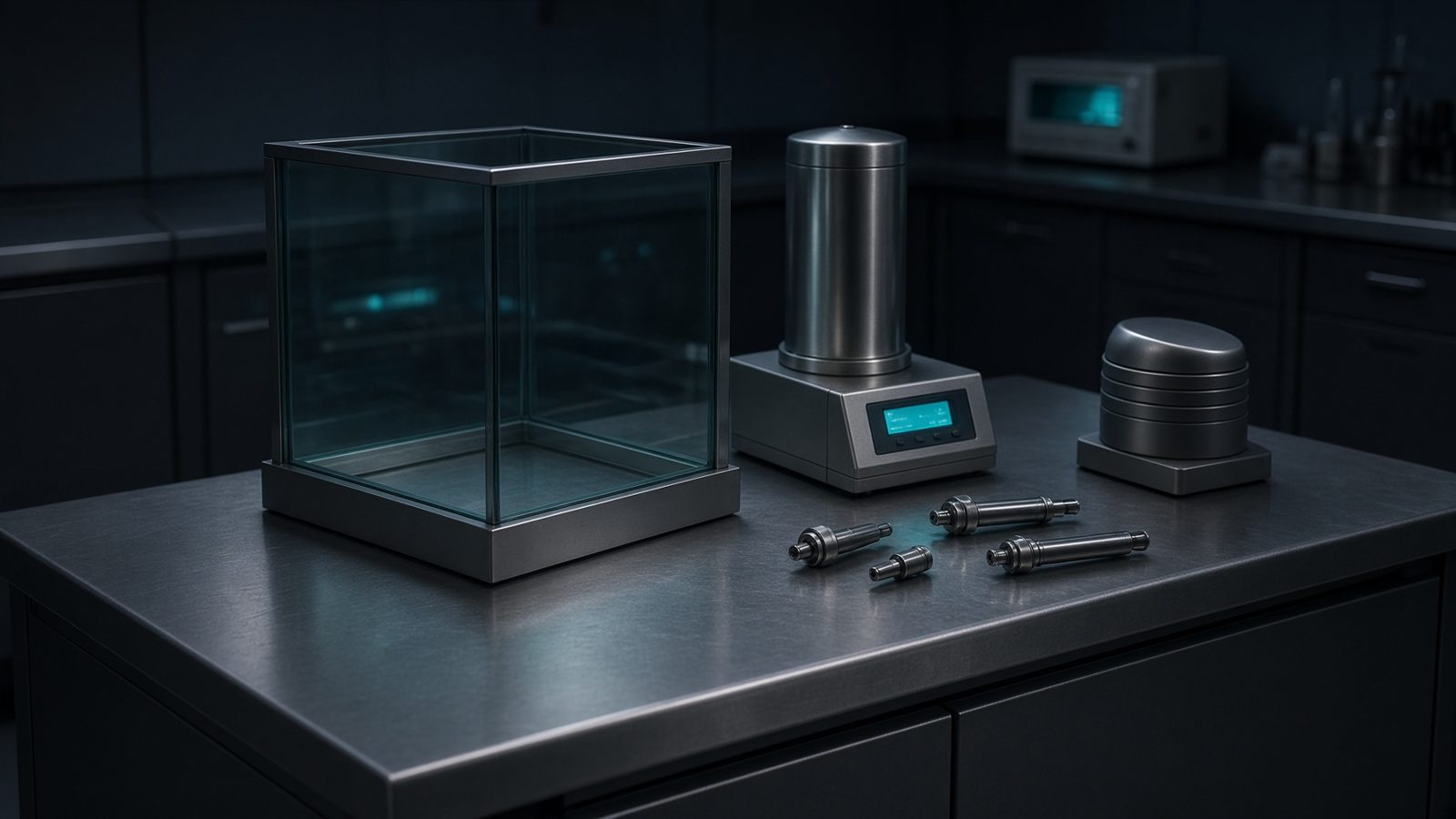
Dose calibrator
In the dose calibrator well — assayed activity, decay between two times, Marinelli.
Open this machineFormula
Typical values
Variables
Results
A
Activity
1.946e+11Bq
A
Activity
194,554.902MBq
a
Specific activity
194,554.9016GBq/mg
Explanation
What it means
Activity is the number of decays per second: A = λN. For a pure radionuclide the atom count N is mass over molar mass times Avogadro’s number. Specific activity a = A/m is then λ N_A / M. Short half-life nuclides have huge specific activity (F-18, Tc-99m); long-lived ones (C-14, U-238) do not. This is a working relation in Radiation physics.
Where it is used
Clinically it sits on the Hot lab — Dose calibrator. In the dose calibrator well — assayed activity, decay between two times, Marinelli. Radiation physics lives at the x-ray target, the linac head, and inside the patient: how a photon is born, how it scatters, and how it dies. Use these relations before you trust a spectrum, a wall, or a kV-versus-MV contrast argument.
Hot lab · Open this machineHow to use it
Enter mass in µg, molar mass g/mol, and half-life in hours. Presets cover common nuclides. Output is Bq, MBq, and GBq/mg. Use it for generator yield checks and ‘no-carrier-added’ calculations — real radiopharmaceuticals are rarely 100% pure. Change one input and watch the curve and the simulation follow.
Symbols
- mMass1 µg
- MMolar mass99 g/mol
- T½Half-life6.02 h
Worked example
A typical case from the default values: m = 1 µg (Mass); M = 99 g/mol (Molar mass); T½ = 6.02 h (Half-life). Substituting into the relation gives A = 1.946e+11 Bq; A = 194,554.902 MBq; a = 194,554.9016 GBq/mg. These are teaching numbers — align them with your machine.
Typical values give
- A = 1.946e+11Bq
- A = 194,554.902MBq
- a = 194,554.9016GBq/mg
Where it comes from
The displayed formula is the working relation. A = λN with N from mass and molar mass. Carrier-free specific activity. Usual reference: Cherry / Podgorsak. Derive it in the specialty lesson, then return here to pin the numbers.
Reference: Cherry / Podgorsak
Assumptions & limits
Assumes a single isotope with no carrier, no branching, and SI activity (1 Bq = 1 s⁻¹). Chemical impurities, isotopic dilution, and decay-chain daughters are omitted.
Pitfalls
Do not mix free-electron Compton kinematics with photoelectric-dominated kV imaging. Check keV versus MeV, and never treat a spectrum as one photon. Assumes a single isotope with no carrier, no branching, and SI activity (1 Bq = 1 s⁻¹). Chemical impurities, isotopic dilution, and decay-chain daughters are omitted.
Keep this
Photons do not deposit dose; the electrons they set in motion do. Assumes a single isotope with no carrier, no branching, and SI activity (1 Bq = 1 s⁻¹). Chemical impurities, isotopic dilution, and decay-chain daughters are omitted.
In this specialty