00 Foundations
Photoelectric Z³ / E³·⁵ scaling
Relative photoelectric cross section between two materials or energies.
Listen
Listen · English
Simulation
Photoelectric Z³ / E³·⁵ scaling — Change the numbers; the scene follows.
Where it works
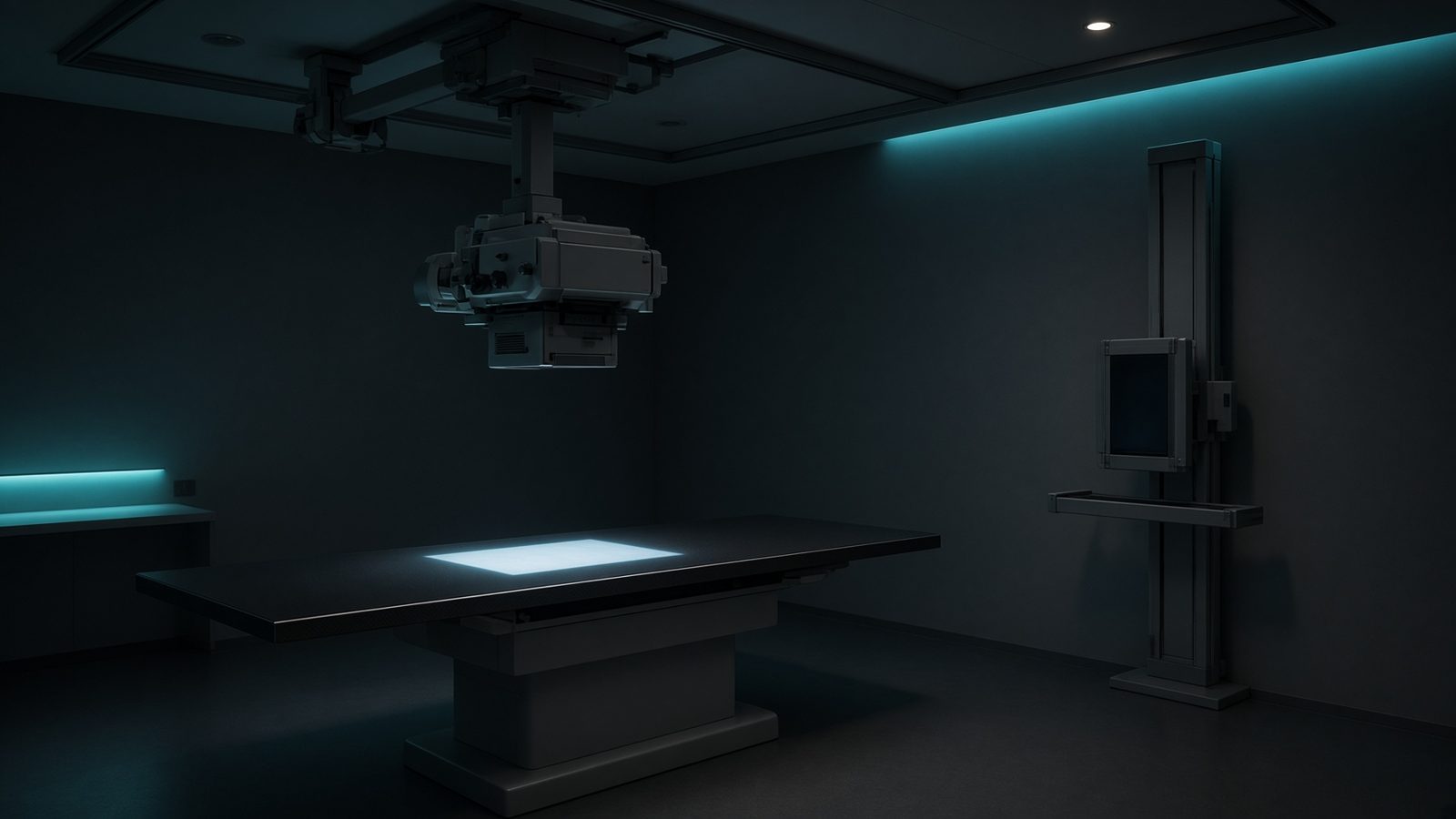
Radiography room
Patient
At the patient entrance — skin dose, subject contrast, photoelectric absorption in tissue.
Open this machineFormula
Typical values
Variables
Results
τ₂/τ₁
Photoelectric ratio
1,518.6296
(Z₂/Z₁)³
Z term
367.3943
(E₁/E₂)³·⁵
Energy term
4.1335
Explanation
What it means
The photoelectric effect goes roughly as Z³–Z⁴ / E³–E³·⁵ between K-edges. That is why bone and iodine light up on kV images, why lead is an excellent kV shield, and why photoelectric contrast collapses at MV energies. The exponent 3.5 is a teaching compromise between the non-relativistic 3.5 and the high-energy 3. This is a working relation in Radiation physics.
Where it is used
Clinically it sits on the Radiography room — Patient. At the patient entrance — skin dose, subject contrast, photoelectric absorption in tissue. Radiation physics lives at the x-ray target, the linac head, and inside the patient: how a photon is born, how it scatters, and how it dies. Use these relations before you trust a spectrum, a wall, or a kV-versus-MV contrast argument.
Radiography room · Open this machineHow to use it
Enter Z and E for the reference (1) and the unknown (2). Read τ₂/τ₁. Example: iodine (Z=53) vs soft tissue (Z_eff≈7.4) at 40 keV is hundreds-to-one — the basis of contrast media. Change one input and watch the curve and the simulation follow.
Symbols
- Z₁Reference Z7.4
- E₁Reference energy60 keV
- Z₂New Z53
- E₂New energy40 keV
Worked example
A typical case from the default values: Z₁ = 7.4 (Reference Z); E₁ = 60 keV (Reference energy); Z₂ = 53 (New Z); E₂ = 40 keV (New energy). Substituting into the relation gives τ₂/τ₁ = 1,518.6296; (Z₂/Z₁)³ = 367.3943; (E₁/E₂)³·⁵ = 4.1335. These are teaching numbers — align them with your machine.
Typical values give
- τ₂/τ₁ = 1,518.6296
- (Z₂/Z₁)³ = 367.3943
- (E₁/E₂)³·⁵ = 4.1335
Where it comes from
Born-approximation photoelectric cross section for a K-shell electron ~ Z⁵ / E³·⁵ per atom; per electron that is ~ Z⁴ / E³·⁵, and empirical fits in the diagnostic range settle near Z³ / E³·⁵ for mixtures.
Reference: Bushberg / Attix
Assumptions & limits
Ignores K-edge discontinuities: crossing an absorption edge (I K-edge 33.2 keV, Ba 37.4, W 69.5) invalidates a smooth power law. Mass (not linear) scaling also needs electron density. Order-of-magnitude teaching tool, not a substitute for NIST XCOM.
Pitfalls
Do not mix free-electron Compton kinematics with photoelectric-dominated kV imaging. Check keV versus MeV, and never treat a spectrum as one photon. Ignores K-edge discontinuities: crossing an absorption edge (I K-edge 33.2 keV, Ba 37.4, W 69.5) invalidates a smooth power law. Mass (not linear) scaling also needs electron density. Order-of-magnitude teaching tool, not a substitute for NIST XCOM.
Keep this
Photons do not deposit dose; the electrons they set in motion do. Ignores K-edge discontinuities: crossing an absorption edge (I K-edge 33.2 keV, Ba 37.4, W 69.5) invalidates a smooth power law. Mass (not linear) scaling also needs electron density. Order-of-magnitude teaching tool, not a substitute for NIST XCOM.
In this specialty