00 Foundations
Pair-production Z² scaling
Pair (and triplet) production rises as Z² above 1.022 MeV.
Listen
Listen · English
Simulation
Pair-production Z² scaling — Change the numbers; the scene follows.
Where it works
Linear accelerator
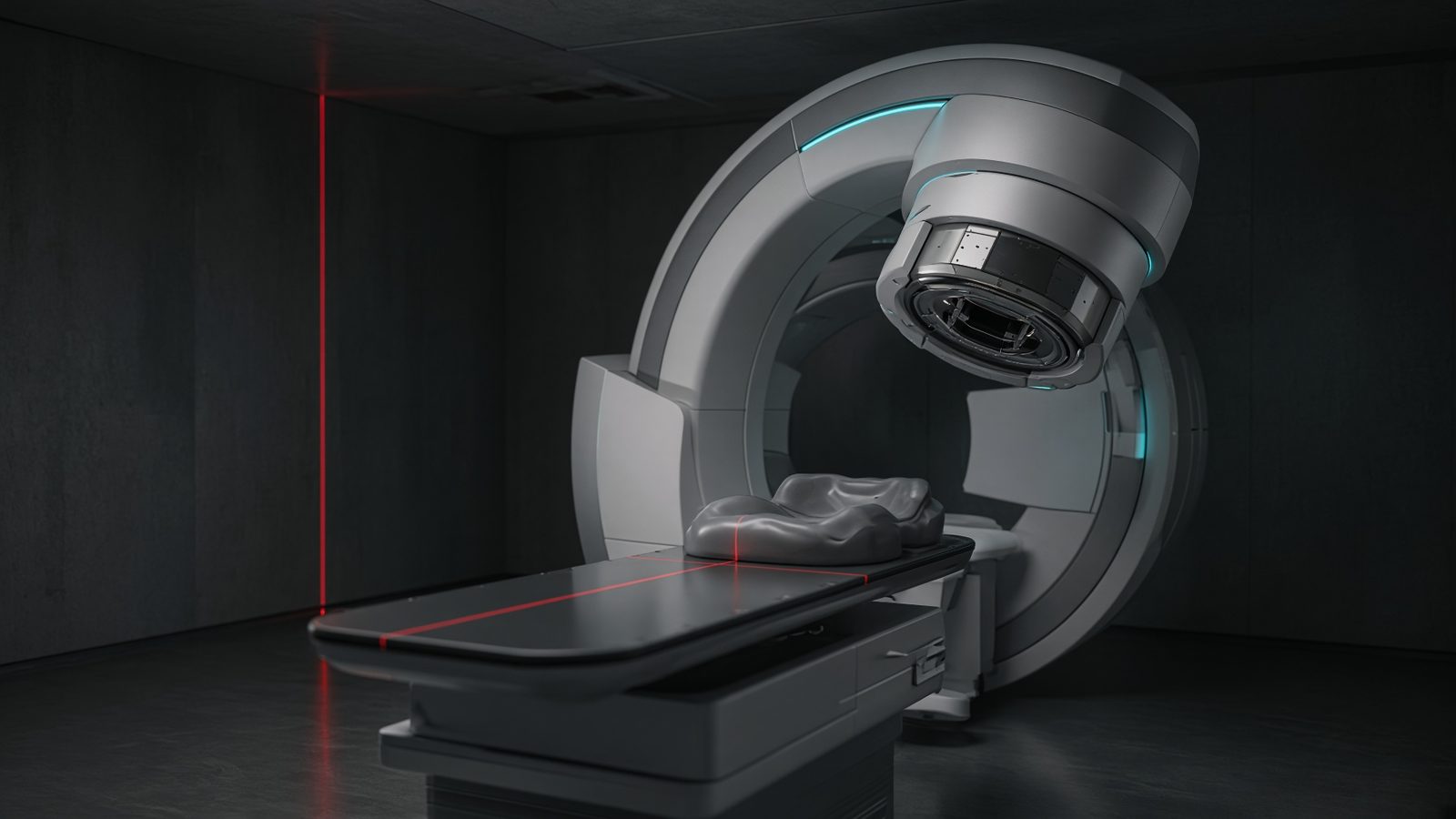
Isocenter
At isocenter, on the central axis through the patient (or a phantom in the same place).
Open this machineFormula
Variables
Results
κ₂/κ₁
Pair ratio
418.7896
E₁−1.022
Above threshold
4.978MeV
E₂−1.022
Above threshold
16.978MeV
Explanation
What it means
A photon of E > 1.022 MeV can materialise as e⁺e⁻ in the Coulomb field of a nucleus. The cross section per atom goes as Z² and, well above threshold, roughly linearly with E. In bone and in high-Z shields at 18 MV this is no longer negligible; in kV imaging it is identically zero. This is a working relation in Radiation physics.
Where it is used
Clinically it sits on the Linear accelerator — Isocenter. At isocenter, on the central axis through the patient (or a phantom in the same place). Radiation physics lives at the x-ray target, the linac head, and inside the patient: how a photon is born, how it scatters, and how it dies. Use these relations before you trust a spectrum, a wall, or a kV-versus-MV contrast argument.
Linear accelerator · Open this machineHow to use it
Enter Z and E (MeV) for two cases. The ratio uses max(E−1.022, 0) so energies below threshold correctly give zero. Compare 6 MV (mean ~2 MeV) in water vs lead. Change one input and watch the curve and the simulation follow.
Symbols
- Z₁Reference Z7.4
- E₁Reference energy6 MeV
- Z₂New Z82
- E₂New energy18 MeV
Worked example
A typical case from the default values: Z₁ = 7.4 (Reference Z); E₁ = 6 MeV (Reference energy); Z₂ = 82 (New Z); E₂ = 18 MeV (New energy). Substituting into the relation gives κ₂/κ₁ = 418.7896; E₁−1.022 = 4.978 MeV; E₂−1.022 = 16.978 MeV. These are teaching numbers — align them with your machine.
Typical values give
- κ₂/κ₁ = 418.7896
- E₁−1.022 = 4.978MeV
- E₂−1.022 = 16.978MeV
Where it comes from
The displayed formula is the working relation. Pair (and triplet) production rises as Z² above 1.022 MeV. Usual reference: Heitler / Attix. Derive it in the specialty lesson, then return here to pin the numbers.
Reference: Heitler / Attix
Assumptions & limits
Threshold kinematics only; screening, triplet production (κ ∝ Z) and the slow logarithmic rise of the high-energy cross section are omitted. For quantitative shielding use NIST XCOM or attenuation tables.
Pitfalls
Do not mix free-electron Compton kinematics with photoelectric-dominated kV imaging. Check keV versus MeV, and never treat a spectrum as one photon. Threshold kinematics only; screening, triplet production (κ ∝ Z) and the slow logarithmic rise of the high-energy cross section are omitted. For quantitative shielding use NIST XCOM or attenuation tables.
Keep this
Photons do not deposit dose; the electrons they set in motion do. Threshold kinematics only; screening, triplet production (κ ∝ Z) and the slow logarithmic rise of the high-energy cross section are omitted. For quantitative shielding use NIST XCOM or attenuation tables.
In this specialty