00 Foundations
Fluence inverse square
Primary fluence from a point source: Φ = N / (4π r²).
Listen
Listen · English
Simulation
Fluence inverse square — Change the numbers; the scene follows.
Where it works
Linear accelerator
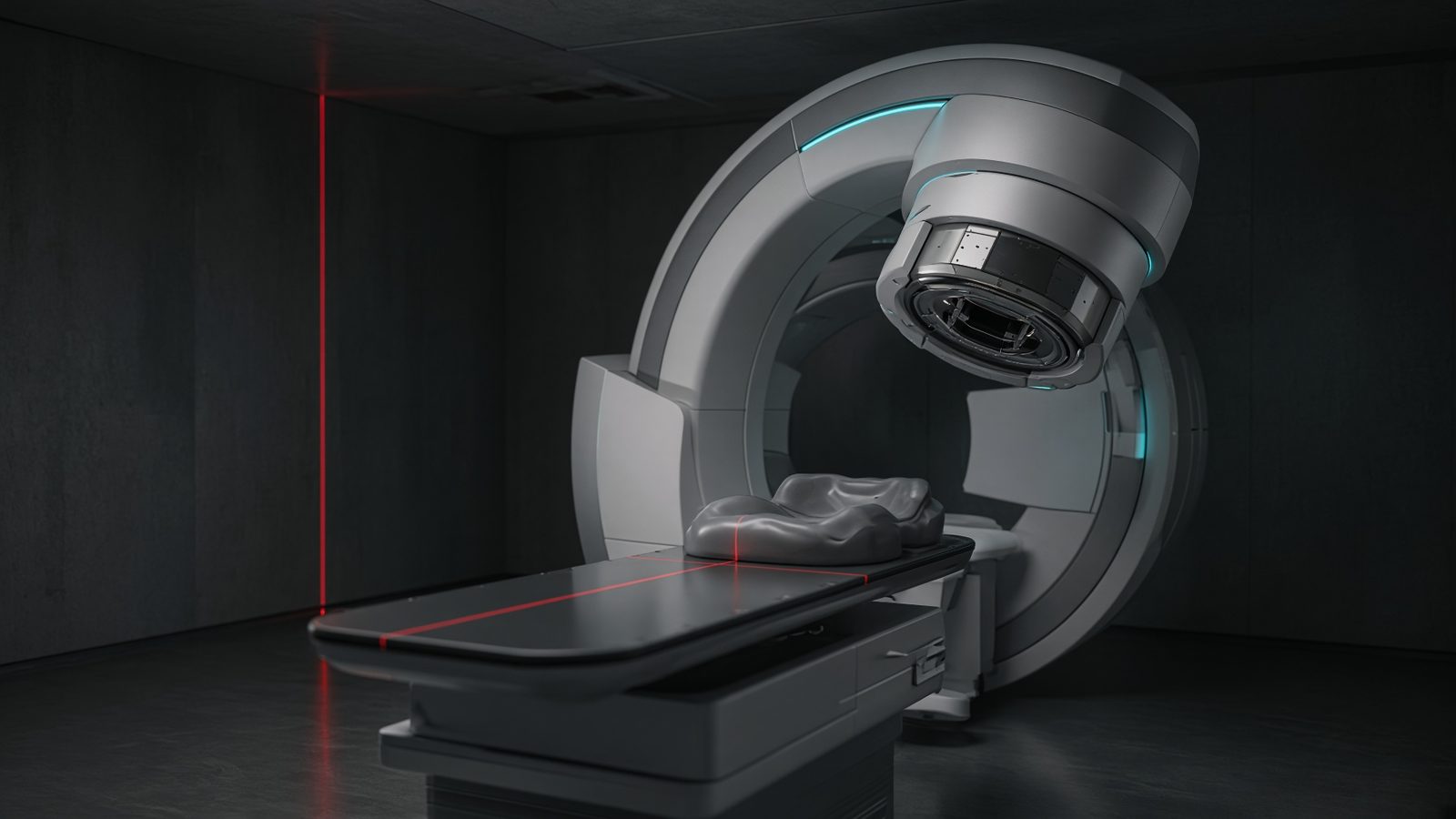
Isocenter
At isocenter, on the central axis through the patient (or a phantom in the same place).
Open this machineFormula
Variables
Results
Φ
Fluence
7.9577e+6cm⁻²
φ
Per steradian
7.9577e+10sr⁻¹
Curve
Explanation
What it means
Photons (or particles) emitted isotropically from a point spread over a sphere of area 4πr². Fluence therefore falls as 1/r². This is the geometric origin of the inverse-square law used in radiotherapy output, HDR, and radiation protection. This is a working relation in Radiation physics.
Where it is used
Clinically it sits on the Linear accelerator — Isocenter. At isocenter, on the central axis through the patient (or a phantom in the same place). Radiation physics lives at the x-ray target, the linac head, and inside the patient: how a photon is born, how it scatters, and how it dies. Use these relations before you trust a spectrum, a wall, or a kV-versus-MV contrast argument.
Linear accelerator · Open this machineHow to use it
Enter number of particles N (or activity×yield×time) and distance in cm. Compare two distances with the radiotherapy inverse-square calculator if you already have a calibrated dose rate. Change one input and watch the curve and the simulation follow.
Symbols
- NParticle number1.0000e+12
- rDistance100 cm
Worked example
A typical case from the default values: N = 1.0000e+12 (Particle number); r = 100 cm (Distance). Substituting into the relation gives Φ = 7.9577e+6 cm⁻²; φ = 7.9577e+10 sr⁻¹. These are teaching numbers — align them with your machine.
Typical values give
- Φ = 7.9577e+6cm⁻²
- φ = 7.9577e+10sr⁻¹
Where it comes from
The displayed formula is the working relation. Primary fluence from a point source: Φ = N / (4π r²). Usual reference: Attix. Derive it in the specialty lesson, then return here to pin the numbers.
Reference: Attix
Assumptions & limits
Isotropic point source in vacuum: no attenuation, scatter, collimation, or anisotropy function. Real brachytherapy sources need TG-43 G(r,θ) and F(r,θ).
Pitfalls
Do not mix free-electron Compton kinematics with photoelectric-dominated kV imaging. Check keV versus MeV, and never treat a spectrum as one photon. Isotropic point source in vacuum: no attenuation, scatter, collimation, or anisotropy function. Real brachytherapy sources need TG-43 G(r,θ) and F(r,θ).
Keep this
Photons do not deposit dose; the electrons they set in motion do. Isotropic point source in vacuum: no attenuation, scatter, collimation, or anisotropy function. Real brachytherapy sources need TG-43 G(r,θ) and F(r,θ).
In this specialty