07 MRI
Ernst angle
Flip angle that maximises signal for given TR and T1.
Listen
Listen · English
Simulation
Ernst angle — Change the numbers; the scene follows.
Where it works
MRI scanner
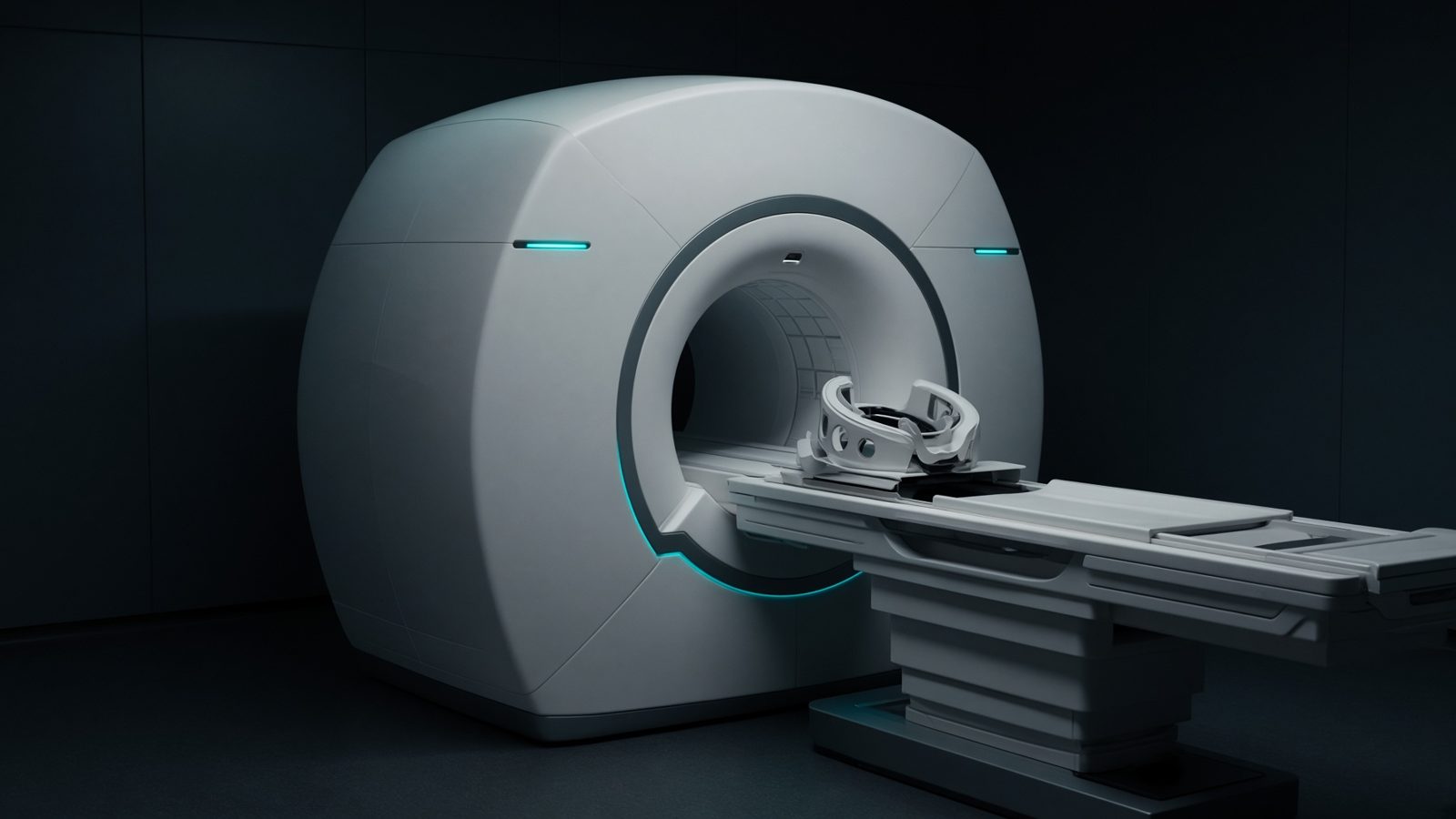
RF coil
At the RF coil — flip angle, SAR, SNR, receive bandwidth, and the pulse sequence.
Open this machineFormula
Variables
Results
θ_E
Ernst angle
9.34°
θ_E
Ernst angle
0.1629rad
Curve
Explanation
What it means
For a spoiled GRE with short TR, the flip angle that maximises steady-state signal is the Ernst angle θ_E = arccos(e^{−TR/T1}). Too low wastes signal; too high saturates long-T1 tissues (CSF). This is a working relation in MRI physics.
Where it is used
Clinically it sits on the MRI scanner — RF coil. At the RF coil — flip angle, SAR, SNR, receive bandwidth, and the pulse sequence. MRI physics lives in the magnet, the gradient, and the voxel: Larmor, Ernst, diffusion, and SAR. These relations decide whether a sequence is possible, safe, and worth the time.
MRI scanner · Open this machineHow to use it
Brain T1 ~ 900–1200 ms at 1.5–3 T; liver shorter. A 12 ms TR and T1 900 ms → θ_E ≈ 9°. T1-weighted GRE uses a larger angle than Ernst on purpose (more T1 contrast, less SNR). Change one input and watch the curve and the simulation follow.
Symbols
- TRRepetition time12 ms
- T₁Longitudinal relaxation900 ms
Worked example
A typical case from the default values: TR = 12 ms (Repetition time); T₁ = 900 ms (Longitudinal relaxation). Substituting into the relation gives θ_E = 9.34 °; θ_E = 0.1629 rad. These are teaching numbers — align them with your machine.
Typical values give
- θ_E = 9.34°
- θ_E = 0.1629rad
Where it comes from
The displayed formula is the working relation. Flip angle that maximises signal for given TR and T1. Usual reference: Ernst & Anderson / McRobbie. Derive it in the specialty lesson, then return here to pin the numbers.
Reference: Ernst & Anderson / McRobbie
Assumptions & limits
Spoiled GRE, perfect spoiling, no T2* decay in the formula. Driven-equilibrium and steady-state free precession (bSSFP) have different optima.
Pitfalls
γ for ¹H is not γ for ¹³C. Ernst angle needs the true T1 at that field, not a 1.5 T table used at 3 T. SAR scales with B₀² and flip² — a 3 T copy of a 1.5 T protocol is not automatically legal. Spoiled GRE, perfect spoiling, no T2* decay in the formula. Driven-equilibrium and steady-state free precession (bSSFP) have different optima.
Keep this
Name the nucleus and the field before you quote a Larmor frequency. Spoiled GRE, perfect spoiling, no T2* decay in the formula. Driven-equilibrium and steady-state free precession (bSSFP) have different optima.
In this specialty