07 MRI
Velocity encoding VENC
VENC = π / (γ m₁) is the velocity that produces a π phase shift.
Listen
Listen · English
Simulation
Velocity encoding VENC — Change the numbers; the scene follows.
Where it works
MRI scanner
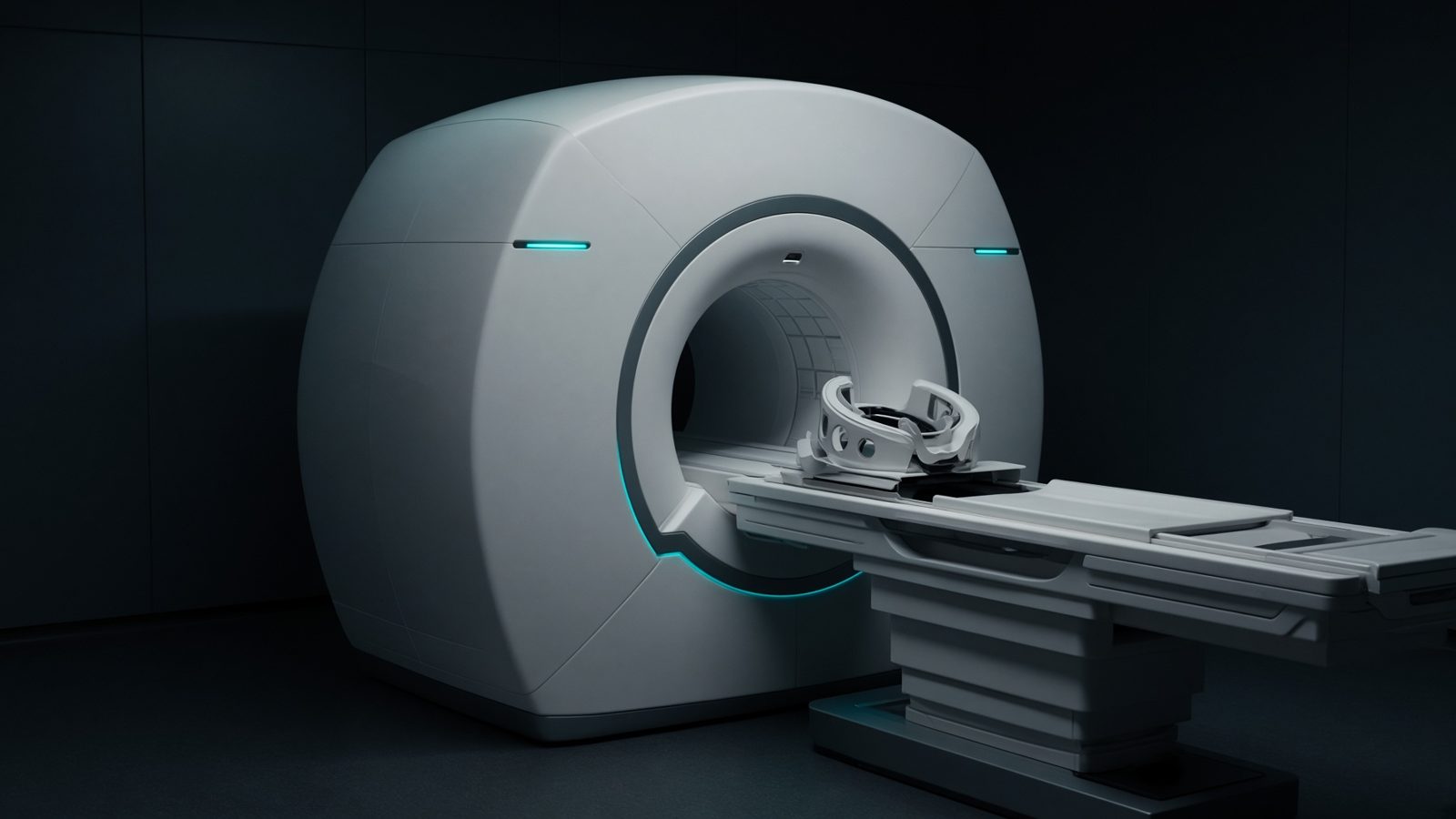
Patient in bore
In the tissue inside the bore — relaxation, fat/water, contrast, flow, magic angle.
Open this machineFormula
Variables
Results
φ
Phase
1.6755rad
φ
Phase
96°
n
Alias wraps
0.5333
Explanation
What it means
Phase-contrast MRI encodes velocity in the phase of the voxel by a bipolar gradient of first moment m₁. VENC is the velocity that wraps phase to π (and then aliases). Set VENC just above the peak expected speed: too low aliases (wrong direction / speed), too high wastes dynamic range (noisy velocity). Aorta ~150 cm/s, carotids ~80, venous ~20, CSF ~5–10. This is a working relation in MRI physics.
Where it is used
Clinically it sits on the MRI scanner — Patient in bore. In the tissue inside the bore — relaxation, fat/water, contrast, flow, magic angle. MRI physics lives in the magnet, the gradient, and the voxel: Larmor, Ernst, diffusion, and SAR. These relations decide whether a sequence is possible, safe, and worth the time.
MRI scanner · Open this machineHow to use it
Enter VENC (cm/s) and the true velocity (cm/s). Read the phase in radians and degrees, and a flag if |v| > VENC (alias). Inverse: enter m₁ if you have the gradient waveform. Change one input and watch the curve and the simulation follow.
Symbols
- VENCVelocity encoding150 cm/s
- vVelocity80 cm/s
Worked example
A typical case from the default values: VENC = 150 cm/s (Velocity encoding); v = 80 cm/s (Velocity). Substituting into the relation gives φ = 1.6755 rad; φ = 96 °; n = 0.5333. These are teaching numbers — align them with your machine.
Typical values give
- φ = 1.6755rad
- φ = 96°
- n = 0.5333
Where it comes from
The displayed formula is the working relation. VENC = π / (γ m₁) is the velocity that produces a π phase shift. Usual reference: Pelc / McRobbie. Derive it in the specialty lesson, then return here to pin the numbers.
Reference: Pelc / McRobbie
Assumptions & limits
First-moment encoding only, through-plane. Acceleration (second moment) and eddy-current offsets are the main residual errors. Background-phase subtraction from a static ROI is mandatory.
Pitfalls
γ for ¹H is not γ for ¹³C. Ernst angle needs the true T1 at that field, not a 1.5 T table used at 3 T. SAR scales with B₀² and flip² — a 3 T copy of a 1.5 T protocol is not automatically legal. First-moment encoding only, through-plane. Acceleration (second moment) and eddy-current offsets are the main residual errors. Background-phase subtraction from a static ROI is mandatory.
Keep this
Name the nucleus and the field before you quote a Larmor frequency. First-moment encoding only, through-plane. Acceleration (second moment) and eddy-current offsets are the main residual errors. Background-phase subtraction from a static ROI is mandatory.
In this specialty