07 MRI
Parallel-imaging g-factor
SNR_p = SNR / (g √R). Geometry factor g ≥ 1; R is the acceleration.
Listen
Listen · English
Simulation
Parallel-imaging g-factor — Change the numbers; the scene follows.
Where it works
MRI scanner
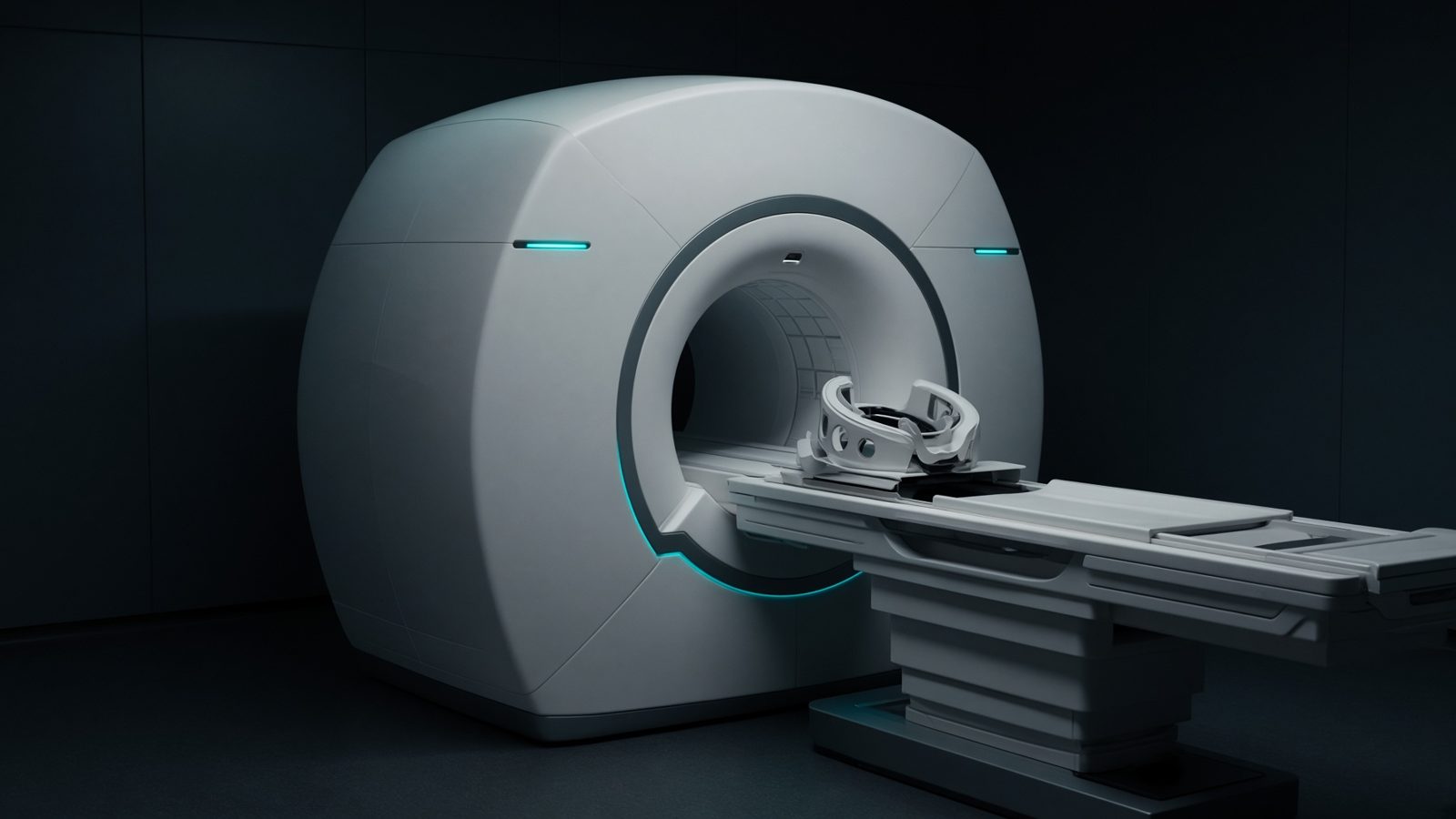
RF coil
At the RF coil — flip angle, SAR, SNR, receive bandwidth, and the pulse sequence.
Open this machineFormula
Variables
Results
SNR_p
Accelerated SNR
27.1964
g√R
Total penalty
1.8385
Explanation
What it means
Skipping k-space lines by R buys time (or resolution) but two penalties: fewer samples (√R) and ill-conditioned unaliasing (g). g is 1.0 in the best-encoded pixels (coil sensitivities very different) and 2–4 in the centre of a poorly positioned array. That’s why a 32-channel head coil accelerates better than a 8-channel, and why R = 4 in 2-D is noisier than R = 2×2 in 3-D. This is a working relation in MRI physics.
Where it is used
Clinically it sits on the MRI scanner — RF coil. At the RF coil — flip angle, SAR, SNR, receive bandwidth, and the pulse sequence. MRI physics lives in the magnet, the gradient, and the voxel: Larmor, Ernst, diffusion, and SAR. These relations decide whether a sequence is possible, safe, and worth the time.
MRI scanner · Open this machineHow to use it
Enter reference SNR, acceleration R and g. Read SNR after SENSE/GRAPPA and the total penalty g√R. A body scan, SNR=50, R=2, g=1.3 → SNR_p = 27. Change one input and watch the curve and the simulation follow.
Symbols
- SNRReference SNR50
- RAcceleration2
- gGeometry factor1.3
Worked example
A typical case from the default values: SNR = 50 (Reference SNR); R = 2 (Acceleration); g = 1.3 (Geometry factor). Substituting into the relation gives SNR_p = 27.1964; g√R = 1.8385. These are teaching numbers — align them with your machine.
Typical values give
- SNR_p = 27.1964
- g√R = 1.8385
Where it comes from
The displayed formula is the working relation. SNR_p = SNR / (g √R). Geometry factor g ≥ 1; R is the acceleration. Usual reference: Pruessmann (SENSE) / Griswold (GRAPPA). Derive it in the specialty lesson, then return here to pin the numbers.
Reference: Pruessmann (SENSE) / Griswold (GRAPPA)
Assumptions & limits
g is an input (from a g-map), not computed from coil geometry. Does not include noise-enhancement of GRAPPA kernels, CAIPIRINHA shifts, or compressed-sensing that does not follow 1/√R.
Pitfalls
γ for ¹H is not γ for ¹³C. Ernst angle needs the true T1 at that field, not a 1.5 T table used at 3 T. SAR scales with B₀² and flip² — a 3 T copy of a 1.5 T protocol is not automatically legal. g is an input (from a g-map), not computed from coil geometry. Does not include noise-enhancement of GRAPPA kernels, CAIPIRINHA shifts, or compressed-sensing that does not follow 1/√R.
Keep this
Name the nucleus and the field before you quote a Larmor frequency. g is an input (from a g-map), not computed from coil geometry. Does not include noise-enhancement of GRAPPA kernels, CAIPIRINHA shifts, or compressed-sensing that does not follow 1/√R.
In this specialty