07 MRI
Larmor frequency
Nuclear resonance frequency: f = (γ/2π) B₀.
Listen
Listen · English
Simulation
Larmor frequency — Change the numbers; the scene follows.
Where it works
MRI scanner
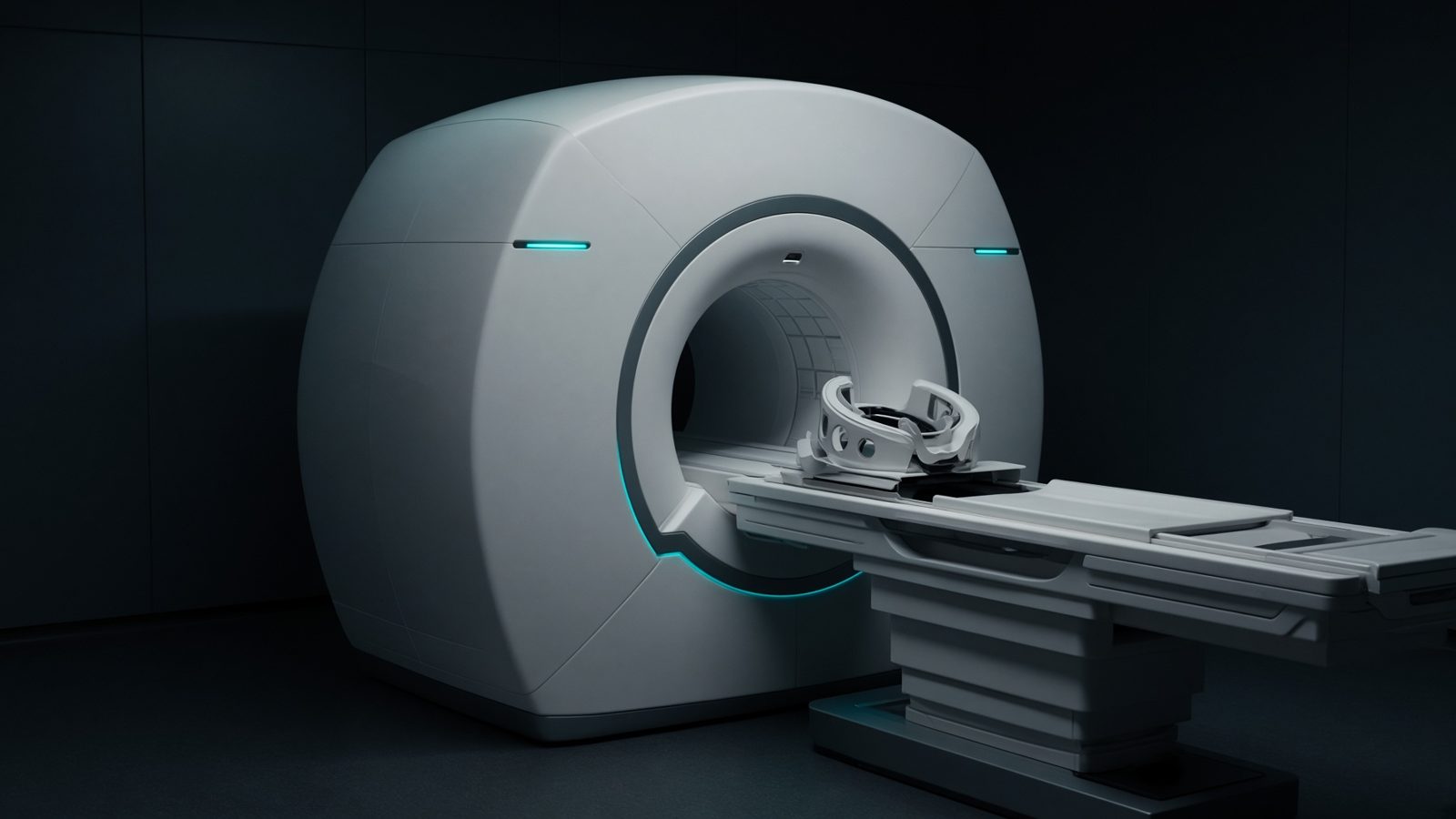
Main magnet
In the main magnet — B₀ sets Larmor frequency and the local field that drives T2*.
Open this machineFormula
Typical values
Variables
Results
f
Larmor frequency
63.8655MHz
ω₀
Angular frequency
401.28×10⁶ rad/s
Curve
Explanation
What it means
Spins precess at the Larmor frequency f = (γ/2π) B₀. For ¹H, γ/2π = 42.577 MHz/T, so 63.9 MHz at 1.5 T and 127.7 MHz at 3 T. Every RF pulse, slice select and readout is tuned to this number (plus a tiny chemical-shift offset). This is a working relation in MRI physics.
Where it is used
Clinically it sits on the MRI scanner — Main magnet. In the main magnet — B₀ sets Larmor frequency and the local field that drives T2*. MRI physics lives in the magnet, the gradient, and the voxel: Larmor, Ernst, diffusion, and SAR. These relations decide whether a sequence is possible, safe, and worth the time.
MRI scanner · Open this machineHow to use it
Presets cover ¹H, ¹³C, ¹⁹F, ²³Na, ³¹P. Use f to set centre frequency and to compute chemical-shift Hz from ppm. Change one input and watch the curve and the simulation follow.
Symbols
- γ/2πGyromagnetic ratio42.577 MHz/T
- B₀Main field1.5 T
Worked example
A typical case from the default values: γ/2π = 42.577 MHz/T (Gyromagnetic ratio); B₀ = 1.5 T (Main field). Substituting into the relation gives f = 63.8655 MHz; ω₀ = 401.28 ×10⁶ rad/s. These are teaching numbers — align them with your machine.
Typical values give
- f = 63.8655MHz
- ω₀ = 401.28×10⁶ rad/s
Where it comes from
The displayed formula is the working relation. Nuclear resonance frequency: f = (γ/2π) B₀. Usual reference: McRobbie / Hashemi. Derive it in the specialty lesson, then return here to pin the numbers.
Reference: McRobbie / Hashemi
Assumptions & limits
Isolated nucleus in a uniform field. Shielding (ppm) and susceptibility offsets are extra. γ here is the tabulated gyromagnetic ratio including the nuclear g-factor.
Pitfalls
γ for ¹H is not γ for ¹³C. Ernst angle needs the true T1 at that field, not a 1.5 T table used at 3 T. SAR scales with B₀² and flip² — a 3 T copy of a 1.5 T protocol is not automatically legal. Isolated nucleus in a uniform field. Shielding (ppm) and susceptibility offsets are extra. γ here is the tabulated gyromagnetic ratio including the nuclear g-factor.
Keep this
γ/2π for ¹H is 42.577 MHz/T. Use the matching gyromagnetic ratio.
In this specialty