07 MRI
Relative SNR
SNR scales with voxel volume, √(NEX · N_y / BW), and B₀.
Listen
Listen · English
Simulation
Relative SNR — Change the numbers; the scene follows.
Where it works
MRI scanner
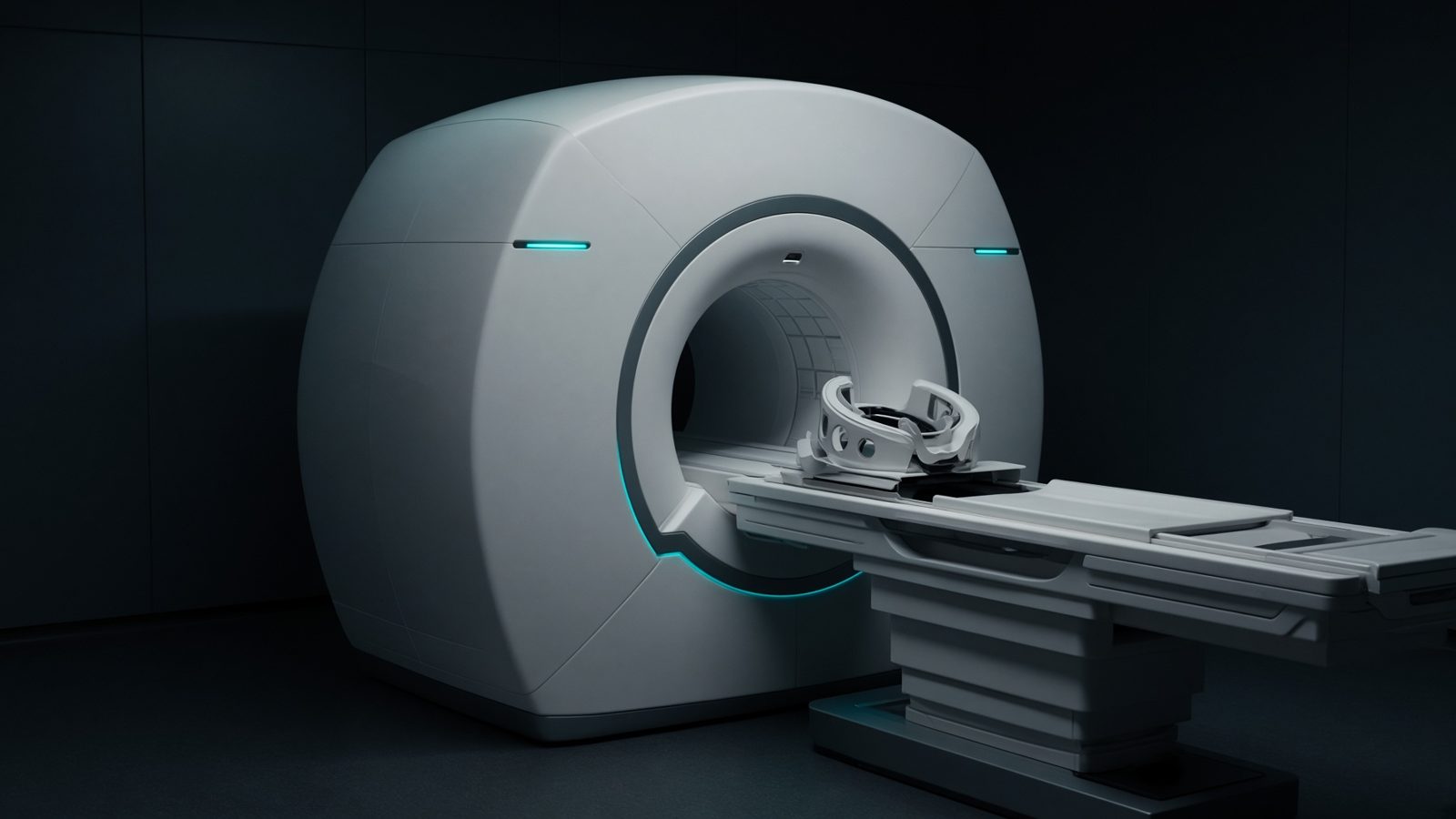
RF coil
At the RF coil — flip angle, SAR, SNR, receive bandwidth, and the pulse sequence.
Open this machineFormula
Variables
Results
SNR
Relative value
13.576a.u.
SNR/SNR₀
Vs 1.5 T reference
1
Explanation
What it means
MRI SNR scales with voxel volume, √(NEX × N_phase / bandwidth) and roughly with B₀ (more spins, more magnetisation). Halving slice thickness halves SNR; doubling NEX gains only √2. This is a working relation in MRI physics.
Where it is used
Clinically it sits on the MRI scanner — RF coil. At the RF coil — flip angle, SAR, SNR, receive bandwidth, and the pulse sequence. MRI physics lives in the magnet, the gradient, and the voxel: Larmor, Ernst, diffusion, and SAR. These relations decide whether a sequence is possible, safe, and worth the time.
MRI scanner · Open this machineHow to use it
The output is a relative number vs a 1.5 T, 1×1×4 mm, NEX 1, 256 phase, 50 kHz reference. Use it to trade protocol knobs, not as an absolute SNR. Change one input and watch the curve and the simulation follow.
Symbols
- ΔxPixel size x1 mm
- ΔyPixel size y1 mm
- ΔzSlice thickness4 mm
- NEXAverages1
- N_yPhase encodes256
- BWBandwidth50 kHz
- B₀Field1.5 T
Worked example
A typical case from the default values: Δx = 1 mm (Pixel size x); Δy = 1 mm (Pixel size y); Δz = 4 mm (Slice thickness); NEX = 1 (Averages); N_y = 256 (Phase encodes); BW = 50 kHz (Bandwidth); B₀ = 1.5 T (Field). Substituting into the relation gives SNR = 13.576 a.u.; SNR/SNR₀ = 1. These are teaching numbers — align them with your machine.
Typical values give
- SNR = 13.576a.u.
- SNR/SNR₀ = 1
Where it comes from
The displayed formula is the working relation. SNR scales with voxel volume, √(NEX · N_y / BW), and B₀. Usual reference: McRobbie / Hashemi. Derive it in the specialty lesson, then return here to pin the numbers.
Reference: McRobbie / Hashemi
Assumptions & limits
Neglects coil geometry, acceleration (SENSE/GRAPPA g-factor), dielectric shading at 3 T, and T1/T2 contrast. Bandwidth here is total, not per pixel.
Pitfalls
γ for ¹H is not γ for ¹³C. Ernst angle needs the true T1 at that field, not a 1.5 T table used at 3 T. SAR scales with B₀² and flip² — a 3 T copy of a 1.5 T protocol is not automatically legal. Neglects coil geometry, acceleration (SENSE/GRAPPA g-factor), dielectric shading at 3 T, and T1/T2 contrast. Bandwidth here is total, not per pixel.
Keep this
Name the nucleus and the field before you quote a Larmor frequency. Neglects coil geometry, acceleration (SENSE/GRAPPA g-factor), dielectric shading at 3 T, and T1/T2 contrast. Bandwidth here is total, not per pixel.
In this specialty