07 MRI
Magic angle
Dipolar coupling ∝ 3cos²θ − 1 = 0 at θ = 54.74°. Tendon T2 lengthens and the tendon lights up.
Listen
Listen · English
Simulation
Magic angle — Change the numbers; the scene follows.
Where it works
MRI scanner
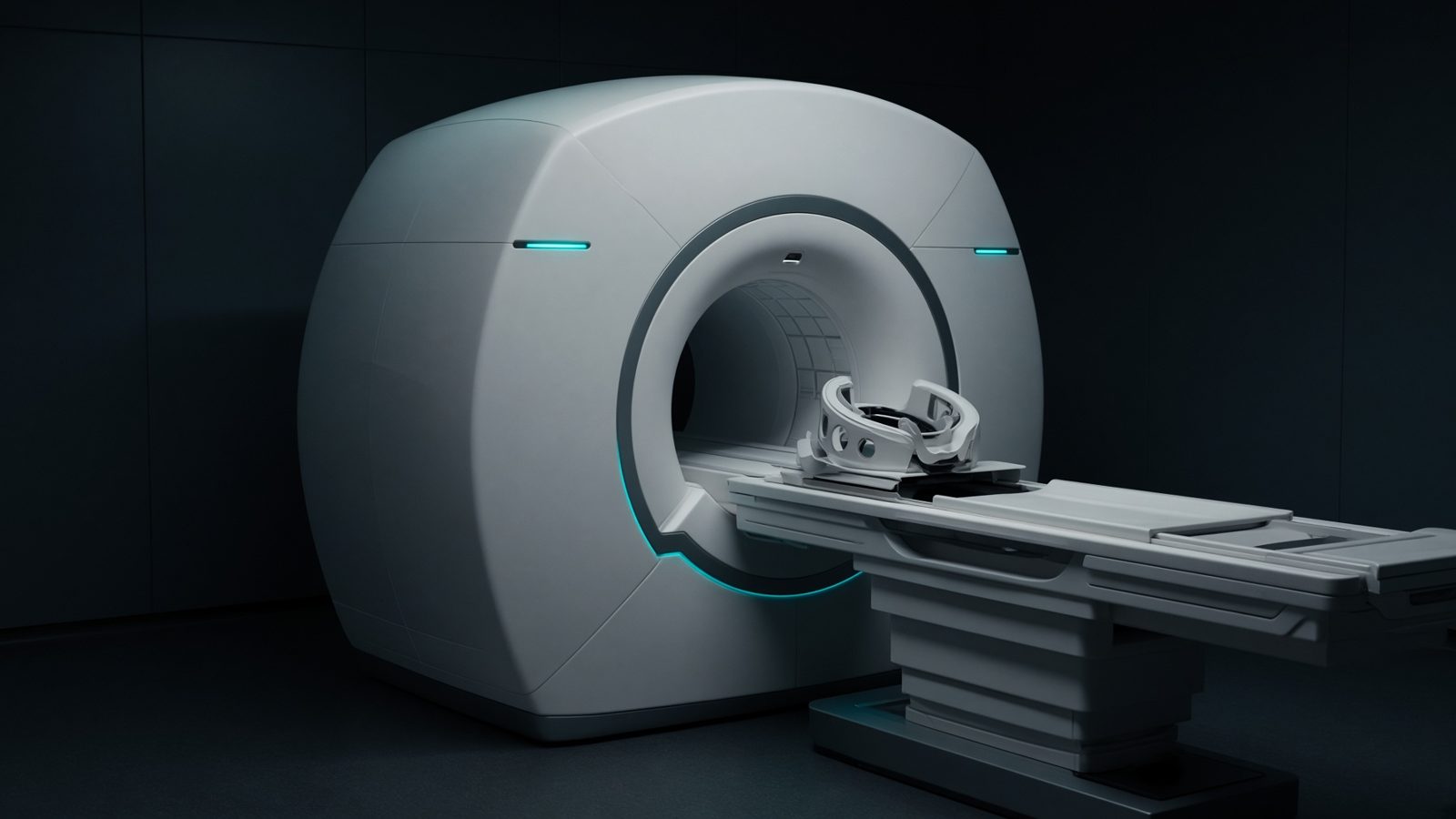
Patient in bore
In the tissue inside the bore — relaxation, fat/water, contrast, flow, magic angle.
Open this machineFormula
Variables
Results
3cos²θ−1
Coupling factor
-0.013
θ_magic
Magic angle
54.7356°
Curve
Explanation
What it means
Collagen in tendon is a dipole lattice. Residual dipolar coupling shortens T2 to a few milliseconds — tendons are dark on short-TE images — except when the fibre-to-B₀ angle hits arccos √(1/3) ≈ 54.7°, where the coupling vanishes, T2 lengthens, and the tendon briefly looks ‘pathological’. Classic pitfall of the rotator cuff and of the ankle on a short-TE GRE. The calculator reports 3cos²θ−1 so you can see the width of the magic-angle peak. This is a working relation in MRI physics.
Where it is used
Clinically it sits on the MRI scanner — Patient in bore. In the tissue inside the bore — relaxation, fat/water, contrast, flow, magic angle. MRI physics lives in the magnet, the gradient, and the voxel: Larmor, Ernst, diffusion, and SAR. These relations decide whether a sequence is possible, safe, and worth the time.
MRI scanner · Open this machineHow to use it
Enter the fibre-to-B₀ angle in degrees. Read 3cos²θ−1 (zero at the magic angle) and the two supplementary angles in 3-D (±54.7 from B₀). 0° (parallel) gives +2 (maximum coupling); 90° gives −1. Change one input and watch the curve and the simulation follow.
Symbols
- θFibre-to-B0 angle55 °
Worked example
A typical case from the default values: θ = 55 ° (Fibre-to-B0 angle). Substituting into the relation gives 3cos²θ−1 = -0.013; θ_magic = 54.7356 °. These are teaching numbers — align them with your machine.
Typical values give
- 3cos²θ−1 = -0.013
- θ_magic = 54.7356°
Where it comes from
The displayed formula is the working relation. Dipolar coupling ∝ 3cos²θ − 1 = 0 at θ = 54.74°. Tendon T2 lengthens and the tendon lights up. Usual reference: Fullerton / McRobbie. Derive it in the specialty lesson, then return here to pin the numbers.
Reference: Fullerton / McRobbie
Assumptions & limits
Uniaxial fibre, no motion. Magic-angle brightening is TE-dependent (short TE shows it more). Not a disease and not a chemical-shift artefact.
Pitfalls
γ for ¹H is not γ for ¹³C. Ernst angle needs the true T1 at that field, not a 1.5 T table used at 3 T. SAR scales with B₀² and flip² — a 3 T copy of a 1.5 T protocol is not automatically legal. Uniaxial fibre, no motion. Magic-angle brightening is TE-dependent (short TE shows it more). Not a disease and not a chemical-shift artefact.
Keep this
Name the nucleus and the field before you quote a Larmor frequency. Uniaxial fibre, no motion. Magic-angle brightening is TE-dependent (short TE shows it more). Not a disease and not a chemical-shift artefact.
In this specialty