02 Imaging
Grey levels and bit depth
N = 2^n distinct levels. Contrast resolution cannot exceed 1/N of the full scale.
Listen
Listen · English
Simulation
Grey levels and bit depth — Change the numbers; the scene follows.
Where it works
Radiography room
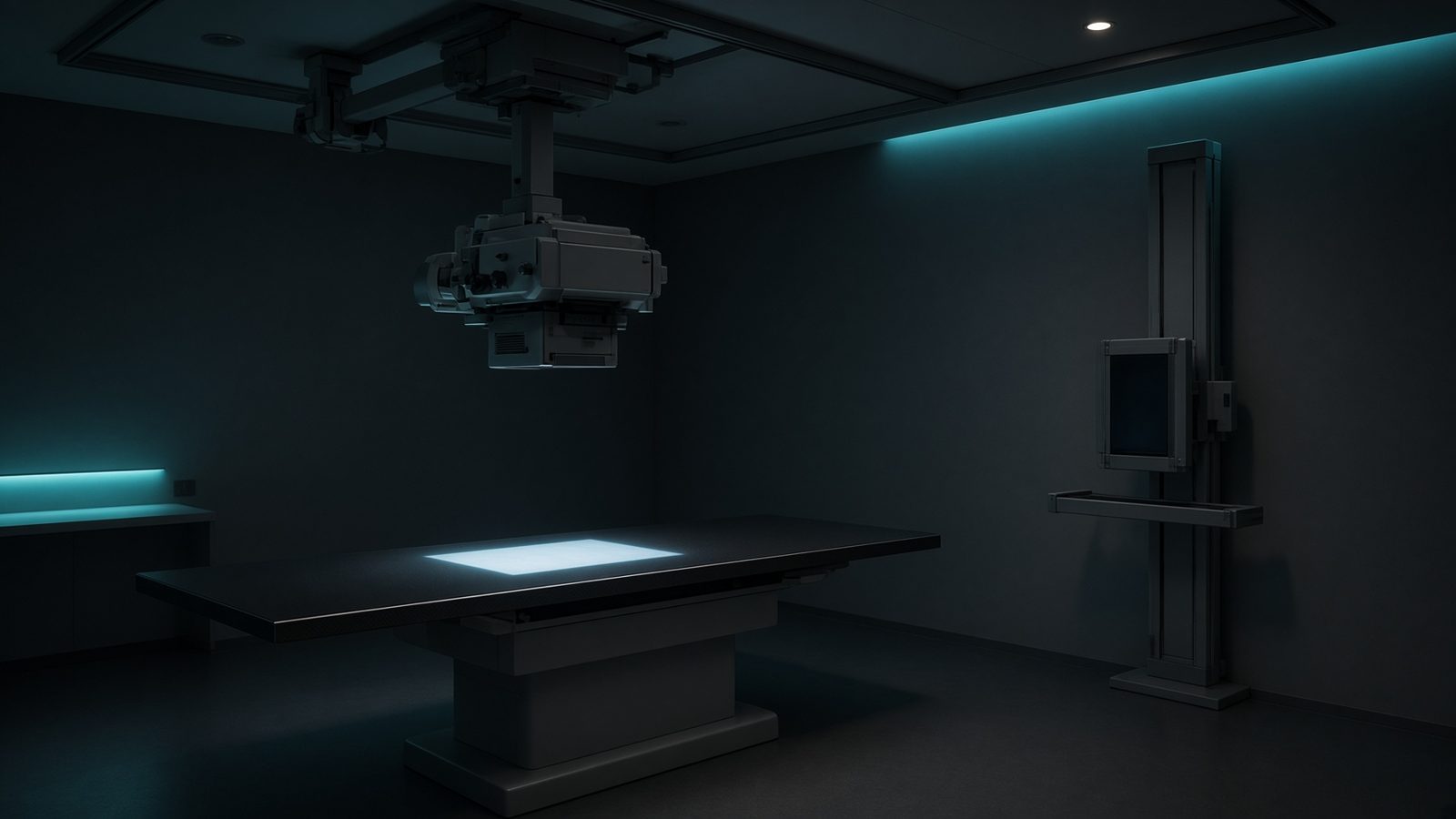
Bucky / detector
In the Bucky / detector: grid, AEC, DQE, and the pixel that samples the image.
Open this machineFormula
Variables
Results
N
Number of levels
4,096
Δ
Quantisation step
1
Explanation
What it means
An n-bit ADC maps the detector’s analogue range onto 2^n integers. 12-bit CT is 4096 HU levels (the historical −1024 to +3071 window). 14-bit mammography is 16384. Human observers distinguish far fewer grey levels on a display (~8–9 bits after the LUT); extra bits are for processing headroom and to keep quantisation noise below quantum noise. This is a working relation in Diagnostic imaging.
Where it is used
Clinically it sits on the Radiography room — Bucky / detector. In the Bucky / detector: grid, AEC, DQE, and the pixel that samples the image. Diagnostic equations live on the tube, the detector, and the patient: magnification, air kerma, CTDI, and why bone lights up at 70 kV. They turn a technique chart into physics you can defend.
Radiography room · Open this machineHow to use it
Enter bit depth n and optionally the physical range R (e.g. 80 keV or 4000 HU). Read N and the quantisation step. Change one input and watch the curve and the simulation follow.
Symbols
- nBit depth12 bit
- RPhysical range4,096
Worked example
A typical case from the default values: n = 12 bit (Bit depth); R = 4,096 (Physical range). Substituting into the relation gives N = 4,096; Δ = 1. These are teaching numbers — align them with your machine.
Typical values give
- N = 4,096
- Δ = 1
Where it comes from
The displayed formula is the working relation. N = 2^n distinct levels. Contrast resolution cannot exceed 1/N of the full scale. Usual reference: Bushberg. Derive it in the specialty lesson, then return here to pin the numbers.
Reference: Bushberg
Assumptions & limits
Uniform quantisation. Log or square-root LUTs (some DR ‘for presentation’ images) stretch the mapping. Window/level on a 12-bit CT uses only a subset of the 4096 levels.
Pitfalls
kVp is not the same as effective energy. CTDI is not patient dose — SSDE and organ dose come after. Do not quote DLP as if it were effective dose without a k-factor. Uniform quantisation. Log or square-root LUTs (some DR ‘for presentation’ images) stretch the mapping. Window/level on a 12-bit CT uses only a subset of the 4096 levels.
Keep this
Technique is physics: kV sets contrast, mAs sets noise, filtration sets the spectrum. Uniform quantisation. Log or square-root LUTs (some DR ‘for presentation’ images) stretch the mapping. Window/level on a 12-bit CT uses only a subset of the 4096 levels.
In this specialty