02 Imaging
Dose-area product
DAP = K_a × area, converted to effective dose with a conversion factor.
Listen
Listen · English
Simulation
Dose-area product — Change the numbers; the scene follows.
Where it works
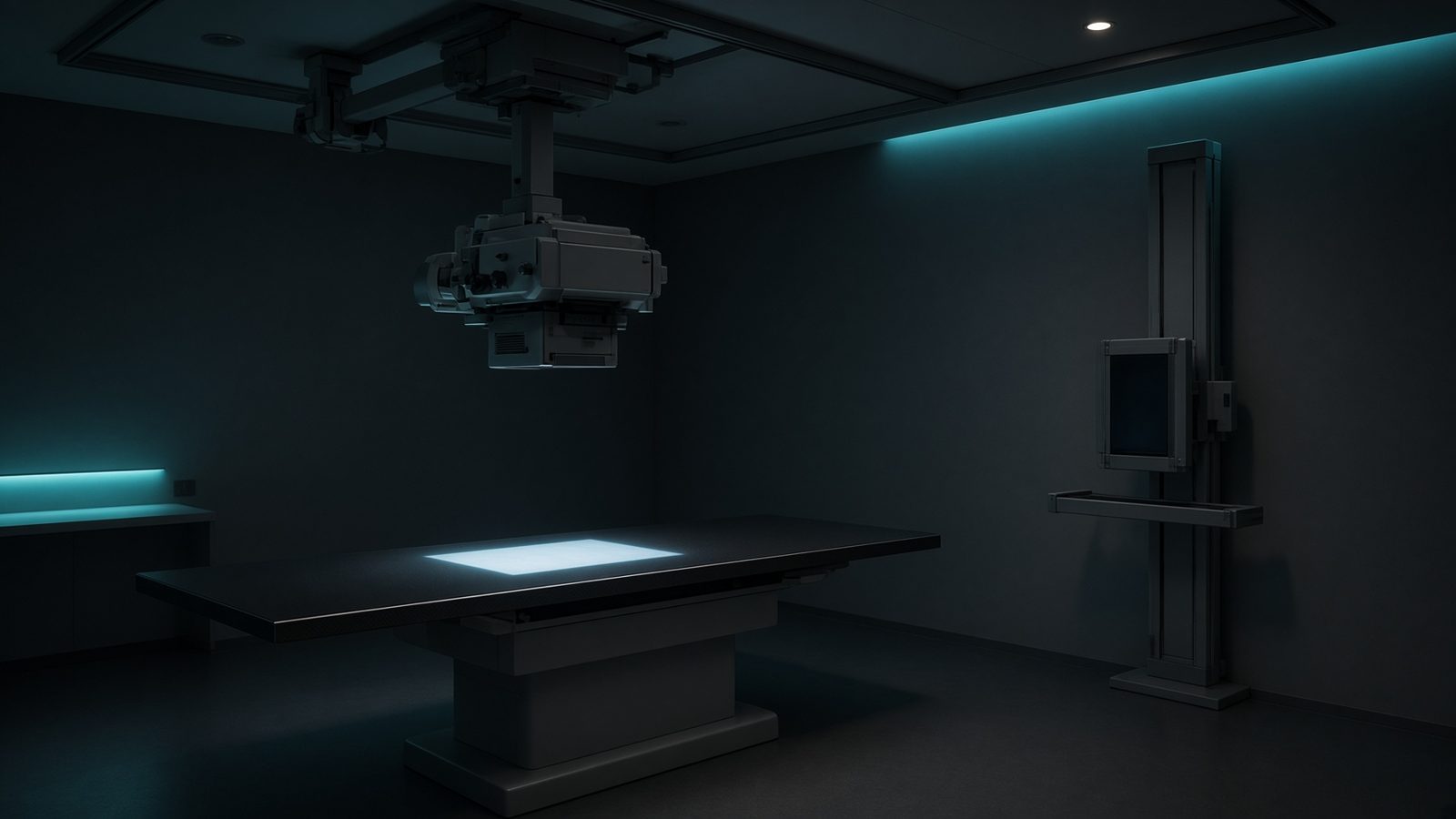
Radiography room
Patient
At the patient entrance — skin dose, subject contrast, photoelectric absorption in tissue.
Open this machineFormula
Typical values
Variables
Results
DAP
Dose-area product
1,200mGy·cm²
E
Effective dose
0.144mSv
Explanation
What it means
Dose-area product (kerma-area product) is incident air kerma times field area and is independent of distance (kerma falls as 1/d² while area grows as d²). Conversion coefficients f turn DAP into a rough effective dose. This is a working relation in Diagnostic imaging.
Where it is used
Clinically it sits on the Radiography room — Patient. At the patient entrance — skin dose, subject contrast, photoelectric absorption in tissue. Diagnostic equations live on the tube, the detector, and the patient: magnification, air kerma, CTDI, and why bone lights up at 70 kV. They turn a technique chart into physics you can defend.
Radiography room · Open this machineHow to use it
Read DAP from the meter (Gy·cm² or cGy·cm² — watch units). Chest PA f ≈ 0.12 mSv/(Gy·cm²). DAP is the right quantity for fluoro dose audits. Change one input and watch the curve and the simulation follow.
Symbols
- K_aIncident air kerma1.5 mGy
- AField area800 cm²
- fConversion factor0.12 mSv/(Gy·cm²)
Worked example
A typical case from the default values: K_a = 1.5 mGy (Incident air kerma); A = 800 cm² (Field area); f = 0.12 mSv/(Gy·cm²) (Conversion factor). Substituting into the relation gives DAP = 1,200 mGy·cm²; E = 0.144 mSv. These are teaching numbers — align them with your machine.
Typical values give
- DAP = 1,200mGy·cm²
- E = 0.144mSv
Where it comes from
The displayed formula is the working relation. DAP = K_a × area, converted to effective dose with a conversion factor. Usual reference: ICRP / NCRP. Derive it in the specialty lesson, then return here to pin the numbers.
Reference: ICRP / NCRP
Assumptions & limits
f-factors are for standard projections and adult body habitus. Backscatter is usually included in KAP meters at the collimator; don’t double-count BSF.
Pitfalls
kVp is not the same as effective energy. CTDI is not patient dose — SSDE and organ dose come after. Do not quote DLP as if it were effective dose without a k-factor. f-factors are for standard projections and adult body habitus. Backscatter is usually included in KAP meters at the collimator; don’t double-count BSF.
Keep this
f in mSv/(Gy·cm²). Chest PA ≈ 0.12, abdomen AP ≈ 0.20, pelvis ≈ 0.21.
In this specialty