02 Imaging
CT pitch
Pitch = table feed per rotation / total collimation.
Listen
Listen · English
Simulation
CT pitch — Change the numbers; the scene follows.
Where it works
CT scanner
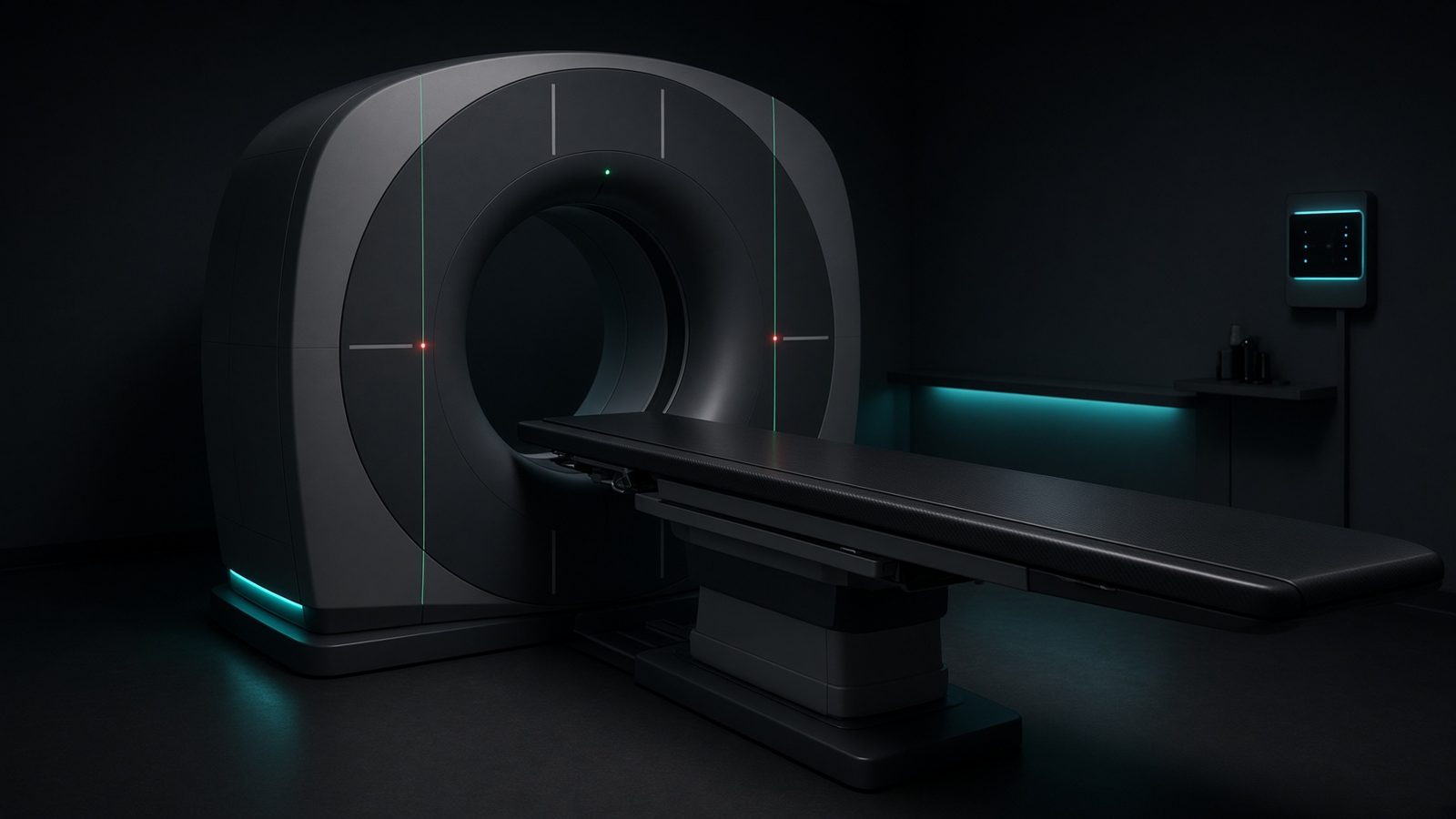
Couch / scan length
Along table travel: DLP integrates CTDI over scan length; pitch is table-per-rotation.
Open this machineFormula
Variables
Results
p
Pitch
1
NT
Total collimation
24mm
Explanation
What it means
Pitch is table travel per rotation divided by the total nominal beam collimation N×T. Pitch 1 means no overlap and no gap at isocentre; pitch > 1 is faster and lower dose; pitch < 1 overlaps. This is a working relation in Diagnostic imaging.
Where it is used
Clinically it sits on the CT scanner — Couch / scan length. Along table travel: DLP integrates CTDI over scan length; pitch is table-per-rotation. Diagnostic equations live on the tube, the detector, and the patient: magnification, air kerma, CTDI, and why bone lights up at 70 kV. They turn a technique chart into physics you can defend.
CT scanner · Open this machineHow to use it
Cardiac helical CT may use pitch ≪ 1. Dual-source systems can run pitch > 3. CTDI_vol already includes pitch (CTDI_w / pitch). Change one input and watch the curve and the simulation follow.
Symbols
- ITable feed per rotation24 mm
- NNumber of detector rows16
- TDetector-row collimation1.5 mm
Worked example
A typical case from the default values: I = 24 mm (Table feed per rotation); N = 16 (Number of detector rows); T = 1.5 mm (Detector-row collimation). Substituting into the relation gives p = 1; NT = 24 mm. These are teaching numbers — align them with your machine.
Typical values give
- p = 1
- NT = 24mm
Where it comes from
The displayed formula is the working relation. Pitch = table feed per rotation / total collimation. Usual reference: IEC / AAPM. Derive it in the specialty lesson, then return here to pin the numbers.
Reference: IEC / AAPM
Assumptions & limits
IEC definition uses total collimation, not single-row width. ‘Flying focal spot’ and over-beaming are separate.
Pitfalls
kVp is not the same as effective energy. CTDI is not patient dose — SSDE and organ dose come after. Do not quote DLP as if it were effective dose without a k-factor. IEC definition uses total collimation, not single-row width. ‘Flying focal spot’ and over-beaming are separate.
Keep this
Technique is physics: kV sets contrast, mAs sets noise, filtration sets the spectrum. IEC definition uses total collimation, not single-row width. ‘Flying focal spot’ and over-beaming are separate.
In this specialty