02 Imaging
DLP and effective dose
Dose-length product converted to effective dose with a k-factor.
Listen
Listen · English
Simulation
DLP and effective dose — Change the numbers; the scene follows.
Where it works
CT scanner
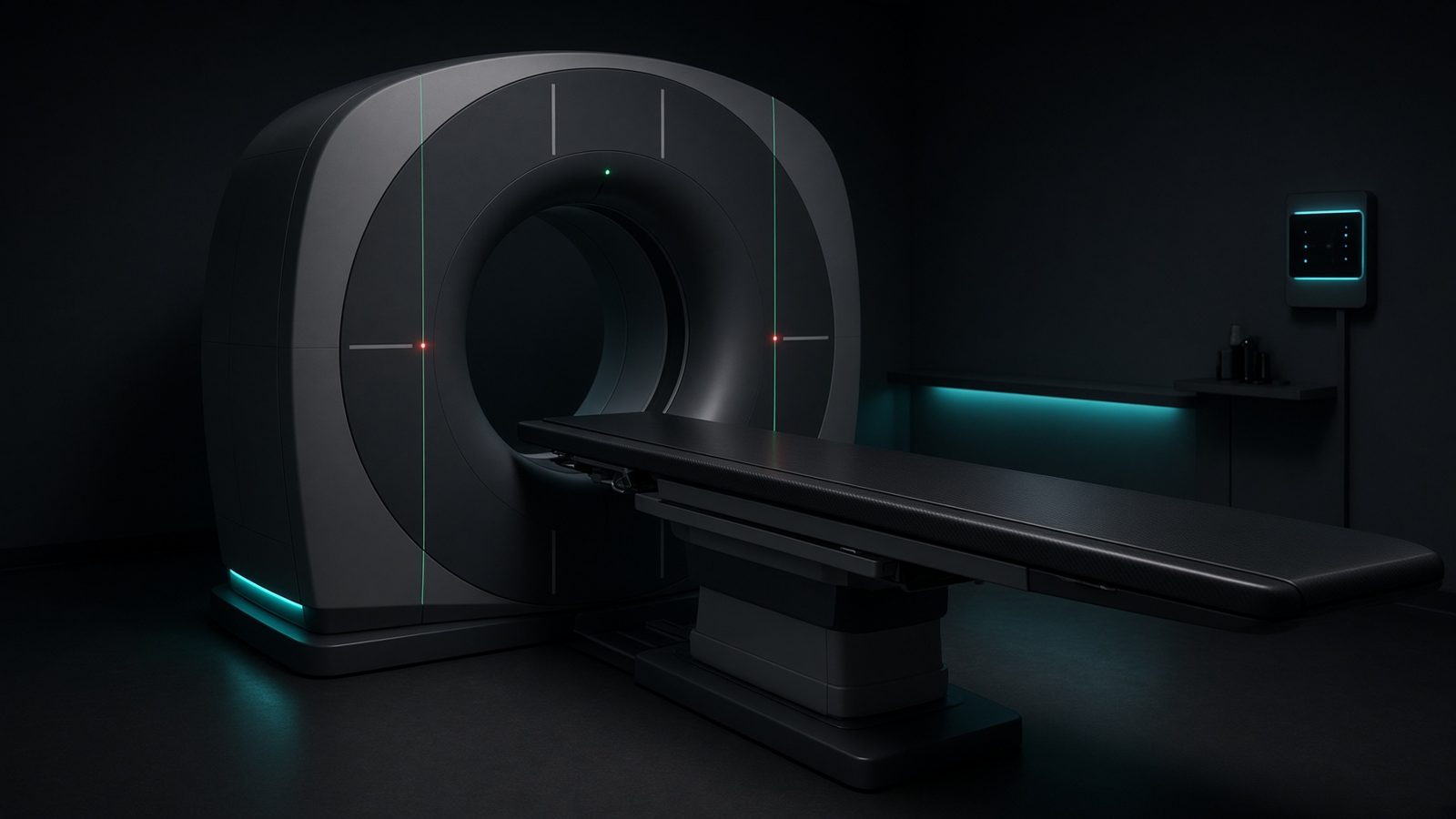
Couch / scan length
Along table travel: DLP integrates CTDI over scan length; pitch is table-per-rotation.
Open this machineFormula
Typical values
Variables
Results
DLP
Dose-length product
300mGy·cm
E
Effective dose
4.5mSv
Curve
Explanation
What it means
Dose-length product DLP = CTDI_vol × L (mGy·cm) summarises the whole acquisition. Effective dose E ≈ k × DLP with k from ICRP/AAPM body-region coefficients — a screening estimate, not a personal dose. This is a working relation in Diagnostic imaging.
Where it is used
Clinically it sits on the CT scanner — Couch / scan length. Along table travel: DLP integrates CTDI over scan length; pitch is table-per-rotation. Diagnostic equations live on the tube, the detector, and the patient: magnification, air kerma, CTDI, and why bone lights up at 70 kV. They turn a technique chart into physics you can defend.
CT scanner · Open this machineHow to use it
Use the presets for adult k (head 0.0021, chest 0.014, abdomen 0.015 mSv mGy⁻¹ cm⁻¹). Paediatric k values are larger. Report both DLP and E. Change one input and watch the curve and the simulation follow.
Symbols
- CTDI_volVolumetric CTDI10 mGy
- LScan length30 cm
- kConversion coefficient0.015 mSv/(mGy·cm)
Worked example
A typical case from the default values: CTDI_vol = 10 mGy (Volumetric CTDI); L = 30 cm (Scan length); k = 0.015 mSv/(mGy·cm) (Conversion coefficient). Substituting into the relation gives DLP = 300 mGy·cm; E = 4.5 mSv. These are teaching numbers — align them with your machine.
Typical values give
- DLP = 300mGy·cm
- E = 4.5mSv
Where it comes from
The displayed formula is the working relation. Dose-length product converted to effective dose with a k-factor. Usual reference: ICRP 103 / AAPM Report 96. Derive it in the specialty lesson, then return here to pin the numbers.
Reference: ICRP 103 / AAPM Report 96
Assumptions & limits
k-factors assume standard phantoms and ICRP 103 weighting. They ignore patient size, sex, and automatic exposure control variation along the scan.
Pitfalls
kVp is not the same as effective energy. CTDI is not patient dose — SSDE and organ dose come after. Do not quote DLP as if it were effective dose without a k-factor. k-factors assume standard phantoms and ICRP 103 weighting. They ignore patient size, sex, and automatic exposure control variation along the scan.
Keep this
k in mSv/(mGy·cm). Head ≈ 0.0021, chest ≈ 0.014, abdomen ≈ 0.015.
In this specialty