02 Imaging
15% kVp rule
mAs that keeps exposure constant when kVp changes (film-screen n≈5).
Listen
Listen · English
Simulation
15% kVp rule — Change the numbers; the scene follows.
Where it works
Radiography room
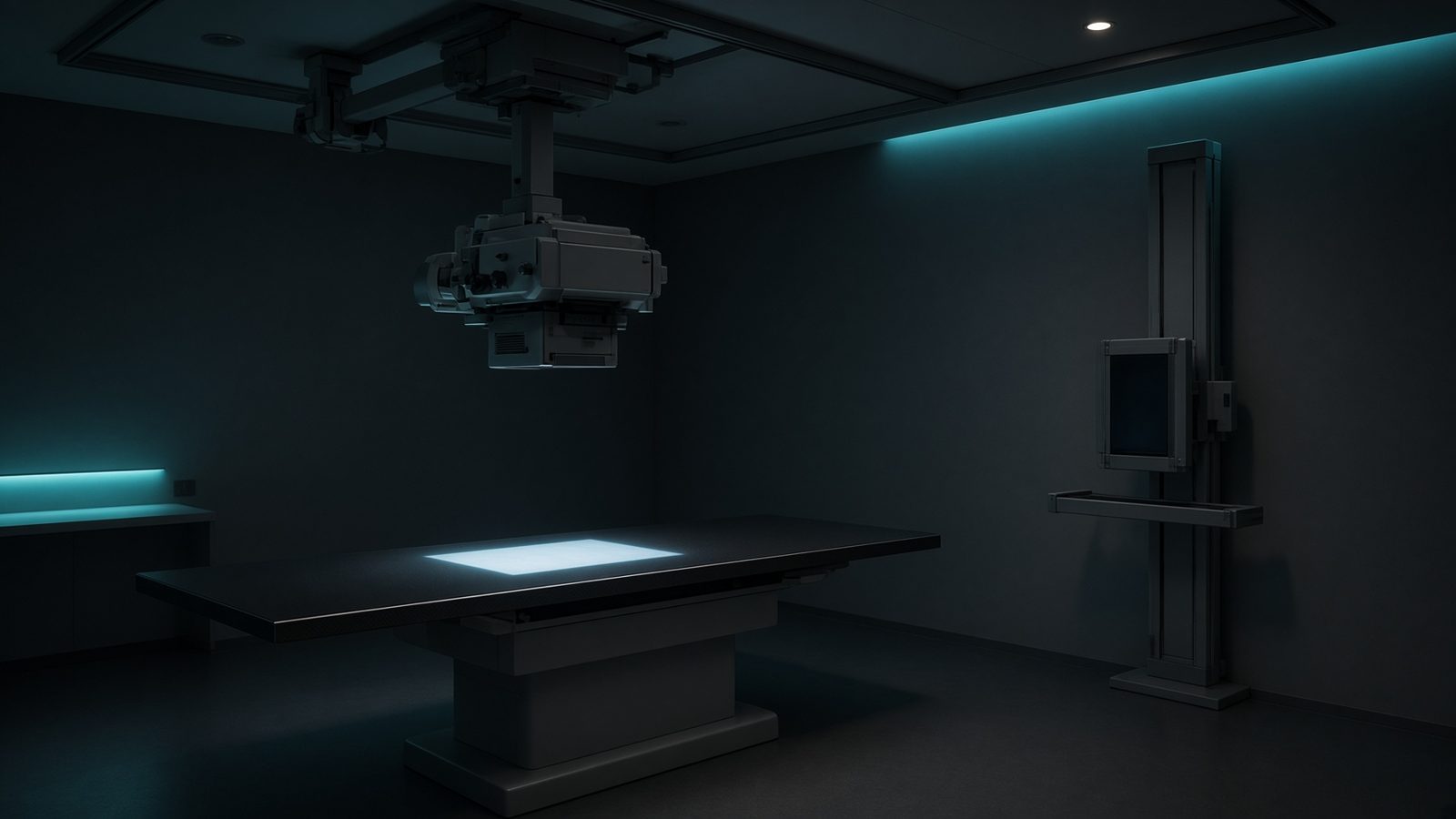
X-ray tube
At the focal spot in the tube housing — spectrum, output, SID geometry, and unsharpness start here.
Open this machineFormula
Variables
Results
mAs₂
mAs to keep exposure
10.26mAs
ΔkVp
kVp change
14.3%
X₂/X₁
Exposure ratio if mAs unchanged
1.9497
Explanation
What it means
The 15% rule: raising kVp by 15% roughly doubles film exposure (n ≈ 5), so you may halve mAs to keep density. In digital radiography it is a dose-management tool, not a density tool — check EI/DI. This is a working relation in Diagnostic imaging.
Where it is used
Clinically it sits on the Radiography room — X-ray tube. At the focal spot in the tube housing — spectrum, output, SID geometry, and unsharpness start here. Diagnostic equations live on the tube, the detector, and the patient: magnification, air kerma, CTDI, and why bone lights up at 70 kV. They turn a technique chart into physics you can defend.
Radiography room · Open this machineHow to use it
Enter original technique and new kVp; the calculator returns the mAs that holds exposure constant for your chosen n. For air kerma / digital detectors set n = 2. Change one input and watch the curve and the simulation follow.
Symbols
- mAs₁Original mAs20 mAs
- kVp₁Original kVp70 kV
- kVp₂New kVp80 kV
- nExponent5
Worked example
A typical case from the default values: mAs₁ = 20 mAs (Original mAs); kVp₁ = 70 kV (Original kVp); kVp₂ = 80 kV (New kVp); n = 5 (Exponent). Substituting into the relation gives mAs₂ = 10.26 mAs; ΔkVp = 14.3 %; X₂/X₁ = 1.9497. These are teaching numbers — align them with your machine.
Typical values give
- mAs₂ = 10.26mAs
- ΔkVp = 14.3%
- X₂/X₁ = 1.9497
Where it comes from
The displayed formula is the working relation. mAs that keeps exposure constant when kVp changes (film-screen n≈5). Usual reference: Carlton & Adler / Bushberg. Derive it in the specialty lesson, then return here to pin the numbers.
Reference: Carlton & Adler / Bushberg
Assumptions & limits
Does not preserve subject contrast (higher kVp lowers photoelectric contrast) or account for AEC. Verify with your exposure index.
Pitfalls
kVp is not the same as effective energy. CTDI is not patient dose — SSDE and organ dose come after. Do not quote DLP as if it were effective dose without a k-factor. Does not preserve subject contrast (higher kVp lowers photoelectric contrast) or account for AEC. Verify with your exposure index.
Keep this
n ≈ 4–5 for optical density (15% ↔ ×2). For air kerma n ≈ 2.
In this specialty