03 Nuclear
Gamma-camera sensitivity
S = C / A (cps/MBq). System sensitivity includes collimator, crystal and window.
Listen
Listen · English
Simulation
Gamma-camera sensitivity — Change the numbers; the scene follows.
Where it works
PET/CT
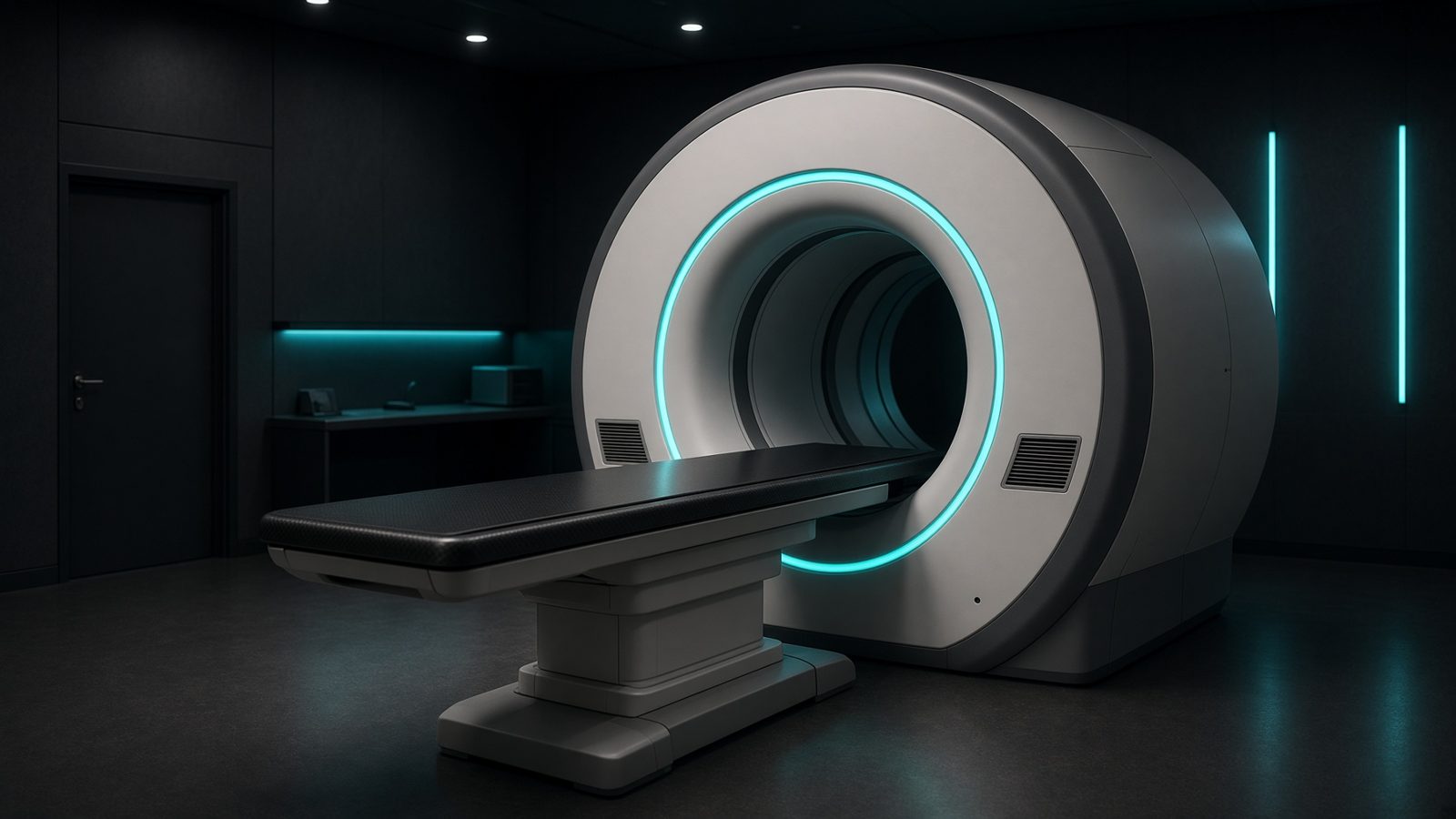
PET detectors
In the PET detector ring — coincidence timing, noise-equivalent counts, randoms.
Open this machineFormula
Variables
Results
C
Count rate
8,333.3cps
S
Sensitivity
104.1667cps/MBq
Explanation
What it means
System sensitivity is the count rate per unit activity for a known source geometry (typically a Petri dish at 10 cm with a LEHR collimator). A modern NaI camera is ~70–100 cps/MBq on LEHR at 140 keV; a high-sensitivity collimator can double that at the cost of resolution. Daily floods track uniformity, not absolute S — S is a NEMA acceptance / annual test. This is a working relation in Nuclear medicine.
Where it is used
Clinically it sits on the PET/CT — PET detectors. In the PET detector ring — coincidence timing, noise-equivalent counts, randoms. Nuclear-medicine relations sit in the hot lab, on the camera, and in the voxel: decay, SUV, TOF, and counting statistics. They decide whether an uptake is real or a clock error.
PET/CT · Open this machineHow to use it
Enter background-corrected counts, live time (s) and activity (MBq). Read cps and cps/MBq. Decay-correct the activity to the mid-acquisition if the assay was earlier. Change one input and watch the curve and the simulation follow.
Symbols
- NNet counts500,000
- tLive time60 s
- AActivity80 MBq
Worked example
A typical case from the default values: N = 500,000 (Net counts); t = 60 s (Live time); A = 80 MBq (Activity). Substituting into the relation gives C = 8,333.3 cps; S = 104.1667 cps/MBq. These are teaching numbers — align them with your machine.
Typical values give
- C = 8,333.3cps
- S = 104.1667cps/MBq
Where it comes from
The displayed formula is the working relation. S = C / A (cps/MBq). System sensitivity includes collimator, crystal and window. Usual reference: NEMA NU 1 / Cherry. Derive it in the specialty lesson, then return here to pin the numbers.
Reference: NEMA NU 1 / Cherry
Assumptions & limits
NEMA NU 1 specifies the dish, distance and window. Scatter from the floor and a poorly peaked window will inflate S. Do not compare LEHR with LEHS numbers.
Pitfalls
Activity is not counts. SUV needs the true injected activity, the residual, and the correct decay time — a clock off by 10 min on ¹⁸F is a several-percent error. Do not compare SUVs across reconstructions. NEMA NU 1 specifies the dish, distance and window. Scatter from the floor and a poorly peaked window will inflate S. Do not compare LEHR with LEHS numbers.
Keep this
Write the assay time next to every activity. Decay does the rest. NEMA NU 1 specifies the dish, distance and window. Scatter from the floor and a poorly peaked window will inflate S. Do not compare LEHR with LEHS numbers.
In this specialty