03 Nuclear
Effective half-life
Combine physical decay and biological clearance.
Listen
Listen · English
Simulation
Effective half-life — Change the numbers; the scene follows.
Where it works
PET/CT
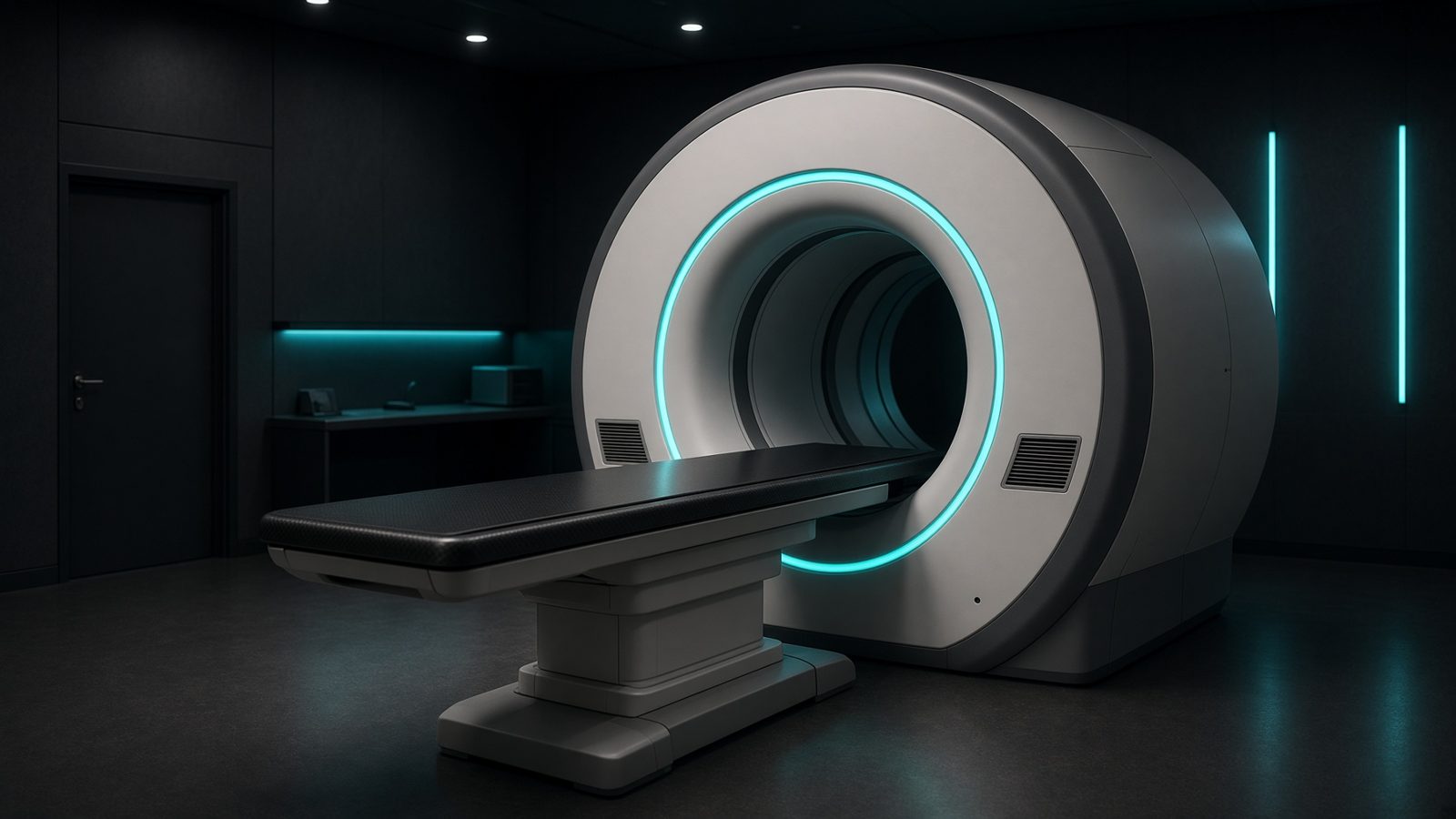
Patient / uptake
In the patient on the PET couch — activity concentration, SUV, and internal dose.
Open this machineFormula
Variables
Results
T_e
Effective half-life
4.8128h
λ_e
Effective decay constant
0.144022h⁻¹
Explanation
What it means
Effective half-life combines physical decay and biological clearance as reciprocals: 1/T_e = 1/T_p + 1/T_b. T_e is always shorter than both. It governs the time integral of activity in an organ (MIRD). This is a working relation in Nuclear medicine.
Where it is used
Clinically it sits on the PET/CT — Patient / uptake. In the patient on the PET couch — activity concentration, SUV, and internal dose. Nuclear-medicine relations sit in the hot lab, on the camera, and in the voxel: decay, SUV, TOF, and counting statistics. They decide whether an uptake is real or a clock error.
PET/CT · Open this machineHow to use it
For Tc-99m MAG3, T_p = 6 h and T_b might be 0.5–2 h in a kidney, so T_e is dominated by biology. For I-131 bound to thyroid, T_b is long and T_e ≈ T_p. Change one input and watch the curve and the simulation follow.
Symbols
- T_pPhysical half-life6.02 h
- T_bBiological half-life24 h
Worked example
A typical case from the default values: T_p = 6.02 h (Physical half-life); T_b = 24 h (Biological half-life). Substituting into the relation gives T_e = 4.8128 h; λ_e = 0.144022 h⁻¹. These are teaching numbers — align them with your machine.
Typical values give
- T_e = 4.8128h
- λ_e = 0.144022h⁻¹
Where it comes from
The displayed formula is the working relation. Combine physical decay and biological clearance. Usual reference: Cherry / ICRP. Derive it in the specialty lesson, then return here to pin the numbers.
Reference: Cherry / ICRP
Assumptions & limits
One-compartment exponential clearance. Multi-exponential organs (liver, tumours) need a sum of terms, not a single T_b.
Pitfalls
Activity is not counts. SUV needs the true injected activity, the residual, and the correct decay time — a clock off by 10 min on ¹⁸F is a several-percent error. Do not compare SUVs across reconstructions. One-compartment exponential clearance. Multi-exponential organs (liver, tumours) need a sum of terms, not a single T_b.
Keep this
Write the assay time next to every activity. Decay does the rest. One-compartment exponential clearance. Multi-exponential organs (liver, tumours) need a sum of terms, not a single T_b.
In this specialty