03 Nuclear
Exposure rate from Γ
Ẋ = Γ A / d² for a point source in air.
Listen
Listen · English
Simulation
Exposure rate from Γ — Change the numbers; the scene follows.
Where it works
Gamma camera
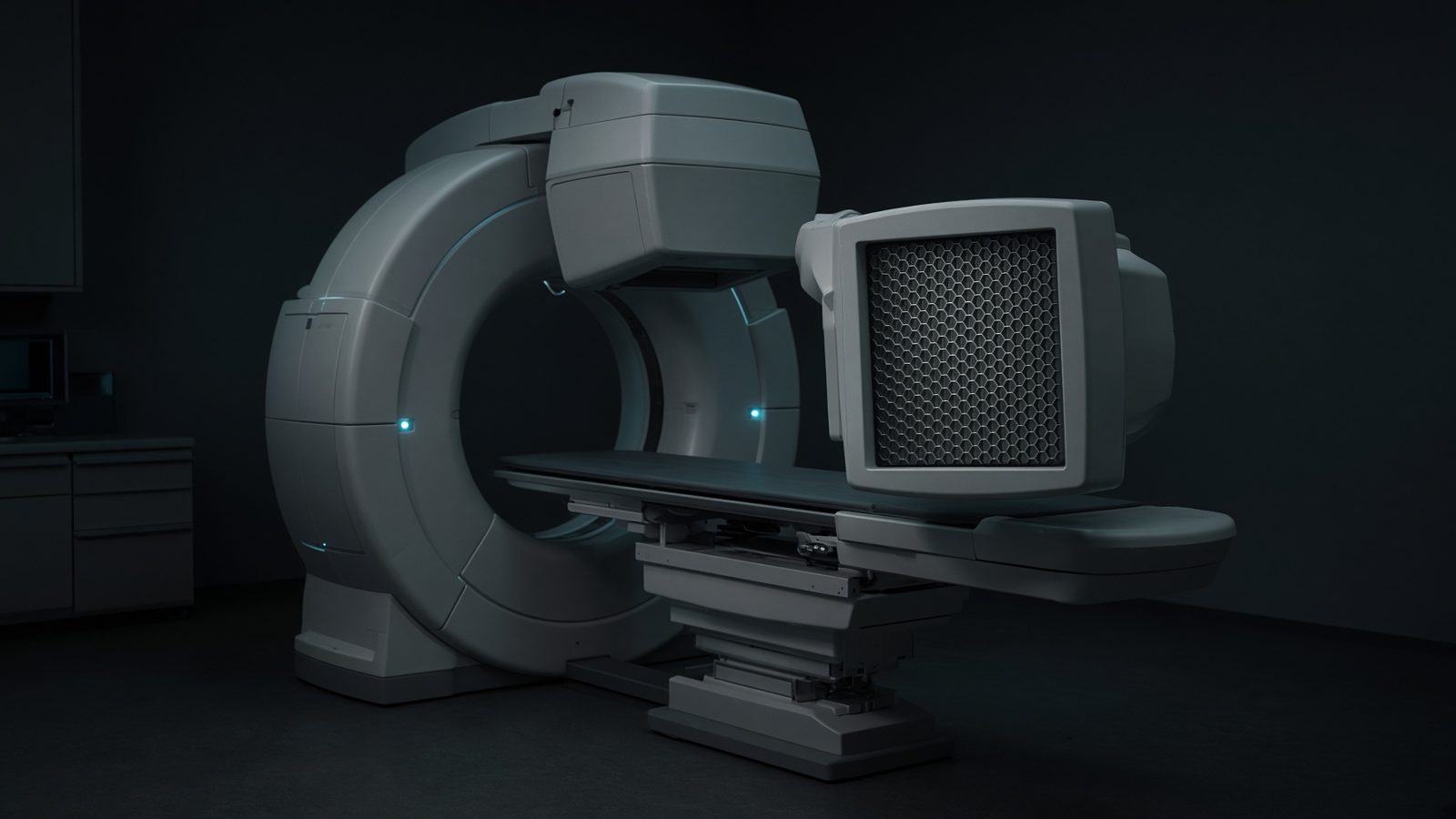
Detector head
In the gamma-camera crystal and PMTs — counts, dead time, energy window, resolution.
Open this machineFormula
Typical values
Variables
Results
Ẋ
Exposure rate
0.01733R/h
Ẋ
Exposure rate
17.333mR/h
K_air
Approx. air kerma rate
0.1518mGy/h
Curve
Explanation
What it means
The specific gamma-ray constant Γ converts activity and distance into exposure rate in air: Ẋ = Γ A / d². It is the health-physics companion of inverse square, with the nuclide’s photon yield and energy baked into Γ. This is a working relation in Nuclear medicine.
Where it is used
Clinically it sits on the Gamma camera — Detector head. In the gamma-camera crystal and PMTs — counts, dead time, energy window, resolution. Nuclear-medicine relations sit in the hot lab, on the camera, and in the voxel: decay, SUV, TOF, and counting statistics. They decide whether an uptake is real or a clock error.
Gamma camera · Open this machineHow to use it
Presets are in R·cm²/(mCi·h): Tc-99m 0.78, I-131 2.2, F-18 5.7, Co-60 13.2. Convert to air kerma with 8.76 mGy/R. Use it for syringe shields, package labels, and stay-time estimates. Change one input and watch the curve and the simulation follow.
Symbols
- ΓSpecific gamma-ray constant0.78 R·cm²/(mCi·h)
- AActivity20 mCi
- dDistance30 cm
Worked example
A typical case from the default values: Γ = 0.78 R·cm²/(mCi·h) (Specific gamma-ray constant); A = 20 mCi (Activity); d = 30 cm (Distance). Substituting into the relation gives Ẋ = 0.01733 R/h; Ẋ = 17.333 mR/h; K_air = 0.1518 mGy/h. These are teaching numbers — align them with your machine.
Typical values give
- Ẋ = 0.01733R/h
- Ẋ = 17.333mR/h
- K_air = 0.1518mGy/h
Where it comes from
The displayed formula is the working relation. Ẋ = Γ A / d² for a point source in air. Usual reference: Cember / Cherry. Derive it in the specialty lesson, then return here to pin the numbers.
Reference: Cember / Cherry
Assumptions & limits
Point source in air, no shielding, no buildup, no scatter from the patient. Γ depends on the energy cutoff of the tabulated value — use a consistent table.
Pitfalls
Activity is not counts. SUV needs the true injected activity, the residual, and the correct decay time — a clock off by 10 min on ¹⁸F is a several-percent error. Do not compare SUVs across reconstructions. Point source in air, no shielding, no buildup, no scatter from the patient. Γ depends on the energy cutoff of the tabulated value — use a consistent table.
Keep this
Γ in R·cm²/(mCi·h). 1 R ≈ 8.76 mGy in air.
In this specialty