03 Nuclear
Radioactive decay
Activity remaining after time t from the half-life.
Listen
Listen · English
Simulation
Radioactive decay — Change the numbers; the scene follows.
Where it works
Hot lab
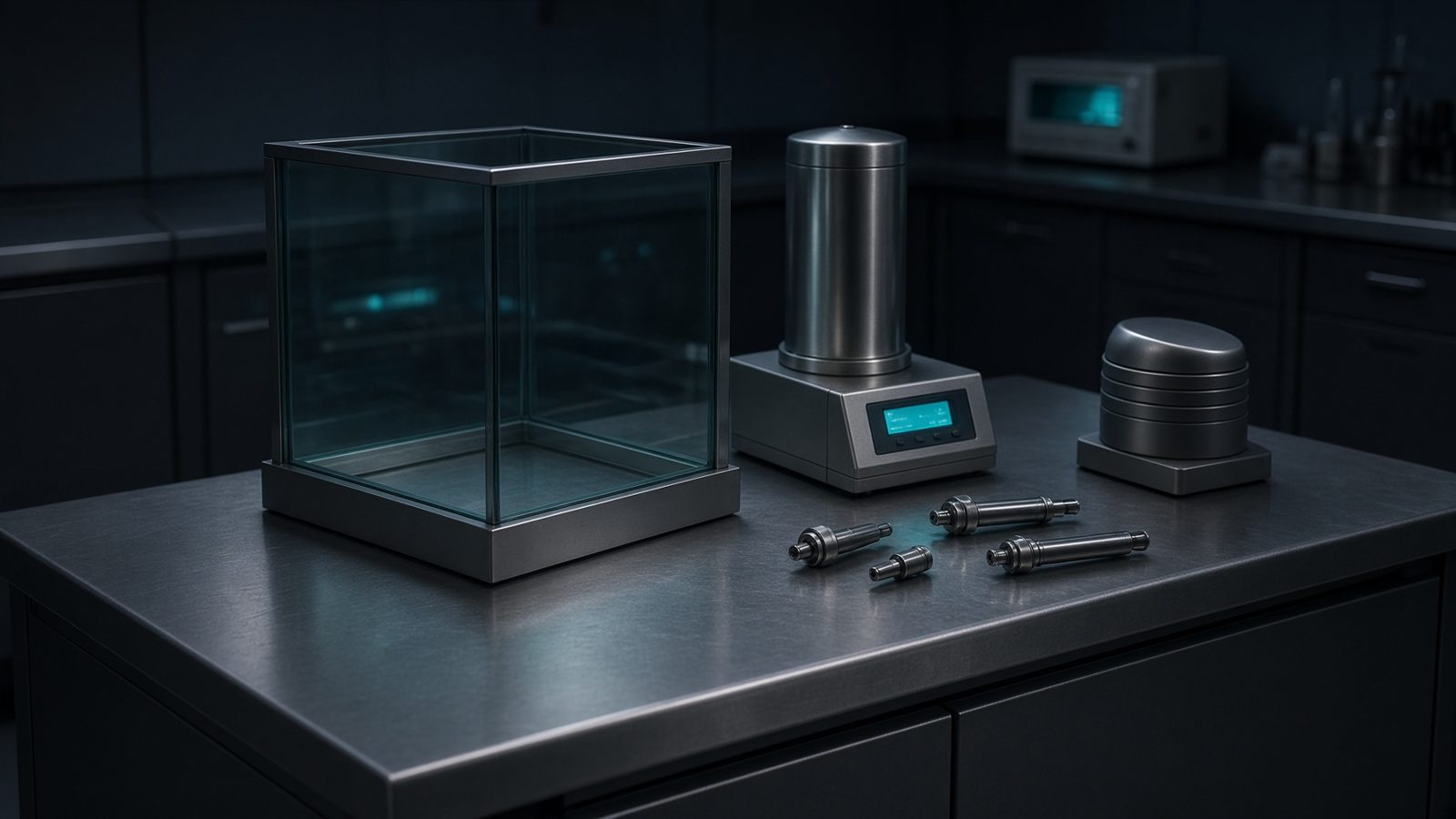
Dose calibrator
In the dose calibrator well — assayed activity, decay between two times, Marinelli.
Open this machineFormula
Typical values
Variables
Results
A
Remaining activity
261.9309MBq
DF
Decay factor
0.7079
λ
Decay constant
0.115141h⁻¹
Curve
Explanation
What it means
Radioactive decay is exponential: A = A₀ e^{−λt} with λ = ln2 / T½. After one half-life half remains; after ten half-lives about 0.1% remains. This is the first calculation in any nuclear-medicine or HDR workflow. This is a working relation in Nuclear medicine.
Where it is used
Clinically it sits on the Hot lab — Dose calibrator. In the dose calibrator well — assayed activity, decay between two times, Marinelli. Nuclear-medicine relations sit in the hot lab, on the camera, and in the voxel: decay, SUV, TOF, and counting statistics. They decide whether an uptake is real or a clock error.
Hot lab · Open this machineHow to use it
Pick a nuclide preset (F-18 109.8 min, Tc-99m 6.02 h, I-131 8.02 d) or type T½. Use consistent time units for T½ and t. The curve shows five half-lives by default. Change one input and watch the curve and the simulation follow.
Symbols
- A₀Initial activity370 MBq
- T½Half-life6.02 h
- tElapsed time3 h
Worked example
A typical case from the default values: A₀ = 370 MBq (Initial activity); T½ = 6.02 h (Half-life); t = 3 h (Elapsed time). Substituting into the relation gives A = 261.9309 MBq; DF = 0.7079; λ = 0.115141 h⁻¹. These are teaching numbers — align them with your machine.
Typical values give
- A = 261.9309MBq
- DF = 0.7079
- λ = 0.115141h⁻¹
Where it comes from
The displayed formula is the working relation. Activity remaining after time t from the half-life. Usual reference: Cherry, Sorenson & Phelps. Derive it in the specialty lesson, then return here to pin the numbers.
Reference: Cherry, Sorenson & Phelps
Assumptions & limits
Single nuclide, no branching daughters, no biological clearance. For in-vivo effective decay use the effective half-life equation.
Pitfalls
Activity is not counts. SUV needs the true injected activity, the residual, and the correct decay time — a clock off by 10 min on ¹⁸F is a several-percent error. Do not compare SUVs across reconstructions. Single nuclide, no branching daughters, no biological clearance. For in-vivo effective decay use the effective half-life equation.
Keep this
Write the assay time next to every activity. Decay does the rest. Single nuclide, no branching daughters, no biological clearance. For in-vivo effective decay use the effective half-life equation.
In this specialty