03 Nuclear
Noise-equivalent counts NEC
NEC = T² / (T + S + 2R) (or k=1 for a delayed window). The figure of merit for PET count-rate.
Listen
Listen · English
Simulation
Noise-equivalent counts NEC — Change the numbers; the scene follows.
Where it works
PET/CT
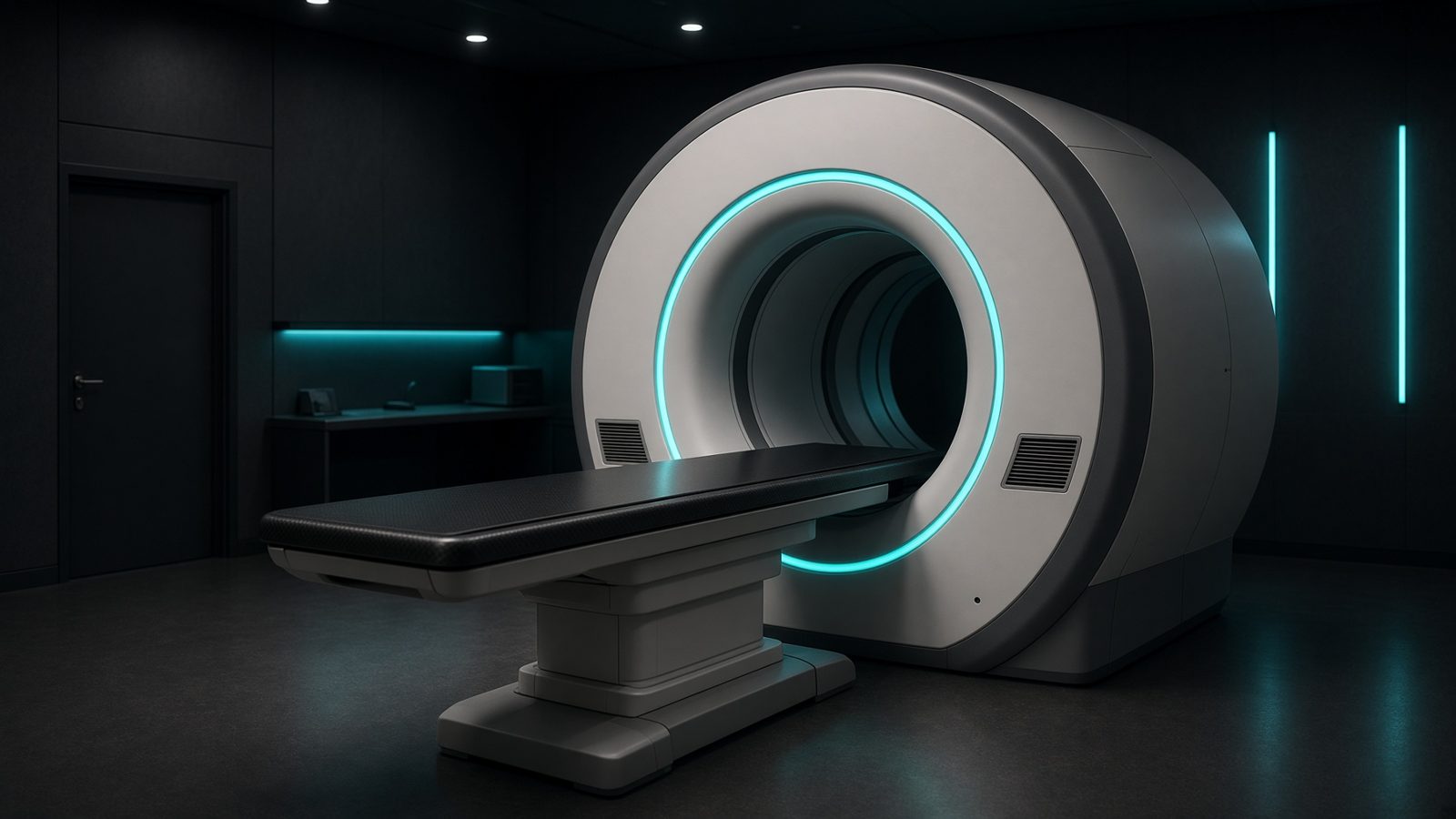
PET detectors
In the PET detector ring — coincidence timing, noise-equivalent counts, randoms.
Open this machineFormula
Variables
Results
NEC
Noise-equivalent counts
35,555.6cps
SF
Scatter fraction
0.3333
Explanation
What it means
Raw coincidence rate is a poor figure of merit because scatter and randoms add variance without adding signal. NEC is the true-coincidence rate that, in a scatter- and random-free scanner, would give the same SNR. Peak NEC (typically 20–40 kcps on a clinical torso phantom) is how vendors compare count-rate performance; it occurs well below the dead-time peak. This is a working relation in Nuclear medicine.
Where it is used
Clinically it sits on the PET/CT — PET detectors. In the PET detector ring — coincidence timing, noise-equivalent counts, randoms. Nuclear-medicine relations sit in the hot lab, on the camera, and in the voxel: decay, SUV, TOF, and counting statistics. They decide whether an uptake is real or a clock error.
PET/CT · Open this machineHow to use it
Enter trues T, scatter S and randoms R in cps, and k (2 for a delayed-window randoms subtraction that adds variance, 1 if randoms are estimated noiselessly). Read NEC and the scatter fraction SF = S/(T+S). Change one input and watch the curve and the simulation follow.
Symbols
- TTrues80,000 cps
- SScatter40,000 cps
- RRandoms30,000 cps
- kRandoms weight2
Worked example
A typical case from the default values: T = 80,000 cps (Trues); S = 40,000 cps (Scatter); R = 30,000 cps (Randoms); k = 2 (Randoms weight). Substituting into the relation gives NEC = 35,555.6 cps; SF = 0.3333. These are teaching numbers — align them with your machine.
Typical values give
- NEC = 35,555.6cps
- SF = 0.3333
Where it comes from
The displayed formula is the working relation. NEC = T² / (T + S + 2R) (or k=1 for a delayed window). The figure of merit for PET count-rate. Usual reference: NEMA NU 2 / Strother. Derive it in the specialty lesson, then return here to pin the numbers.
Reference: NEMA NU 2 / Strother
Assumptions & limits
Single-bed, no decay, no dead-time model. Activity-varying NEC curves need T,S,R vs activity (NEMA NU 2 protocol). 2R is the NEMA default for noisy randoms subtraction.
Pitfalls
Activity is not counts. SUV needs the true injected activity, the residual, and the correct decay time — a clock off by 10 min on ¹⁸F is a several-percent error. Do not compare SUVs across reconstructions. Single-bed, no decay, no dead-time model. Activity-varying NEC curves need T,S,R vs activity (NEMA NU 2 protocol). 2R is the NEMA default for noisy randoms subtraction.
Keep this
Write the assay time next to every activity. Decay does the rest. Single-bed, no decay, no dead-time model. Activity-varying NEC curves need T,S,R vs activity (NEMA NU 2 protocol). 2R is the NEMA default for noisy randoms subtraction.
In this specialty