03 Nuclear
Time between two activities
Elapsed time from A₀, A, and half-life.
Listen
Listen · English
Simulation
Time between two activities — Change the numbers; the scene follows.
Where it works
Hot lab
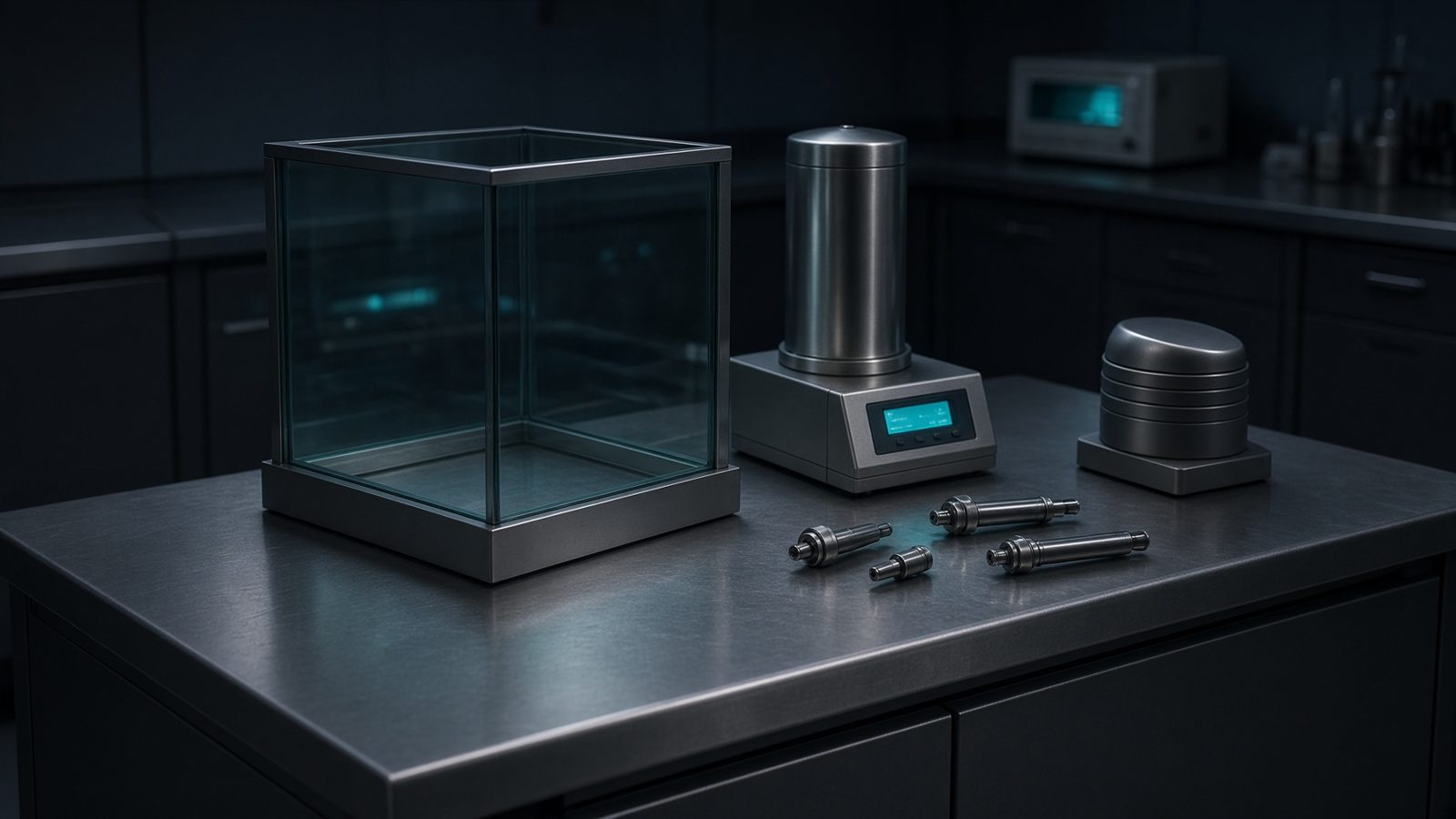
Dose calibrator
In the dose calibrator well — assayed activity, decay between two times, Marinelli.
Open this machineFormula
Variables
Results
t
Elapsed time
6.02h
n
Number of half-lives
1
Explanation
What it means
Inverting the decay law gives the time between two assayed activities: t = (T½/ln2) ln(A₀/A). Useful when a labelled syringe was assayed earlier and you need the activity ‘now’ — or to date an unknown sample. This is a working relation in Nuclear medicine.
Where it is used
Clinically it sits on the Hot lab — Dose calibrator. In the dose calibrator well — assayed activity, decay between two times, Marinelli. Nuclear-medicine relations sit in the hot lab, on the camera, and in the voxel: decay, SUV, TOF, and counting statistics. They decide whether an uptake is real or a clock error.
Hot lab · Open this machineHow to use it
If current activity exceeds initial, the warning fires (growth, not decay, or swapped values). n = t/T½ is the number of elapsed half-lives. Change one input and watch the curve and the simulation follow.
Symbols
- A₀Initial activity400 MBq
- ACurrent activity200 MBq
- T½Half-life6.02 h
Worked example
A typical case from the default values: A₀ = 400 MBq (Initial activity); A = 200 MBq (Current activity); T½ = 6.02 h (Half-life). Substituting into the relation gives t = 6.02 h; n = 1. These are teaching numbers — align them with your machine.
Typical values give
- t = 6.02h
- n = 1
Where it comes from
The displayed formula is the working relation. Elapsed time from A₀, A, and half-life. Usual reference: Cherry. Derive it in the specialty lesson, then return here to pin the numbers.
Reference: Cherry
Assumptions & limits
Same nuclide, no daughter in-growth. Assay geometry and dead-time must be consistent between the two measurements.
Pitfalls
Activity is not counts. SUV needs the true injected activity, the residual, and the correct decay time — a clock off by 10 min on ¹⁸F is a several-percent error. Do not compare SUVs across reconstructions. Same nuclide, no daughter in-growth. Assay geometry and dead-time must be consistent between the two measurements.
Keep this
Write the assay time next to every activity. Decay does the rest. Same nuclide, no daughter in-growth. Assay geometry and dead-time must be consistent between the two measurements.
In this specialty