03 Nuclear
PET random coincidences
R = 2 τ S₁ S₂ for a pair of detectors; τ is the coincidence window.
Listen
Listen · English
Simulation
PET random coincidences — Change the numbers; the scene follows.
Where it works
PET/CT
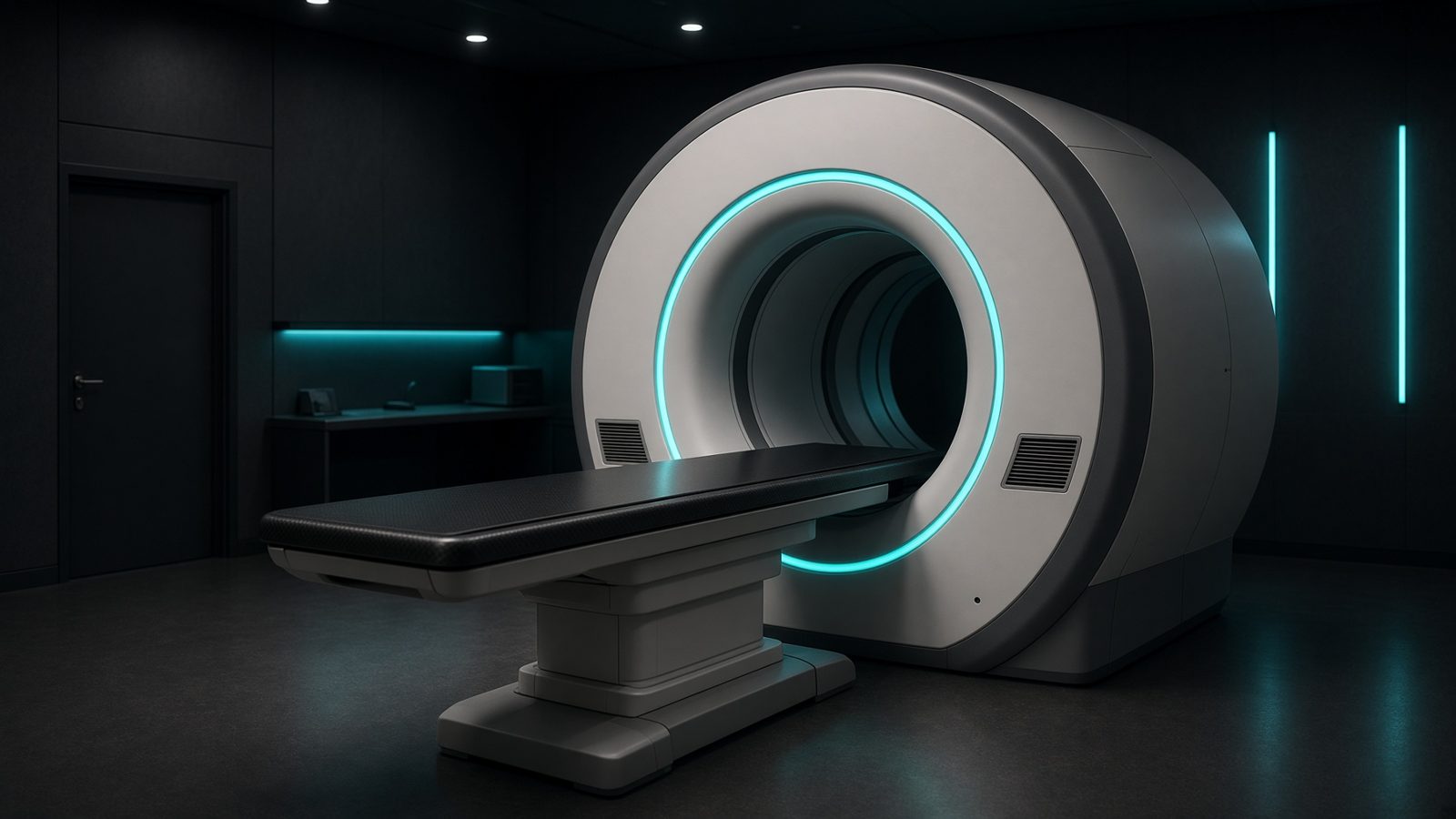
PET detectors
In the PET detector ring — coincidence timing, noise-equivalent counts, randoms.
Open this machineFormula
Variables
Results
R
Randoms
9,000cps
R
Randoms
9kcps
Curve
Explanation
What it means
A random coincidence is two unrelated photons arriving within the window τ. Rate is the product of the singles rates times the window (the factor 2 counts both time orderings). Randoms grow as activity squared and become the count-rate killer at high dose; TOF (smaller effective τ) and a well-shielded ring are the remedies. Delayed-window subtraction measures R directly. This is a working relation in Nuclear medicine.
Where it is used
Clinically it sits on the PET/CT — PET detectors. In the PET detector ring — coincidence timing, noise-equivalent counts, randoms. Nuclear-medicine relations sit in the hot lab, on the camera, and in the voxel: decay, SUV, TOF, and counting statistics. They decide whether an uptake is real or a clock error.
PET/CT · Open this machineHow to use it
Enter singles S₁, S₂ (cps) and τ in ns. For a symmetric ring use S₁ = S₂. 10⁷ cps, 4.5 ns → R ≈ 900 kcps on that pair — illustrating why clinical τ is kept to 2–6 ns and why shields matter. Change one input and watch the curve and the simulation follow.
Symbols
- S₁Singles 11.0000e+6 cps
- S₂Singles 21.0000e+6 cps
- τCoincidence window4.5 ns
Worked example
A typical case from the default values: S₁ = 1.0000e+6 cps (Singles 1); S₂ = 1.0000e+6 cps (Singles 2); τ = 4.5 ns (Coincidence window). Substituting into the relation gives R = 9,000 cps; R = 9 kcps. These are teaching numbers — align them with your machine.
Typical values give
- R = 9,000cps
- R = 9kcps
Where it comes from
The displayed formula is the working relation. R = 2 τ S₁ S₂ for a pair of detectors; τ is the coincidence window. Usual reference: Cherry / NEMA NU 2. Derive it in the specialty lesson, then return here to pin the numbers.
Reference: Cherry / NEMA NU 2
Assumptions & limits
One detector pair, constant rates, no dead time. A full ring sums R over all pairs. Prompt-gamma coincidences (non-pure positron emitters: ¹²⁴I, ⁸²Rb) are an extra true-looking background not in this formula.
Pitfalls
Activity is not counts. SUV needs the true injected activity, the residual, and the correct decay time — a clock off by 10 min on ¹⁸F is a several-percent error. Do not compare SUVs across reconstructions. One detector pair, constant rates, no dead time. A full ring sums R over all pairs. Prompt-gamma coincidences (non-pure positron emitters: ¹²⁴I, ⁸²Rb) are an extra true-looking background not in this formula.
Keep this
Write the assay time next to every activity. Decay does the rest. One detector pair, constant rates, no dead time. A full ring sums R over all pairs. Prompt-gamma coincidences (non-pure positron emitters: ¹²⁴I, ⁸²Rb) are an extra true-looking background not in this formula.
In this specialty