03 Nuclear
Coincidence window width
τ ≥ 2 D / c plus timing FWHM. A 70 cm ring needs ≥ 4.7 ns of flight plus jitter.
Listen
Listen · English
Simulation
Coincidence window width — Change the numbers; the scene follows.
Where it works
PET/CT
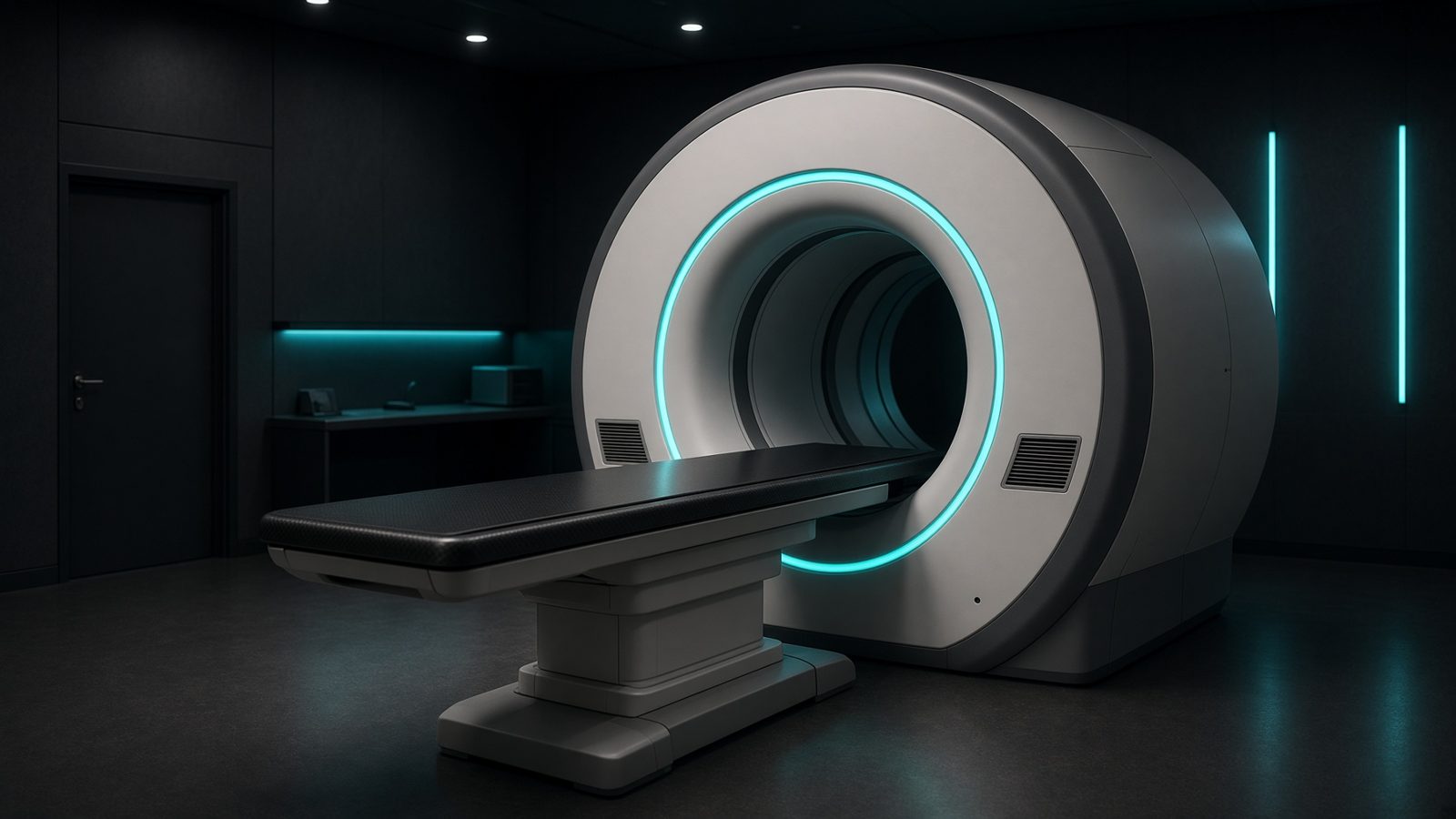
PET detectors
In the PET detector ring — coincidence timing, noise-equivalent counts, randoms.
Open this machineFormula
Variables
Results
t_flight
One-way flight time
2.3349ns
τ_min
Suggested minimum window
5.4699ns
Explanation
What it means
The coincidence window must be wide enough that a true pair born at the edge of the FOV still meets, but narrow enough that randoms (∝ τ) stay tolerable. Flight time across a 70 cm detector ring is 2.3 ns one-way, so 4.7 ns round-trip; add a few FWHM of timing jitter. Clinical windows are 4–6 ns (BGO, LYSO) and can be 2–3 ns on a fast LSO/LYSO TOF system. This is a working relation in Nuclear medicine.
Where it is used
Clinically it sits on the PET/CT — PET detectors. In the PET detector ring — coincidence timing, noise-equivalent counts, randoms. Nuclear-medicine relations sit in the hot lab, on the camera, and in the voxel: decay, SUV, TOF, and counting statistics. They decide whether an uptake is real or a clock error.
PET/CT · Open this machineHow to use it
Enter ring diameter D (cm) and timing FWHM (ns). The suggested τ is 2D/c + 2 FWHM. Compare with your scanner’s configured window. Change one input and watch the curve and the simulation follow.
Symbols
- DRing diameter70 cm
- FWHMTiming FWHM0.4 ns
Worked example
A typical case from the default values: D = 70 cm (Ring diameter); FWHM = 0.4 ns (Timing FWHM). Substituting into the relation gives t_flight = 2.3349 ns; τ_min = 5.4699 ns. These are teaching numbers — align them with your machine.
Typical values give
- t_flight = 2.3349ns
- τ_min = 5.4699ns
Where it comes from
The displayed formula is the working relation. τ ≥ 2 D / c plus timing FWHM. A 70 cm ring needs ≥ 4.7 ns of flight plus jitter. Usual reference: Cherry. Derive it in the specialty lesson, then return here to pin the numbers.
Reference: Cherry
Assumptions & limits
Straight-line vacuum flight, no crystal DOI. Randoms and dead time still set a practical upper bound on τ. Scatter coincidences have a similar flight-time distribution and are not rejected by τ.
Pitfalls
Activity is not counts. SUV needs the true injected activity, the residual, and the correct decay time — a clock off by 10 min on ¹⁸F is a several-percent error. Do not compare SUVs across reconstructions. Straight-line vacuum flight, no crystal DOI. Randoms and dead time still set a practical upper bound on τ. Scatter coincidences have a similar flight-time distribution and are not rejected by τ.
Keep this
Write the assay time next to every activity. Decay does the rest. Straight-line vacuum flight, no crystal DOI. Randoms and dead time still set a practical upper bound on τ. Scatter coincidences have a similar flight-time distribution and are not rejected by τ.
In this specialty