01 Therapy
Geometric penumbra
Source-size penumbra at depth from collimator distance.
Listen
Listen · English
Simulation
Geometric penumbra — Change the numbers; the scene follows.
Where it works
Linear accelerator
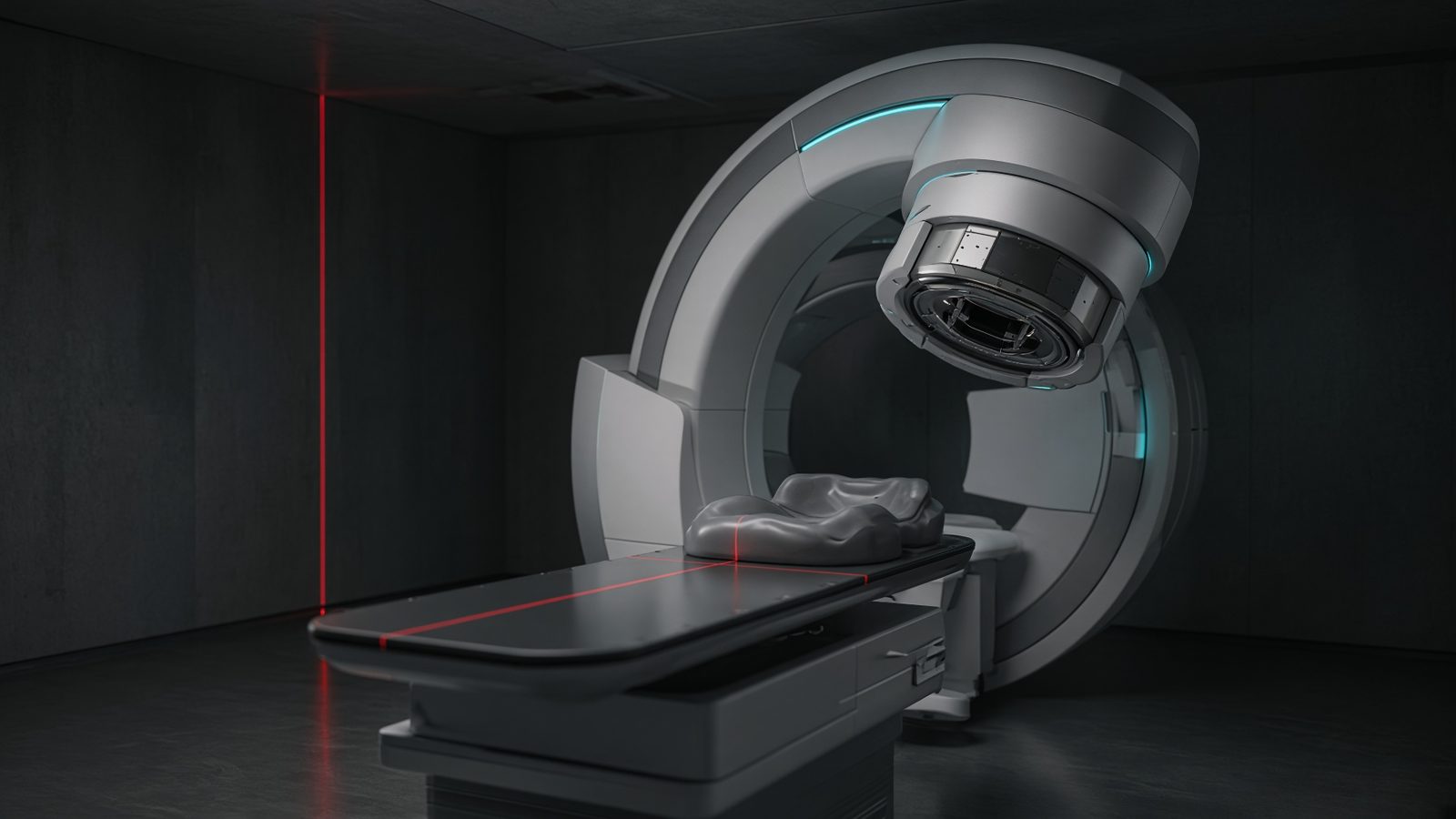
Collimator / MLC
At the jaws / MLC: field size on the collimator sets equivalent square, penumbra, and Sc,p.
Open this machineFormula
Variables
Results
P
Geometric penumbra
6mm
Explanation
What it means
Geometric penumbra is the region where the finite source is partially obscured by the collimator. It widens with source size and with distance beyond the collimator, and narrows if you push the jaws closer to the patient (larger SCD… actually smaller gap beyond SCD). This is a working relation in Radiotherapy.
Where it is used
Clinically it sits on the Linear accelerator — Collimator / MLC. At the jaws / MLC: field size on the collimator sets equivalent square, penumbra, and Sc,p. Radiotherapy equations sit at the console and in the bunker: output, depth dose, equivalent square, and the monitor units that treat the patient. Hand-calc them beside the TPS, never instead of a commissioned plan.
Linear accelerator · Open this machineHow to use it
Enter source diameter s (≈ 3–7 mm for a linac target as seen through the primary collimator), SSD, depth, and source-to-collimator distance. Physical penumbra also includes lateral scatter and transmission — typically 4–8 mm (20–80%) at 10 cm for 6 MV. Change one input and watch the curve and the simulation follow.
Symbols
- sSource diameter5 mm
- SSDSSD100 cm
- dDepth10 cm
- SCDSource-collimator distance50 cm
Worked example
A typical case from the default values: s = 5 mm (Source diameter); SSD = 100 cm (SSD); d = 10 cm (Depth); SCD = 50 cm (Source-collimator distance). Substituting into the relation gives P = 6 mm. These are teaching numbers — align them with your machine.
Typical values give
- P = 6mm
Where it comes from
The displayed formula is the working relation. Source-size penumbra at depth from collimator distance. Usual reference: Khan. Derive it in the specialty lesson, then return here to pin the numbers.
Reference: Khan
Assumptions & limits
Pure geometry. Transmission through jaws, extrafocal radiation, and phantom scatter add to the measured 20–80% penumbra.
Pitfalls
Never mix PDD from one SSD with TMR from another without converting. Field size at the surface is not the size at isocentre. A hand MU is a check, not a treatment. Pure geometry. Transmission through jaws, extrafocal radiation, and phantom scatter add to the measured 20–80% penumbra.
Keep this
Name the SSD, energy, and field size with every PDD or TMR you quote. Pure geometry. Transmission through jaws, extrafocal radiation, and phantom scatter add to the measured 20–80% penumbra.
In this specialty