01 Therapy
Mayneord F-factor
PDD correction when SSD changes at constant surface field size.
Listen
Listen · English
Simulation
Mayneord F-factor — Change the numbers; the scene follows.
Where it works
Linear accelerator
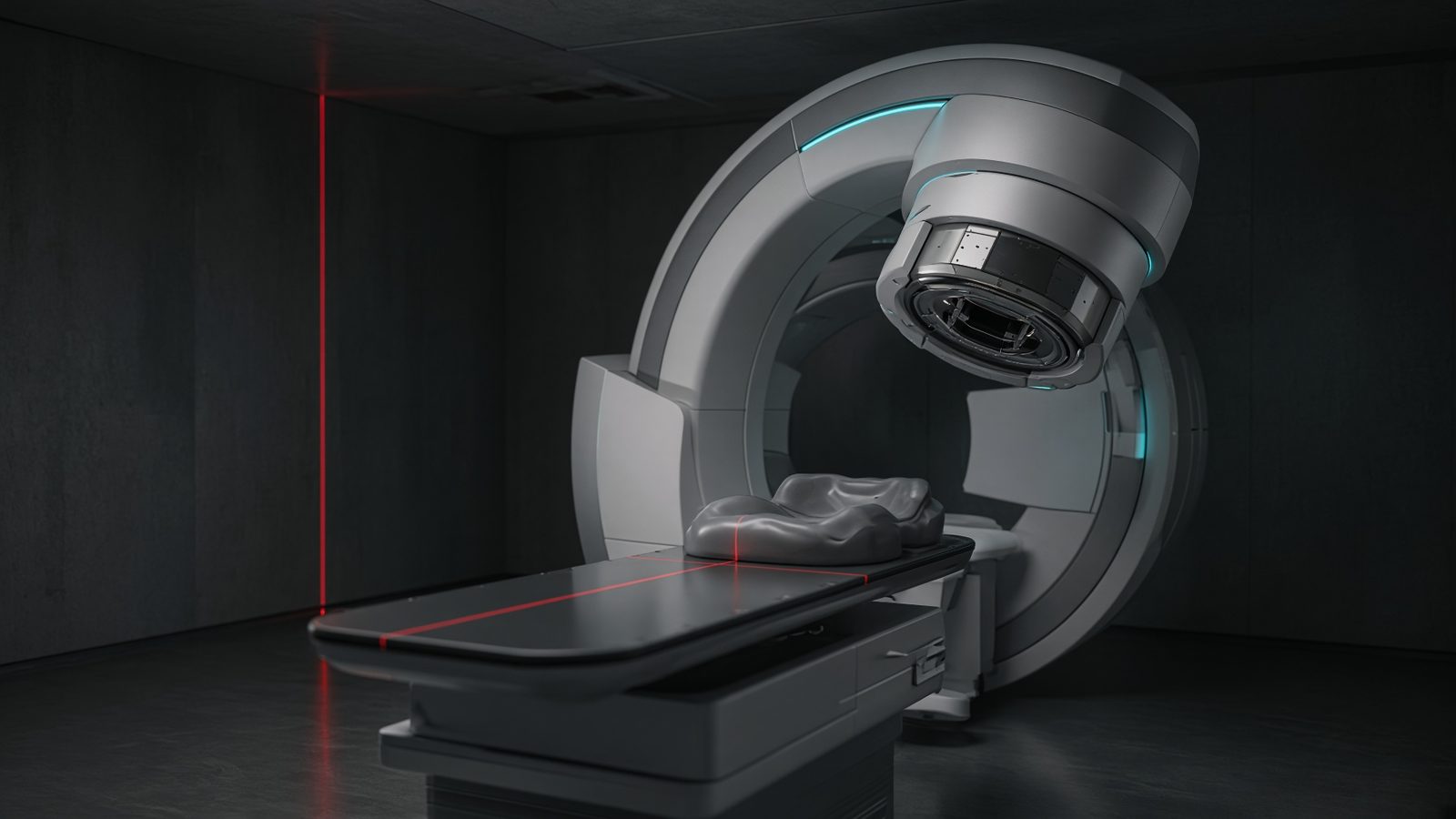
Treatment couch
On the couch: changing SSD versus SAD is a setup change, not a new beam model.
Open this machineFormula
Variables
Results
F
Mayneord factor
1.0259
PDD₂
PDD at SSD₂
68.7375%
Explanation
What it means
Mayneord F corrects PDD when SSD changes at constant surface field size. It is two inverse-square ratios: one at dmax and one at depth. Longer SSD slightly improves PDD (less inverse-square fall-off across the phantom). This is a working relation in Radiotherapy.
Where it is used
Clinically it sits on the Linear accelerator — Treatment couch. On the couch: changing SSD versus SAD is a setup change, not a new beam model. Radiotherapy equations sit at the console and in the bunker: output, depth dose, equivalent square, and the monitor units that treat the patient. Hand-calc them beside the TPS, never instead of a commissioned plan.
Linear accelerator · Open this machineHow to use it
Enter PDD₁ at SSD₁ plus the new SSD, depth, and dmax. For 6 MV, 10 cm, going from 100 to 120 cm, F is a few percent above 1. Apply F to PDD, not to TMR. Change one input and watch the curve and the simulation follow.
Symbols
- PDD₁PDD at SSD₁67 %
- SSD₁Original SSD100 cm
- SSD₂New SSD120 cm
- dDepth10 cm
- dₘₐₓDepth of dose maximum1.5 cm
Worked example
A typical case from the default values: PDD₁ = 67 % (PDD at SSD₁); SSD₁ = 100 cm (Original SSD); SSD₂ = 120 cm (New SSD); d = 10 cm (Depth); dₘₐₓ = 1.5 cm (Depth of dose maximum). Substituting into the relation gives F = 1.0259; PDD₂ = 68.7375 %. These are teaching numbers — align them with your machine.
Typical values give
- F = 1.0259
- PDD₂ = 68.7375%
Where it comes from
The displayed formula is the working relation. PDD correction when SSD changes at constant surface field size. Usual reference: Khan, Ch. 9. Derive it in the specialty lesson, then return here to pin the numbers.
Reference: Khan, Ch. 9
Assumptions & limits
Overestimates at low energy and large depth because scatter does not follow inverse square. Not valid if field size is specified at isocentre rather than at the surface.
Pitfalls
Never mix PDD from one SSD with TMR from another without converting. Field size at the surface is not the size at isocentre. A hand MU is a check, not a treatment. Overestimates at low energy and large depth because scatter does not follow inverse square. Not valid if field size is specified at isocentre rather than at the surface.
Keep this
Slightly overestimates at low energy and large depth because of scatter.
In this specialty