01 Therapy
Adjacent-field gap
Skin gap so beam edges meet at a chosen depth.
Listen
Listen · English
Simulation
Adjacent-field gap — Change the numbers; the scene follows.
Where it works
Linear accelerator
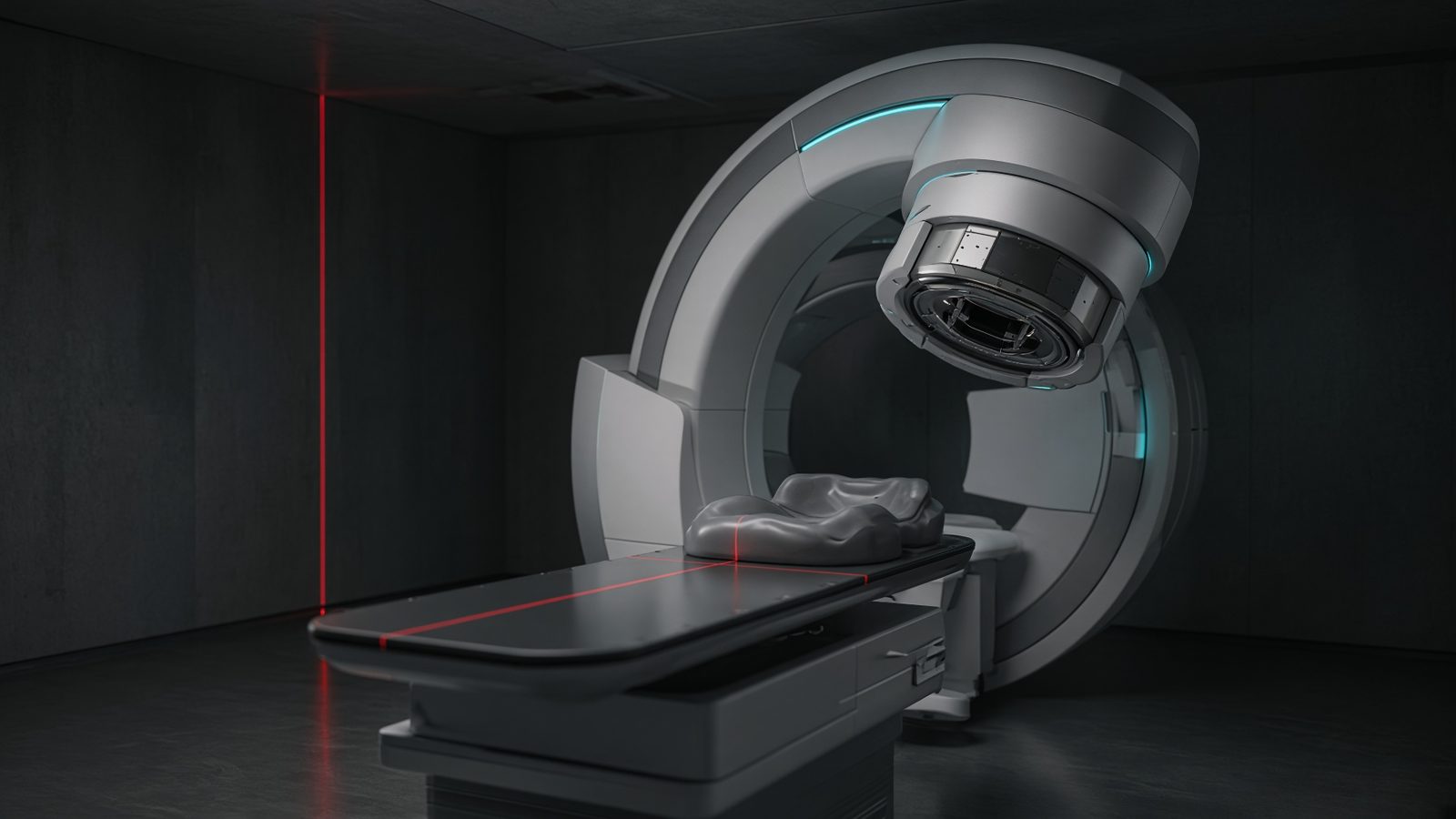
Isocenter
At isocenter, on the central axis through the patient (or a phantom in the same place).
Open this machineFormula
Variables
Results
g
Surface gap
1.8cm
Explanation
What it means
When two adjacent photon fields meet at depth d, a skin gap is needed because the geometric edges diverge. g = (d/2)(L₁/SSD₁ + L₂/SSD₂). Too small a gap hot-spots the junction; too large cold-spots it — critical near cord and craniospinal junctions. This is a working relation in Radiotherapy.
Where it is used
Clinically it sits on the Linear accelerator — Isocenter. At isocenter, on the central axis through the patient (or a phantom in the same place). Radiotherapy equations sit at the console and in the bunker: output, depth dose, equivalent square, and the monitor units that treat the patient. Hand-calc them beside the TPS, never instead of a commissioned plan.
Linear accelerator · Open this machineHow to use it
L is the surface field length along the junction. For two 20 cm fields at SSD 100 meeting at 10 cm, g = 2 cm. Feather the junction over several fractions in CSI. Change one input and watch the curve and the simulation follow.
Symbols
- dJunction depth10 cm
- L₁Field 1 length20 cm
- SSD₁SSD field 1100 cm
- L₂Field 2 length16 cm
- SSD₂SSD field 2100 cm
Worked example
A typical case from the default values: d = 10 cm (Junction depth); L₁ = 20 cm (Field 1 length); SSD₁ = 100 cm (SSD field 1); L₂ = 16 cm (Field 2 length); SSD₂ = 100 cm (SSD field 2). Substituting into the relation gives g = 1.8 cm. These are teaching numbers — align them with your machine.
Typical values give
- g = 1.8cm
Where it comes from
The displayed formula is the working relation. Skin gap so beam edges meet at a chosen depth. Usual reference: Khan, matching fields. Derive it in the specialty lesson, then return here to pin the numbers.
Reference: Khan, matching fields
Assumptions & limits
Geometric only — no scatter, beam penumbra, or couch rotation. Never treat spinal cord junctions from a hand calc alone; verify with film, EPID, or TPS.
Pitfalls
Never mix PDD from one SSD with TMR from another without converting. Field size at the surface is not the size at isocentre. A hand MU is a check, not a treatment. Geometric only — no scatter, beam penumbra, or couch rotation. Never treat spinal cord junctions from a hand calc alone; verify with film, EPID, or TPS.
Keep this
L is the surface field length. Does not replace film or TPS checks near cord.
In this specialty