01 Therapy
Monitor units — SSD technique
MU for a prescribed dose at depth with an SSD setup.
Listen
Listen · English
Simulation
Monitor units — SSD technique — Change the numbers; the scene follows.
Where it works
Linear accelerator
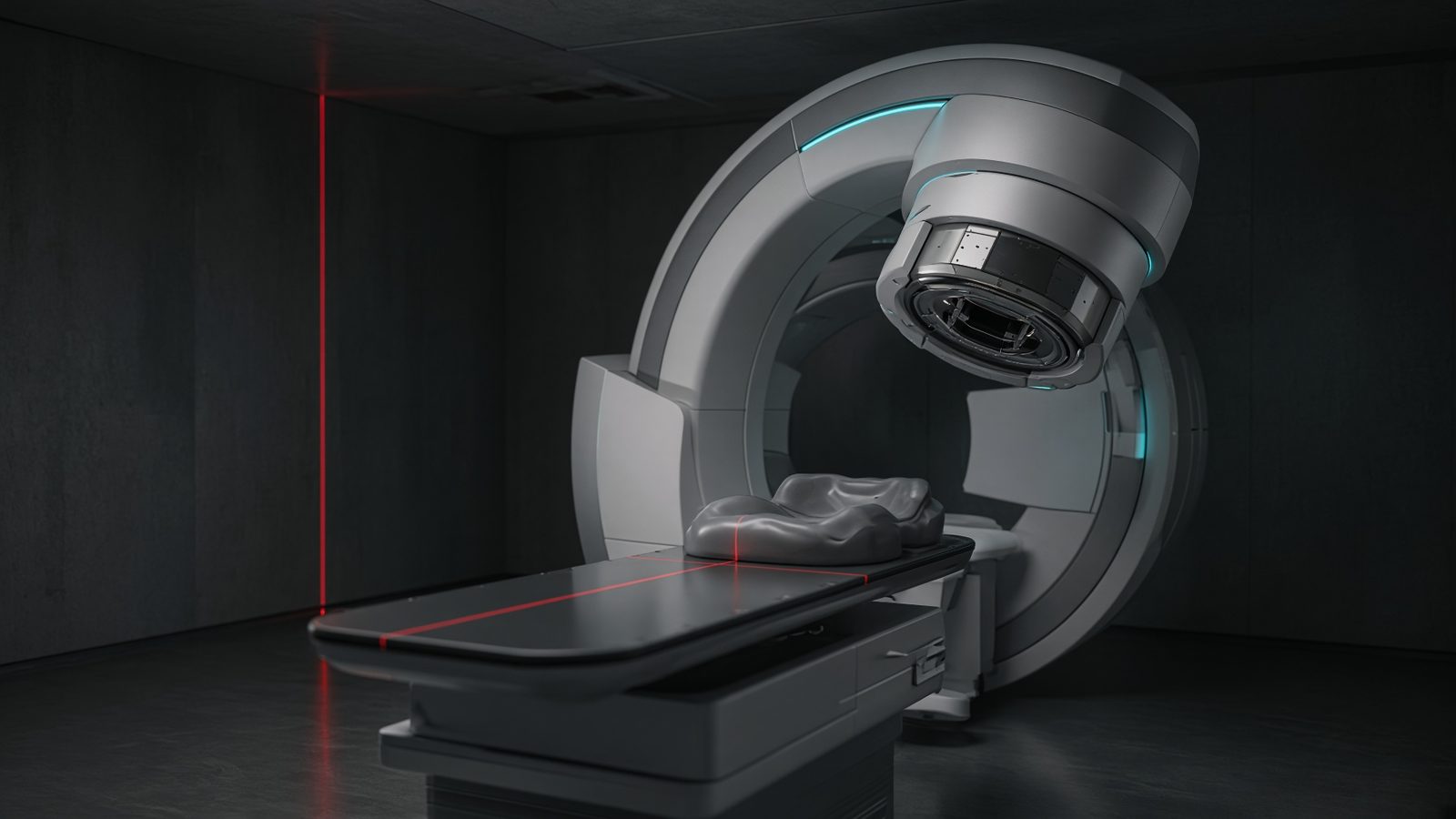
Treatment head
Inside the treatment head: monitor chambers measure output; wedges and leakage live here.
Open this machineFormula
Variables
Results
MU
Monitor units
289.76MU
D/MU
Dose per MU
0.6902cGy/MU
Explanation
What it means
Monitor units for an SSD (fixed-SSD) treatment equal prescribed dose divided by the product of calibration output, PDD/100, and the modifiers Sc, Sp, wedge and tray. If the machine is calibrated to 1 cGy/MU at dmax, 10×10, reference SSD, the formula is the clinical workhorse for non-isocentric setups. This is a working relation in Radiotherapy.
Where it is used
Clinically it sits on the Linear accelerator — Treatment head. Inside the treatment head: monitor chambers measure output; wedges and leakage live here. Radiotherapy equations sit at the console and in the bunker: output, depth dose, equivalent square, and the monitor units that treat the patient. Hand-calc them beside the TPS, never instead of a commissioned plan.
Linear accelerator · Open this machineHow to use it
Set unused factors to 1. Example: 200 cGy, PDD 67%, Sc 1.02, Sp 1.01, cal 1 cGy/MU → MU ≈ 200/(0.67×1.02×1.01) ≈ 288. Always compare with the record-and-verify / TPS MU. Change one input and watch the curve and the simulation follow.
Symbols
- DPrescribed dose200 cGy
- Ḋ_calCalibration output1 cGy/MU
- PDDPercent depth dose67 %
- S_cCollimator scatter1.02
- S_pPhantom scatter1.01
- W_fWedge factor1
- T_fTray factor1
Worked example
A typical case from the default values: D = 200 cGy (Prescribed dose); Ḋ_cal = 1 cGy/MU (Calibration output); PDD = 67 % (Percent depth dose); S_c = 1.02 (Collimator scatter); S_p = 1.01 (Phantom scatter); W_f = 1 (Wedge factor); T_f = 1 (Tray factor). Substituting into the relation gives MU = 289.76 MU; D/MU = 0.6902 cGy/MU. These are teaching numbers — align them with your machine.
Typical values give
- MU = 289.76MU
- D/MU = 0.6902cGy/MU
Where it comes from
The displayed formula is the working relation. MU for a prescribed dose at depth with an SSD setup. Usual reference: Khan / clinical MU calc. Derive it in the specialty lesson, then return here to pin the numbers.
Reference: Khan / clinical MU calc
Assumptions & limits
Does not include inverse-square off the calibration distance unless you fold it into Ḋ_cal. Blocks, bolus, inhomogeneity and IMRT modulation need extra factors or a TPS.
Pitfalls
Never mix PDD from one SSD with TMR from another without converting. Field size at the surface is not the size at isocentre. A hand MU is a check, not a treatment. Does not include inverse-square off the calibration distance unless you fold it into Ḋ_cal. Blocks, bolus, inhomogeneity and IMRT modulation need extra factors or a TPS.
Keep this
D_cal is typically 1 cGy/MU at dmax, 10×10, reference SSD. Set unused factors to 1.
In this specialty