01 Therapy
HDR dwell time (point source)
t = D / [S_K Λ (r₀/r)² g(r) F]. S_K in U, Λ in cGy h⁻¹ U⁻¹.
Listen
Listen · English
Simulation
HDR dwell time (point source) — Change the numbers; the scene follows.
Where it works
Brachytherapy suite
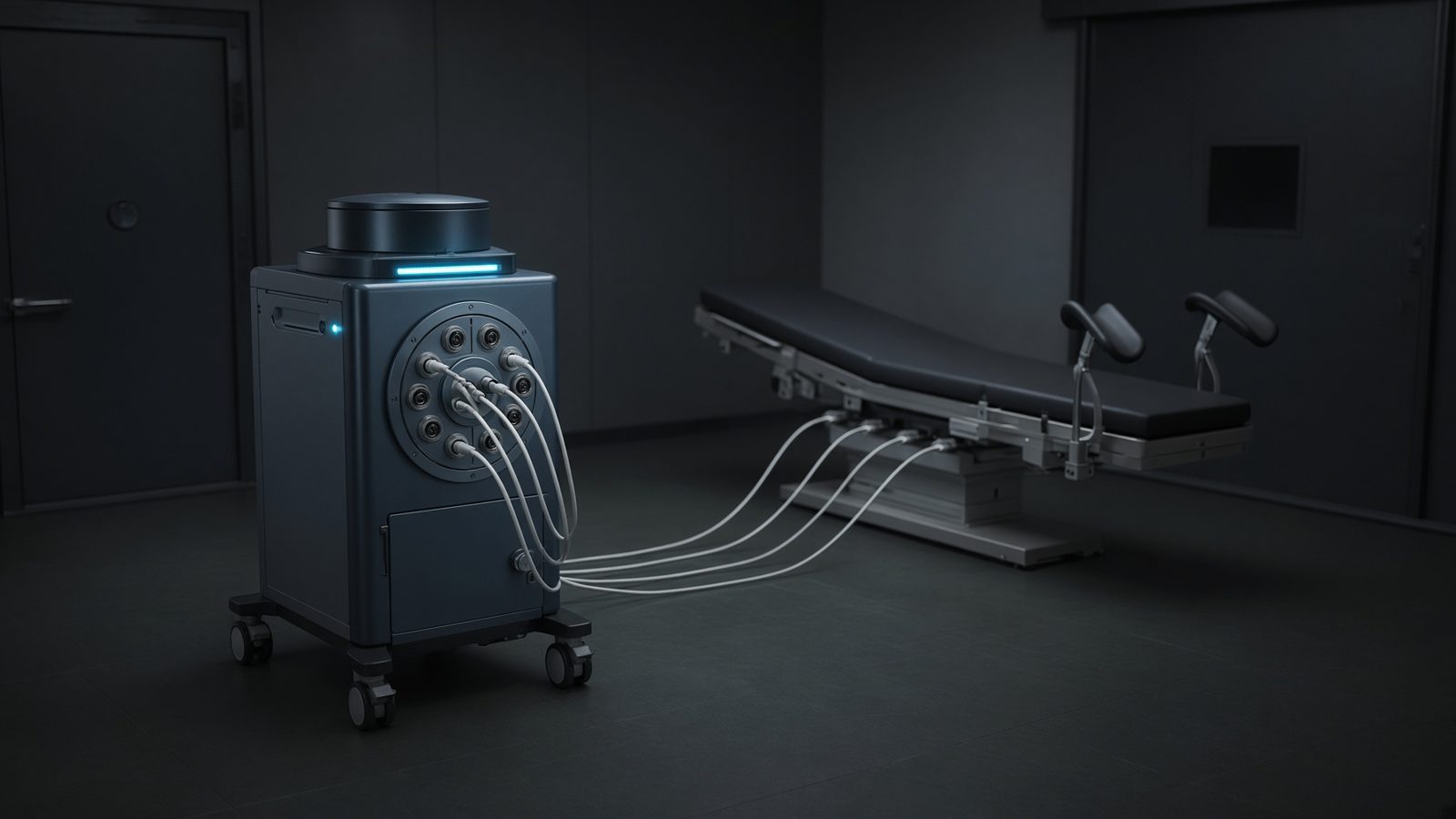
Afterloader
In the afterloader safe: Ir-192 source strength and the dwell-time calculation start here.
Open this machineFormula
Typical values
Variables
Results
Ḋ
Dose rate
45,584cGy/h
Ḋ
Dose rate
12.6622cGy/s
t
Dwell time
39.4875s
t
Dwell time
0.6581min
Explanation
What it means
TG-43 writes dose rate as air-kerma strength × dose-rate constant × geometry × radial × anisotropy. For a point-source approximation G(r) = (r₀/r)² with r₀ = 1 cm, and F≈1 on the transverse axis. Ir-192 Λ ≈ 1.12 cGy h⁻¹ U⁻¹. A 10 Ci source is ~40 700 U and delivers ~12.7 cGy/s at 1 cm — dwells are seconds, not hours. This is a working relation in Radiotherapy.
Where it is used
Clinically it sits on the Brachytherapy suite — Afterloader. In the afterloader safe: Ir-192 source strength and the dwell-time calculation start here. Radiotherapy equations sit at the console and in the bunker: output, depth dose, equivalent square, and the monitor units that treat the patient. Hand-calc them beside the TPS, never instead of a commissioned plan.
Brachytherapy suite · Open this machineHow to use it
Enter dose (cGy), S_K (U), Λ, radius (cm), g(r) and F. Read dose rate and dwell in seconds and minutes. Default Λ = 1.12 (Ir-192), g=1, F=1. Change one input and watch the curve and the simulation follow.
Symbols
- DDose500 cGy
- S_KAir-kerma strength40,700 U
- ΛDose-rate constant1.12 cGy h⁻¹ U⁻¹
- rDistance1 cm
- g(r)Radial function1
- FAnisotropy1
Worked example
A typical case from the default values: D = 500 cGy (Dose); S_K = 40,700 U (Air-kerma strength); Λ = 1.12 cGy h⁻¹ U⁻¹ (Dose-rate constant); r = 1 cm (Distance); g(r) = 1 (Radial function); F = 1 (Anisotropy). Substituting into the relation gives Ḋ = 45,584 cGy/h; Ḋ = 12.6622 cGy/s; t = 39.4875 s; t = 0.6581 min. These are teaching numbers — align them with your machine.
Typical values give
- Ḋ = 45,584cGy/h
- Ḋ = 12.6622cGy/s
- t = 39.4875s
- t = 0.6581min
Where it comes from
The displayed formula is the working relation. t = D / [S_K Λ (r₀/r)² g(r) F]. S_K in U, Λ in cGy h⁻¹ U⁻¹. Usual reference: AAPM TG-43U1. Derive it in the specialty lesson, then return here to pin the numbers.
Reference: AAPM TG-43U1
Assumptions & limits
Point-source geometry only. Line-source G(r,θ), 2D anisotropy and a measured g(r) table are required for clinical dwells. Does not replace the afterloader TPS. Inverse-square diverges as r→0 — keep r ≥ 0.5 cm.
Pitfalls
Never mix PDD from one SSD with TMR from another without converting. Field size at the surface is not the size at isocentre. A hand MU is a check, not a treatment. Point-source geometry only. Line-source G(r,θ), 2D anisotropy and a measured g(r) table are required for clinical dwells. Does not replace the afterloader TPS. Inverse-square diverges as r→0 — keep r ≥ 0.5 cm.
Keep this
Name the SSD, energy, and field size with every PDD or TMR you quote. Point-source geometry only. Line-source G(r,θ), 2D anisotropy and a measured g(r) table are required for clinical dwells. Does not replace the afterloader TPS. Inverse-square diverges as r→0 — keep r ≥ 0.5 cm.
In this specialty