01 Therapy
Electron monitor units
MU = D / [(D/MU)_ref × cutout × insert × SSD factor].
Listen
Listen · English
Simulation
Electron monitor units — Change the numbers; the scene follows.
Where it works
Linear accelerator
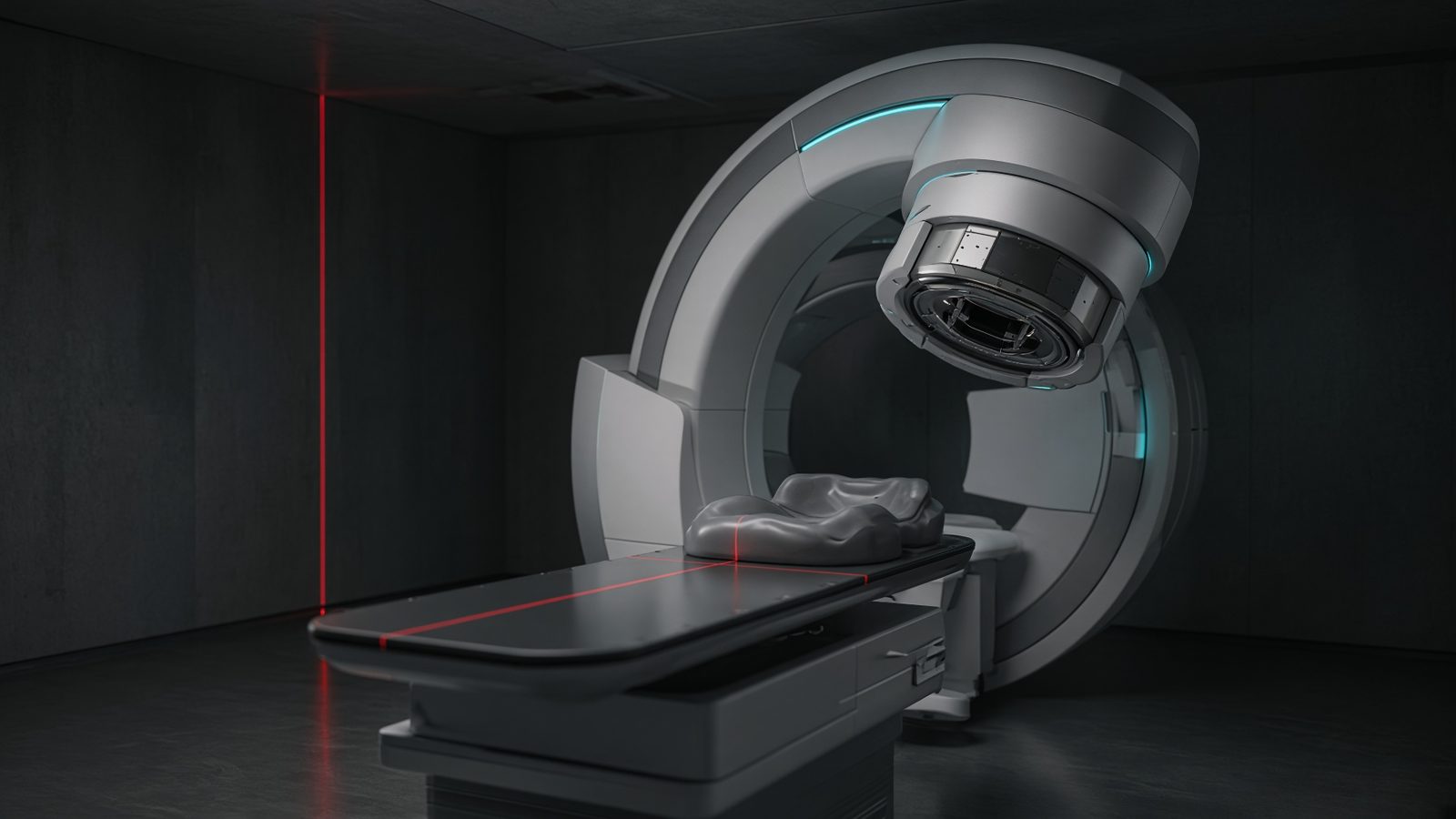
Treatment head
Inside the treatment head: monitor chambers measure output; wedges and leakage live here.
Open this machineFormula
Variables
Results
MU
Monitor units
210.5263MU
Explanation
What it means
Electron output is calibrated at a reference cone (often 10×10 or 15×15) and dmax, 1 cGy/MU. End-user cutouts change output (small cuts under-scatter and can drop 10–20%). An insert/cone factor accounts for the applicator. Extended SSD uses an effective-SSD inverse-square factor, not the nominal 100 cm, because of scatter from the cone. This is a working relation in Radiotherapy.
Where it is used
Clinically it sits on the Linear accelerator — Treatment head. Inside the treatment head: monitor chambers measure output; wedges and leakage live here. Radiotherapy equations sit at the console and in the bunker: output, depth dose, equivalent square, and the monitor units that treat the patient. Hand-calc them beside the TPS, never instead of a commissioned plan.
Linear accelerator · Open this machineHow to use it
Set unused factors to 1. Example: 200 cGy, cal 1 cGy/MU, cutout 0.92, cone 1.00, F_SSD 0.96 → MU ≈ 226. Verify against the departmental cutout-factor curve. Change one input and watch the curve and the simulation follow.
Symbols
- DPrescribed dose200 cGy
- D/MUCalibration1 cGy/MU
- C_cutCutout factor0.95
- C_insCone / insert factor1
- F_SSDEffective-SSD factor1
Worked example
A typical case from the default values: D = 200 cGy (Prescribed dose); D/MU = 1 cGy/MU (Calibration); C_cut = 0.95 (Cutout factor); C_ins = 1 (Cone / insert factor); F_SSD = 1 (Effective-SSD factor). Substituting into the relation gives MU = 210.5263 MU. These are teaching numbers — align them with your machine.
Typical values give
- MU = 210.5263MU
Where it comes from
The displayed formula is the working relation. MU = D / [(D/MU)_ref × cutout × insert × SSD factor]. Usual reference: Khan Ch. 14 / AAPM TG-70. Derive it in the specialty lesson, then return here to pin the numbers.
Reference: Khan Ch. 14 / AAPM TG-70
Assumptions & limits
Does not compute the cutout factor (needs measured data or a sector-integration / VMC model). Bolus, bone heterogeneity and obliquity are extra. Never use photon PDD/TMR for electrons.
Pitfalls
Never mix PDD from one SSD with TMR from another without converting. Field size at the surface is not the size at isocentre. A hand MU is a check, not a treatment. Does not compute the cutout factor (needs measured data or a sector-integration / VMC model). Bolus, bone heterogeneity and obliquity are extra. Never use photon PDD/TMR for electrons.
Keep this
Name the SSD, energy, and field size with every PDD or TMR you quote. Does not compute the cutout factor (needs measured data or a sector-integration / VMC model). Bolus, bone heterogeneity and obliquity are extra. Never use photon PDD/TMR for electrons.
In this specialty