05 Biology
Ellis NSD (historical)
NSD = D N^{−0.24} T^{−0.11}. Historical isoeffect, superseded by LQ.
Listen
Listen · English
Simulation
Ellis NSD (historical) — Change the numbers; the scene follows.
Where it works
Linear accelerator
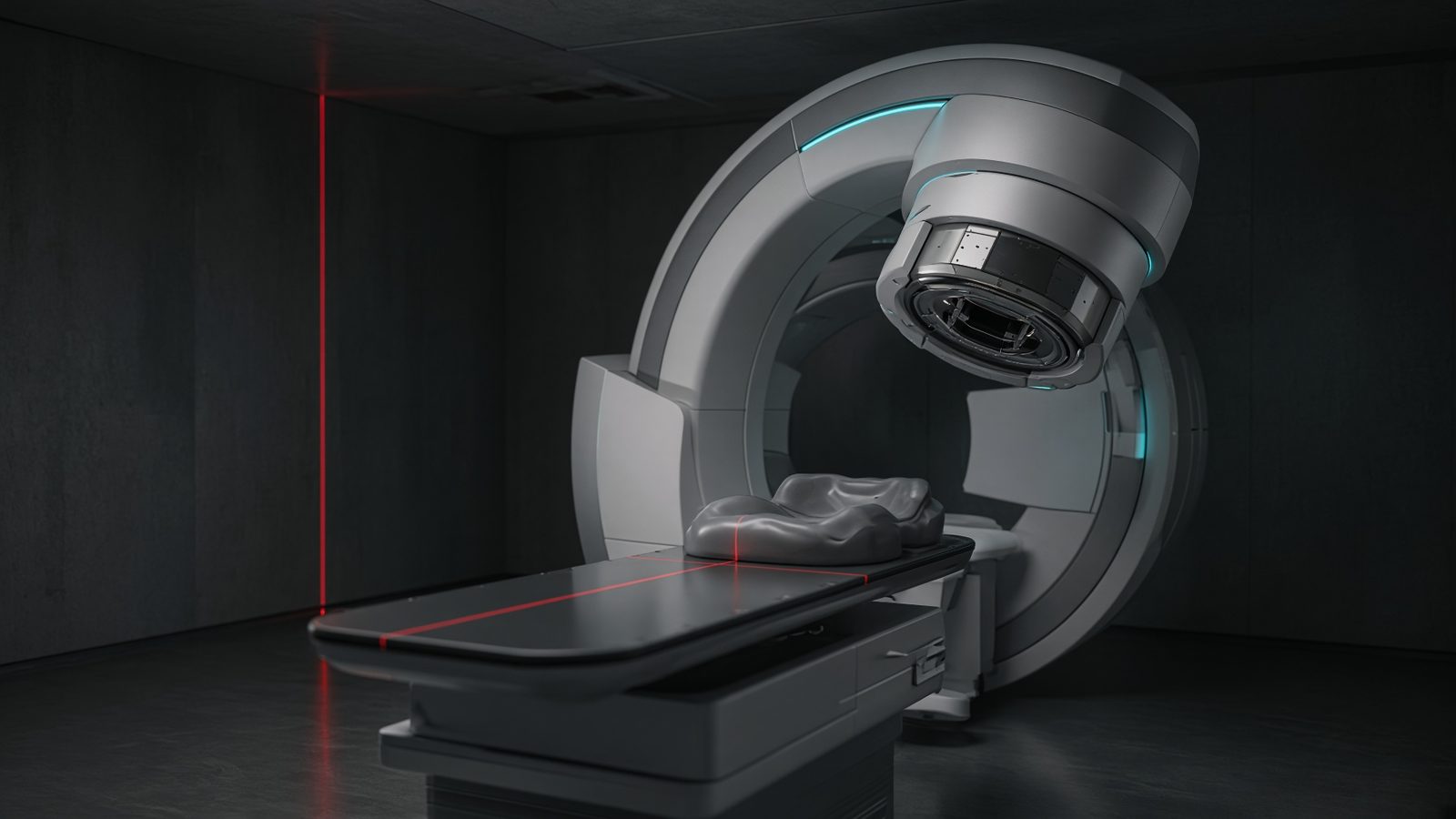
Isocenter
In the treated volume — tumour and OARs at isocenter, after the dose has been delivered.
Open this machineFormula
Variables
Results
NSD
Nominal standard dose
17.6773ret
Explanation
What it means
Nominal standard dose was the 1960s language of isoeffect: a 60 Gy / 30 fx / 6 week course is 1800 ret. The N^{−0.24} term is fractionation, T^{−0.11} is overall time (repopulation). It treated all tissues as one, overweighted time for late effects, and is not used for prescription today. You will still meet it in old notes and in TDF tables — compute it so you can translate, then redo the problem in BED/EQD2. This is a working relation in Radiobiology.
Where it is used
Clinically it sits on the Linear accelerator — Isocenter. In the treated volume — tumour and OARs at isocenter, after the dose has been delivered. Radiobiology sits between the prescription and the organ-at-risk: LQ, BED, EQD2, and why 2 Gy is not 2 Gy if the fraction size changed. Use it to compare regimens, not to invent one.
Linear accelerator · Open this machineHow to use it
Enter total dose D (Gy), number of fractions N and overall time T (days). 60 Gy, 30 fx, 40 days → NSD ≈ 1770 ret. Change one input and watch the curve and the simulation follow.
Symbols
- DTotal dose60 Gy
- NFractions30
- TOverall time40 d
Worked example
A typical case from the default values: D = 60 Gy (Total dose); N = 30 (Fractions); T = 40 d (Overall time). Substituting into the relation gives NSD = 17.6773 ret. These are teaching numbers — align them with your machine.
Typical values give
- NSD = 17.6773ret
Where it comes from
The displayed formula is the working relation. NSD = D N^{−0.24} T^{−0.11}. Historical isoeffect, superseded by LQ. Usual reference: Ellis 1969. Derive it in the specialty lesson, then return here to pin the numbers.
Reference: Ellis 1969
Assumptions & limits
Not valid below ~4 fractions or for late-responding tissues. T must count the treatment span, not N−1 blindly if there are gaps. Do not use for SBRT, protons, or any modern constraint.
Pitfalls
α/β is a model parameter, not a measured organ. BED from incomplete repair or a changed overall time is not the simple n·d·(1+d/(α/β)). Never EQD2 a stereotactic dose with an α/β you did not state. Not valid below ~4 fractions or for late-responding tissues. T must count the treatment span, not N−1 blindly if there are gaps. Do not use for SBRT, protons, or any modern constraint.
Keep this
Always write α/β and the fraction size next to a BED or EQD2. Not valid below ~4 fractions or for late-responding tissues. T must count the treatment span, not N−1 blindly if there are gaps. Do not use for SBRT, protons, or any modern constraint.
In this specialty