05 Biology
Quasi-threshold Dq
Dq = D₀ ln n = D₀ ln(n). Width of the survival-curve shoulder.
Listen
Listen · English
Simulation
Quasi-threshold Dq — Change the numbers; the scene follows.
Where it works
Linear accelerator
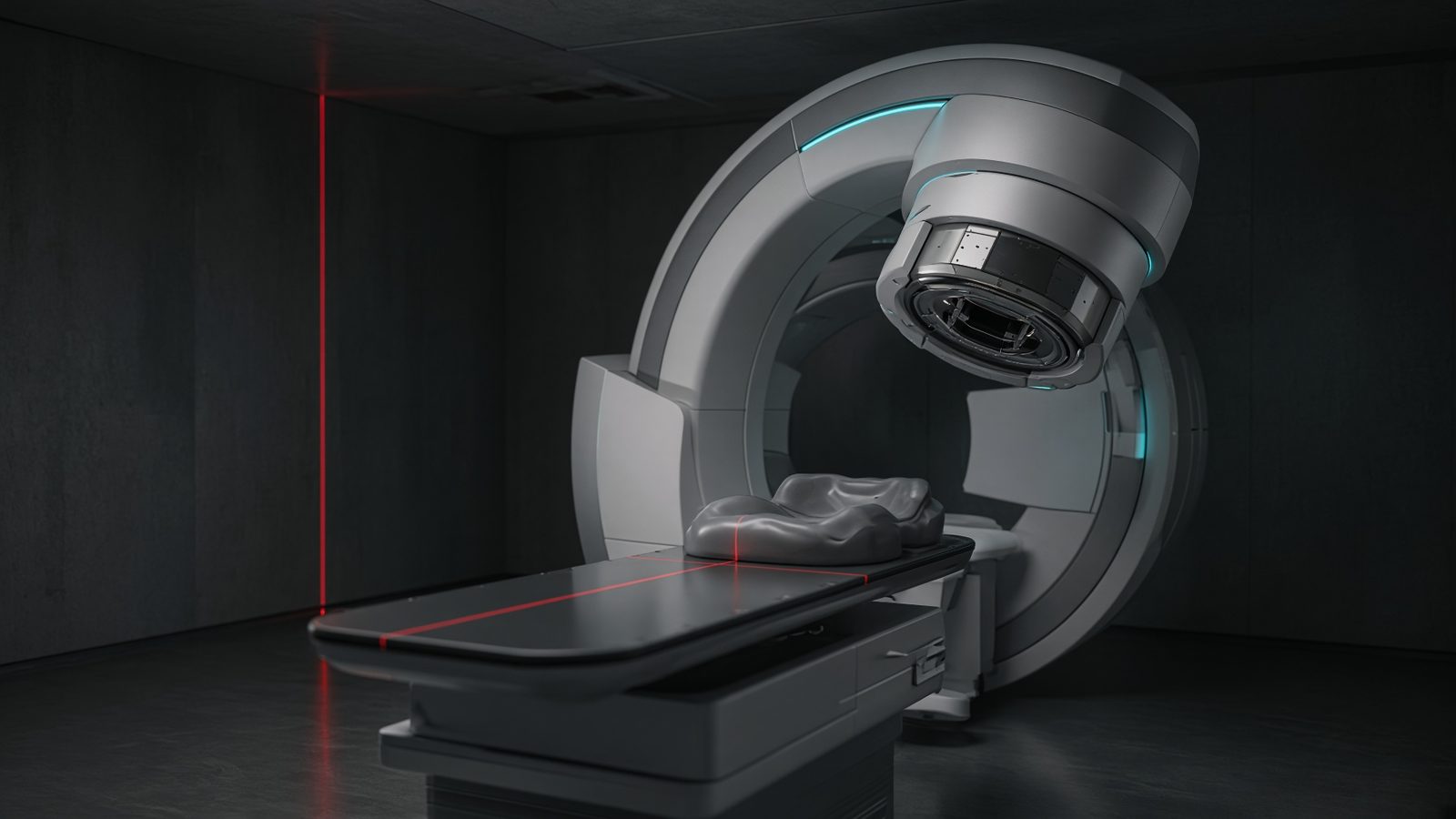
Isocenter
In the treated volume — tumour and OARs at isocenter, after the dose has been delivered.
Open this machineFormula
Variables
Results
D_q
Quasi-threshold
1.6479Gy
ln n
ln n
1.0986
Explanation
What it means
Dq is the intercept of the terminal exponential with the SF=1 axis — a one-number summary of the shoulder. Broad shoulders (large Dq) mean the tissue (or cell line) repairs sublethal damage well and will be spared by fractionation; narrow shoulders (late-responding? actually the opposite in LQ language — late tissues have small α/β i.e. more curvature). Use it when reading an old paper that quotes D₀ and n instead of α, β. This is a working relation in Radiobiology.
Where it is used
Clinically it sits on the Linear accelerator — Isocenter. In the treated volume — tumour and OARs at isocenter, after the dose has been delivered. Radiobiology sits between the prescription and the organ-at-risk: LQ, BED, EQD2, and why 2 Gy is not 2 Gy if the fraction size changed. Use it to compare regimens, not to invent one.
Linear accelerator · Open this machineHow to use it
Enter D₀ and n. A cell line with D₀ = 1.5 Gy, n = 3 has Dq = 1.65 Gy. Inverse: n = exp(Dq/D₀). Change one input and watch the curve and the simulation follow.
Symbols
- D_0D01.5 Gy
- nExtrapolation number3
Worked example
A typical case from the default values: D_0 = 1.5 Gy (D0); n = 3 (Extrapolation number). Substituting into the relation gives D_q = 1.6479 Gy; ln n = 1.0986. These are teaching numbers — align them with your machine.
Typical values give
- D_q = 1.6479Gy
- ln n = 1.0986
Where it comes from
The displayed formula is the working relation. Dq = D₀ ln n = D₀ ln(n). Width of the survival-curve shoulder. Usual reference: Hall. Derive it in the specialty lesson, then return here to pin the numbers.
Reference: Hall
Assumptions & limits
Defined only for the multi-target model. LQ has no Dq; the initial slope is α and the curvature is β.
Pitfalls
α/β is a model parameter, not a measured organ. BED from incomplete repair or a changed overall time is not the simple n·d·(1+d/(α/β)). Never EQD2 a stereotactic dose with an α/β you did not state. Defined only for the multi-target model. LQ has no Dq; the initial slope is α and the curvature is β.
Keep this
Always write α/β and the fraction size next to a BED or EQD2. Defined only for the multi-target model. LQ has no Dq; the initial slope is α and the curvature is β.
In this specialty