05 Biology
Single-hit multi-target SF
SF = 1 − (1 − e^{−D/D₀})^n. Shoulder characterised by n and Dq = D₀ ln n.
Listen
Listen · English
Simulation
Single-hit multi-target SF — Change the numbers; the scene follows.
Where it works
Linear accelerator
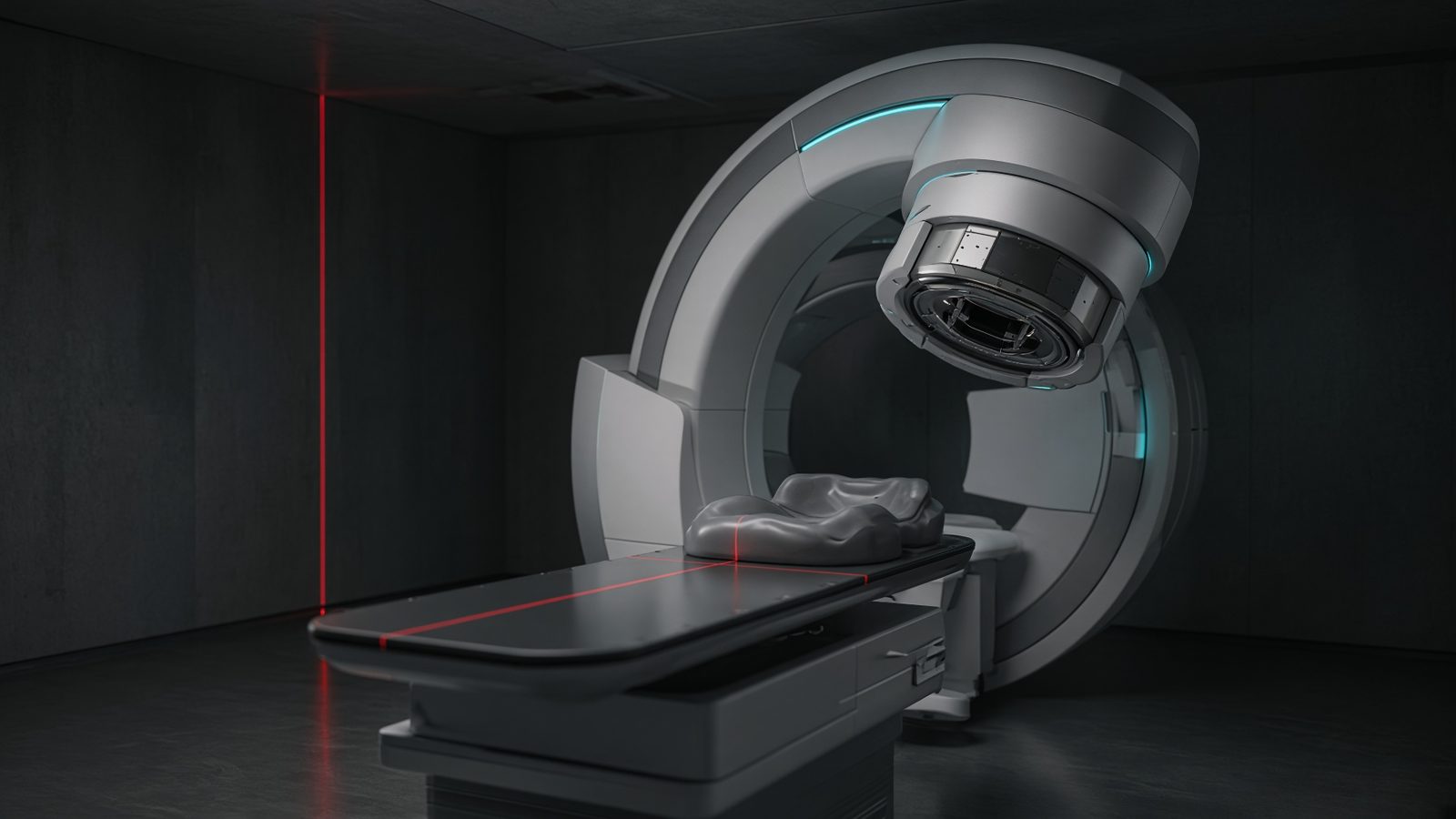
Isocenter
In the treated volume — tumour and OARs at isocenter, after the dose has been delivered.
Open this machineFormula
Variables
Results
SF
Surviving fraction
0.01203
D_q
Shoulder width
1.3744Gy
−ln S
−ln S
4.4207
Curve
Explanation
What it means
Before LQ, clonogenic survival was fit by a single-hit multi-target model: n targets must each take a hit. The curve has a shoulder (width Dq) then an exponential of slope −1/D₀. n is the extrapolation number (2–5 for many lines). LQ replaced it because the shoulder is better described by βD² and because the multi-target model predicts zero initial slope, contradicting low-dose data. Still used to read D₀ off a published curve. This is a working relation in Radiobiology.
Where it is used
Clinically it sits on the Linear accelerator — Isocenter. In the treated volume — tumour and OARs at isocenter, after the dose has been delivered. Radiobiology sits between the prescription and the organ-at-risk: LQ, BED, EQD2, and why 2 Gy is not 2 Gy if the fraction size changed. Use it to compare regimens, not to invent one.
Linear accelerator · Open this machineHow to use it
Enter D, D₀ (Gy) and n. Read SF, Dq and D10 (dose for SF=0.1, solved iteratively on the graph). Typical mammalian D₀ 1–2 Gy. Change one input and watch the curve and the simulation follow.
Symbols
- DDose8 Gy
- D_0D0 (terminal 37%)1.5 Gy
- nExtrapolation number2.5
Worked example
A typical case from the default values: D = 8 Gy (Dose); D_0 = 1.5 Gy (D0 (terminal 37%)); n = 2.5 (Extrapolation number). Substituting into the relation gives SF = 0.01203; D_q = 1.3744 Gy; −ln S = 4.4207. These are teaching numbers — align them with your machine.
Typical values give
- SF = 0.01203
- D_q = 1.3744Gy
- −ln S = 4.4207
Where it comes from
The displayed formula is the working relation. SF = 1 − (1 − e^{−D/D₀})^n. Shoulder characterised by n and Dq = D₀ ln n. Usual reference: Hall / Elkind. Derive it in the specialty lesson, then return here to pin the numbers.
Reference: Hall / Elkind
Assumptions & limits
Equal targets, no repair during irradiation (acute dose). Does not include time, OER or RBE. Prefer LQ (the SF calculator) for modern isoeffect.
Pitfalls
α/β is a model parameter, not a measured organ. BED from incomplete repair or a changed overall time is not the simple n·d·(1+d/(α/β)). Never EQD2 a stereotactic dose with an α/β you did not state. Equal targets, no repair during irradiation (acute dose). Does not include time, OER or RBE. Prefer LQ (the SF calculator) for modern isoeffect.
Keep this
Always write α/β and the fraction size next to a BED or EQD2. Equal targets, no repair during irradiation (acute dose). Does not include time, OER or RBE. Prefer LQ (the SF calculator) for modern isoeffect.
In this specialty