05 Biology
BED with time factor
Subtract repopulation after kick-off time Tk.
Listen
Listen · English
Simulation
BED with time factor — Change the numbers; the scene follows.
Where it works
Linear accelerator
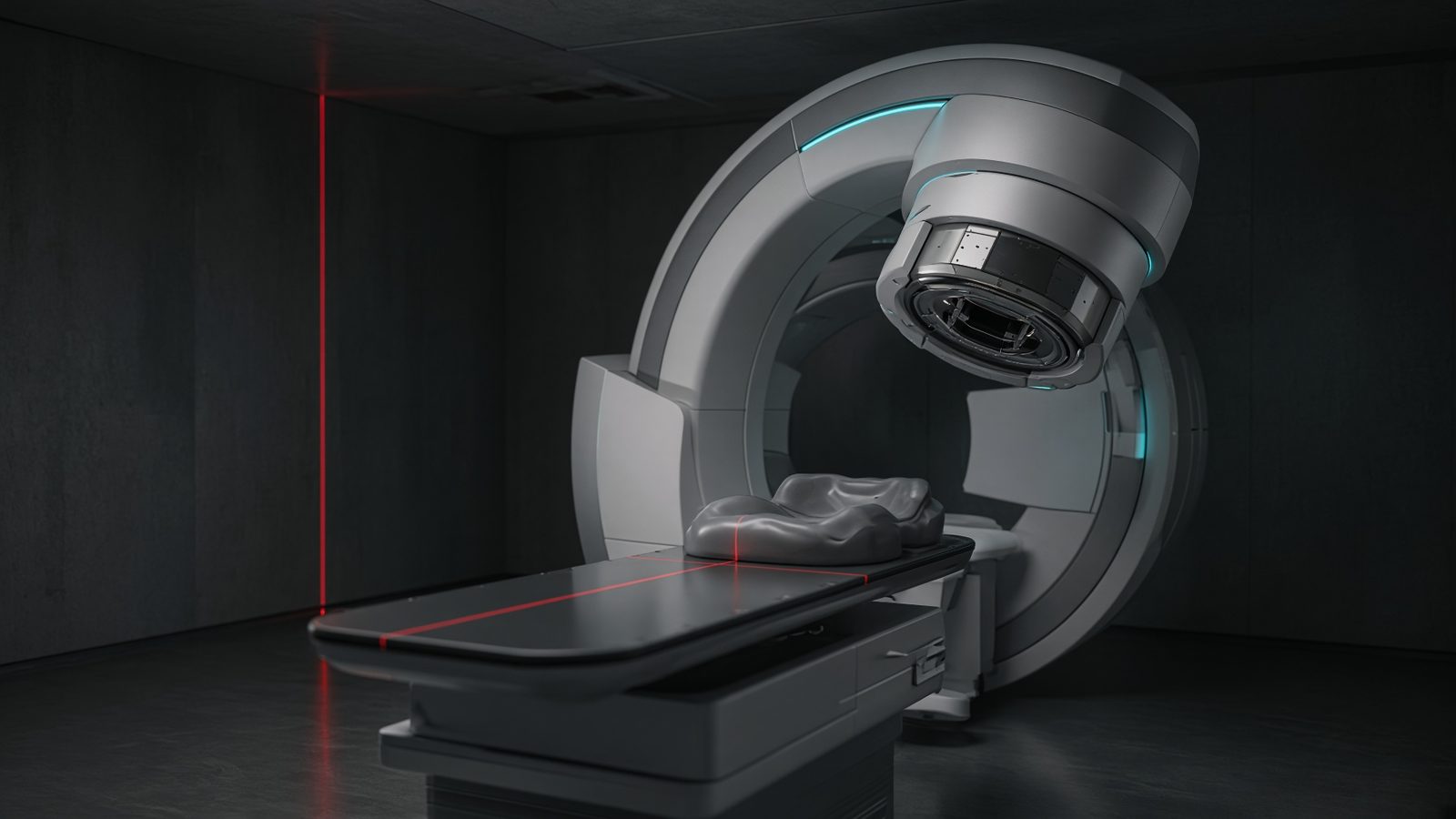
Isocenter
In the treated volume — tumour and OARs at isocenter, after the dose has been delivered.
Open this machineFormula
Variables
Results
BED₀
Without time factor
84Gy
Δ
Repopulation subtraction
11.5525Gy
BED
With time factor
72.4475Gy
Explanation
What it means
Protracted schedules lose BED to tumour repopulation after a kick-off time T_k (often ~21 days for H&N). The subtraction is (ln2)/(α T_p) × (T−T_k). Accelerated regimes recover that term. This is a working relation in Radiobiology.
Where it is used
Clinically it sits on the Linear accelerator — Isocenter. In the treated volume — tumour and OARs at isocenter, after the dose has been delivered. Radiobiology sits between the prescription and the organ-at-risk: LQ, BED, EQD2, and why 2 Gy is not 2 Gy if the fraction size changed. Use it to compare regimens, not to invent one.
Linear accelerator · Open this machineHow to use it
H&N: T_p ~ 4–5 days, α ~ 0.3 Gy⁻¹, T_k ~ 21 d. A 7-week 70 Gy course loses ~10–15 Gy₁₀ of BED relative to a short course with the same physical dose. Change one input and watch the curve and the simulation follow.
Symbols
- nNumber of fractions35
- dDose per fraction2 Gy
- α/βAlpha/beta10 Gy
- αLinear coefficient0.3 Gy⁻¹
- TOverall time46 day
- T_kKick-off time21 day
- T_pPotential doubling time5 day
Worked example
A typical case from the default values: n = 35 (Number of fractions); d = 2 Gy (Dose per fraction); α/β = 10 Gy (Alpha/beta); α = 0.3 Gy⁻¹ (Linear coefficient); T = 46 day (Overall time); T_k = 21 day (Kick-off time); T_p = 5 day (Potential doubling time). Substituting into the relation gives BED₀ = 84 Gy; Δ = 11.5525 Gy; BED = 72.4475 Gy. These are teaching numbers — align them with your machine.
Typical values give
- BED₀ = 84Gy
- Δ = 11.5525Gy
- BED = 72.4475Gy
Where it comes from
The displayed formula is the working relation. Subtract repopulation after kick-off time Tk. Usual reference: Fowler. Derive it in the specialty lesson, then return here to pin the numbers.
Reference: Fowler
Assumptions & limits
Applies to tumour (early) BED, not late normal tissue (which does not repopulate on this time scale). Weekend gaps are inside T. T_p is notoriously uncertain.
Pitfalls
α/β is a model parameter, not a measured organ. BED from incomplete repair or a changed overall time is not the simple n·d·(1+d/(α/β)). Never EQD2 a stereotactic dose with an α/β you did not state. Applies to tumour (early) BED, not late normal tissue (which does not repopulate on this time scale). Weekend gaps are inside T. T_p is notoriously uncertain.
Keep this
No subtraction if T ≤ Tk. Tp is potential doubling time.
In this specialty