08 Ultrasound
PW Doppler aliasing limit
Nyquist velocity = PRF × c / (4 f₀ cosθ). Raise PRF, drop f₀, or switch to CW to un-alias.
Listen
Listen · English
Simulation
PW Doppler aliasing limit — Change the numbers; the scene follows.
Where it works
Ultrasound
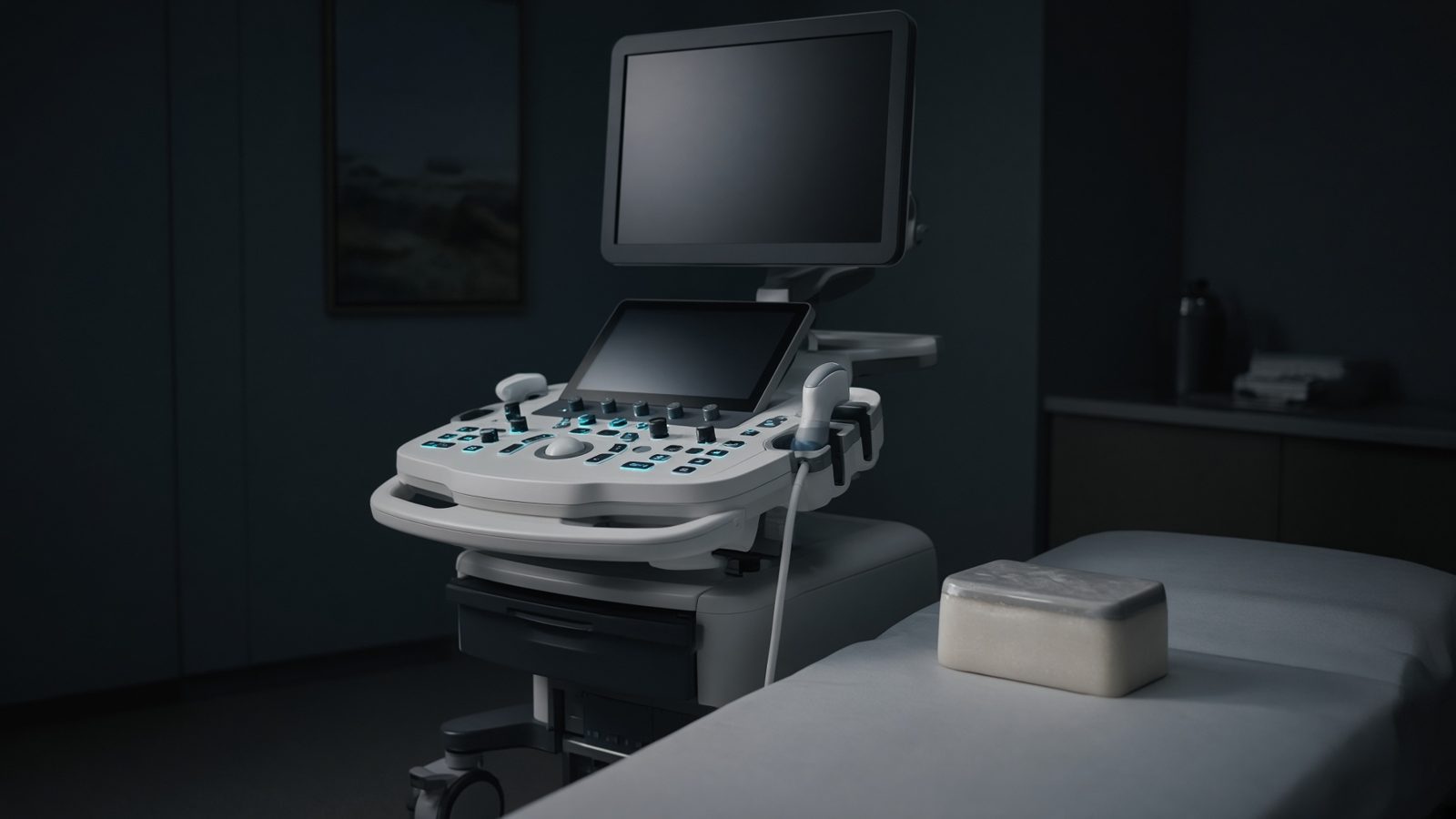
Console
On the console — depth (13 µs/cm), PRF, frame rate, dynamic range, aliasing limit.
Open this machineFormula
Variables
Results
v_Nyq
Nyquist velocity
1.155m/s
v_Nyq
Nyquist velocity
115.5cm/s
PRF/2
Max Doppler shift
3,000Hz
Curve
Explanation
What it means
Pulsed Doppler samples the RF at PRF, so the Doppler shift aliases above PRF/2. Translating f_D = 2 v f₀ cosθ / c gives a maximum unambiguous velocity PRF c / (4 f₀ cosθ). Deep sample volume forces a low PRF (wait for the echo) and is exactly when the jet aliases — the reason we keep a CW probe on the echo cart. Baseline shift buys you almost 2× in one direction at the cost of the other. This is a working relation in Ultrasound.
Where it is used
Clinically it sits on the Ultrasound — Console. On the console — depth (13 µs/cm), PRF, frame rate, dynamic range, aliasing limit. Ultrasound equations sit on the probe face and along the beam: impedance, Snell, Doppler, MI and TI. They explain why gel matters, why aliasing appears, and why a mechanical index is on the screen.
Ultrasound · Open this machineHow to use it
Enter PRF (kHz), centre frequency (MHz), angle (0 = aligned) and c (1540 m/s). 6 kHz, 2 MHz, 0° → v_Nyq ≈ 1.16 m/s. A 4 m/s AS jet will alias — use CW. Change one input and watch the curve and the simulation follow.
Symbols
- PRFPulse repetition frequency6 kHz
- f_0Transducer frequency2 MHz
- θDoppler angle0 °
- cSpeed of sound1,540 m/s
Worked example
A typical case from the default values: PRF = 6 kHz (Pulse repetition frequency); f_0 = 2 MHz (Transducer frequency); θ = 0 ° (Doppler angle); c = 1,540 m/s (Speed of sound). Substituting into the relation gives v_Nyq = 1.155 m/s; v_Nyq = 115.5 cm/s; PRF/2 = 3,000 Hz. These are teaching numbers — align them with your machine.
Typical values give
- v_Nyq = 1.155m/s
- v_Nyq = 115.5cm/s
- PRF/2 = 3,000Hz
Where it comes from
The displayed formula is the working relation. Nyquist velocity = PRF × c / (4 f₀ cosθ). Raise PRF, drop f₀, or switch to CW to un-alias. Usual reference: Edelman / Kremkau. Derive it in the specialty lesson, then return here to pin the numbers.
Reference: Edelman / Kremkau
Assumptions & limits
Single-gate PW, constant PRF, no HPRF (multi-gate) mode. Angle in the denominator: 60° already halves the Nyquist velocity, which is why we stay < 20° in vascular work when we can.
Pitfalls
Soft-tissue 1540 m/s is an assumption — not a measurement in that patient. Doppler angle 90° gives no shift. MI and TI are on-screen estimates, not absorbed dose. Single-gate PW, constant PRF, no HPRF (multi-gate) mode. Angle in the denominator: 60° already halves the Nyquist velocity, which is why we stay < 20° in vascular work when we can.
Keep this
Gel, angle, and assumed speed of sound — get those three right before you trust a centimetre. Single-gate PW, constant PRF, no HPRF (multi-gate) mode. Angle in the denominator: 60° already halves the Nyquist velocity, which is why we stay < 20° in vascular work when we can.
In this specialty