06 Dose
TG-43 point-source dose rate
Ḋ(r) = S_K Λ (r₀/r)² g(r) F, with r₀ = 1 cm.
Listen
Listen · English
Simulation
TG-43 point-source dose rate — Change the numbers; the scene follows.
Where it works
Brachytherapy suite
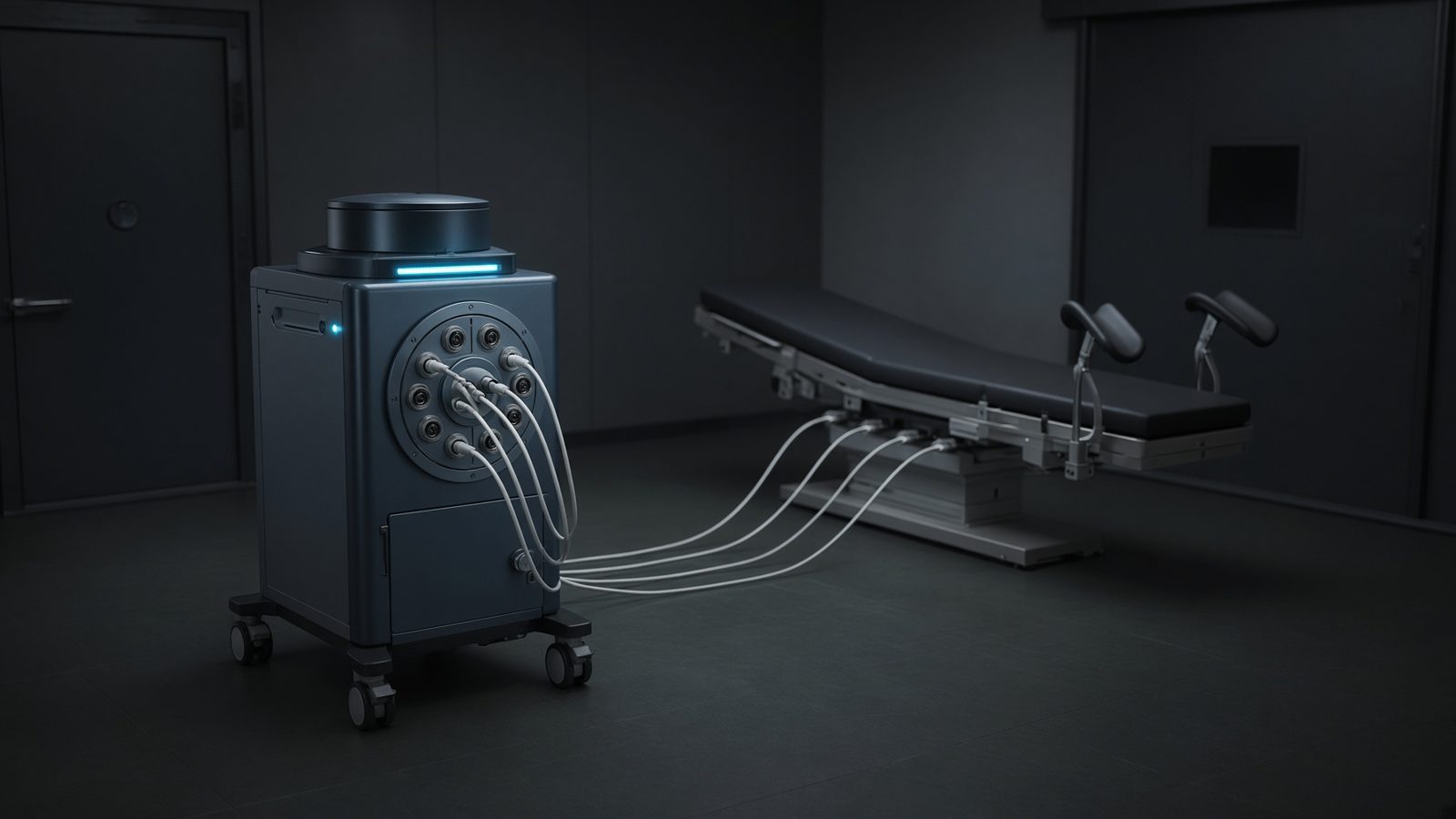
Applicator / dwell
Around the dwell in the applicator — TG-43 dose to tissue a few centimetres out.
Open this machineFormula
Variables
Results
Ḋ
Dose rate
44,800cGy/h
D
Dose
124.4444cGy
Explanation
What it means
AAPM TG-43 writes brachytherapy dose rate as S_K × Λ × geometry × g(r) × F(r,θ). For a point source the geometry is (r₀/r)² with r₀ = 1 cm. Λ for Ir-192 is about 1.12 cGy h⁻¹ U⁻¹. This is a working relation in Dosimetry.
Where it is used
Clinically it sits on the Brachytherapy suite — Applicator / dwell. Around the dwell in the applicator — TG-43 dose to tissue a few centimetres out. Dosimetry is the chamber in water under the linac, or the well counter in the hot lab: TG-51, TRS-398, kerma, and recombination. These numbers are the calibration the rest of the department borrows.
Brachytherapy suite · Open this machineHow to use it
Set g = F = 1 for an isotropic point in water — a dwell check, not a plan. Multiply Ḋ by dwell time (hours) for cGy. Pair with Ir-192 decay for today’s S_K. Change one input and watch the curve and the simulation follow.
Symbols
- S_KAir-kerma strength40,000 U
- ΛDose-rate constant1.12 cGy h⁻¹ U⁻¹
- rDistance1 cm
- g(r)Radial dose function1
- FAnisotropy function1
- tDwell time10 s
Worked example
A typical case from the default values: S_K = 40,000 U (Air-kerma strength); Λ = 1.12 cGy h⁻¹ U⁻¹ (Dose-rate constant); r = 1 cm (Distance); g(r) = 1 (Radial dose function); F = 1 (Anisotropy function); t = 10 s (Dwell time). Substituting into the relation gives Ḋ = 44,800 cGy/h; D = 124.4444 cGy. These are teaching numbers — align them with your machine.
Typical values give
- Ḋ = 44,800cGy/h
- D = 124.4444cGy
Where it comes from
The displayed formula is the working relation. Ḋ(r) = S_K Λ (r₀/r)² g(r) F, with r₀ = 1 cm. Usual reference: AAPM TG-43U1. Derive it in the specialty lesson, then return here to pin the numbers.
Reference: AAPM TG-43U1
Assumptions & limits
No applicator wall, no heterogeneity (TG-186), no inter-seed attenuation. Line-source G_L(r,θ) differs from 1/r² near a 4.5 mm HDR source.
Pitfalls
kQ is for that chamber and that beam quality — not a neighbour's value. Polarity and recombination are measured, not copied. A ⁶⁰Co N_D,w is not an MV calibration until kQ is applied. No applicator wall, no heterogeneity (TG-186), no inter-seed attenuation. Line-source G_L(r,θ) differs from 1/r² near a 4.5 mm HDR source.
Keep this
S_K in U ≡ cGy cm² h⁻¹. Λ for Ir-192 ≈ 1.12 cGy h⁻¹ U⁻¹. Set g = F = 1 for isotropic water.
In this specialty