06 Dose
Bragg-Gray relation
Medium dose from gas dose and the mass stopping-power ratio.
Listen
Listen · English
Simulation
Bragg-Gray relation — Change the numbers; the scene follows.
Where it works
Water phantom
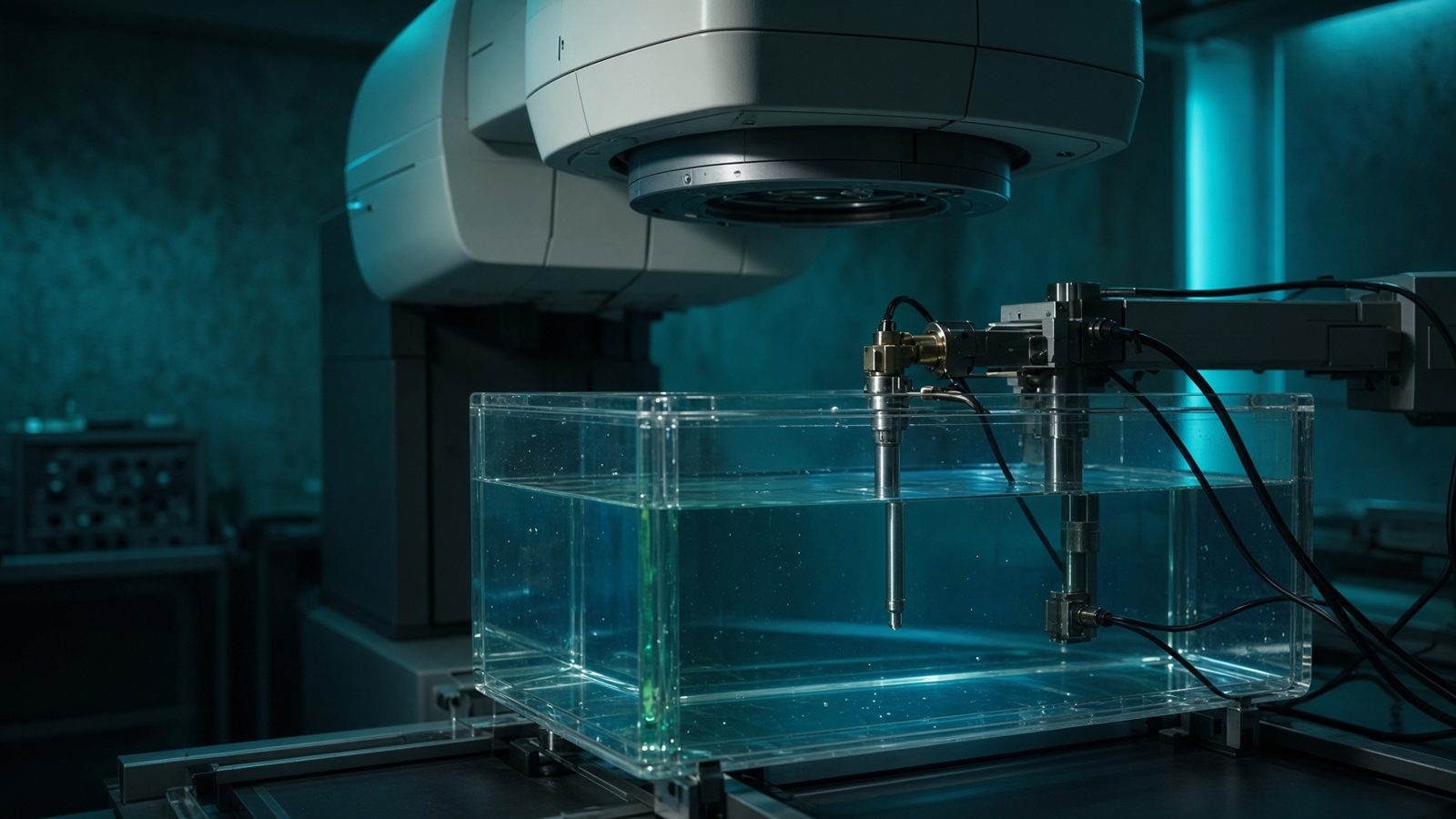
Ion chamber
In the water tank under the linac, at the ion chamber — reference dosimetry happens here.
Open this machineFormula
Variables
Results
D_med
Medium dose
0.0113Gy
Explanation
What it means
Bragg–Gray cavity theory: if a gas cavity is small enough not to perturb the electron fluence, dose to the medium is dose to the gas times the stopping-power ratio medium/gas. It is the ancestor of TG-21 and of every ion-chamber factor. This is a working relation in Dosimetry.
Where it is used
Clinically it sits on the Water phantom — Ion chamber. In the water tank under the linac, at the ion chamber — reference dosimetry happens here. Dosimetry is the chamber in water under the linac, or the well counter in the hot lab: TG-51, TRS-398, kerma, and recombination. These numbers are the calibration the rest of the department borrows.
Water phantom · Open this machineHow to use it
Enter D_gas (from charge, mass, W/e) and the Spencer-Attix stopping-power ratio. For water/air at Co-60, (L/ρ) ≈ 1.11. Spencer-Attix (restricted) is preferred over unrestricted Bragg–Gray at radiotherapy energies. Change one input and watch the curve and the simulation follow.
Symbols
- D_gasGas dose0.01 Gy
- (S/ρ)Stopping-power ratio1.127
Worked example
A typical case from the default values: D_gas = 0.01 Gy (Gas dose); (S/ρ) = 1.127 (Stopping-power ratio). Substituting into the relation gives D_med = 0.0113 Gy. These are teaching numbers — align them with your machine.
Typical values give
- D_med = 0.0113Gy
Where it comes from
The displayed formula is the working relation. Medium dose from gas dose and the mass stopping-power ratio. Usual reference: Attix / ICRU. Derive it in the specialty lesson, then return here to pin the numbers.
Reference: Attix / ICRU
Assumptions & limits
Charged-particle equilibrium or a known fluence perturbation. Fails for very large cavities, low-density media, and at interfaces. Burlin theory interpolates large cavities.
Pitfalls
kQ is for that chamber and that beam quality — not a neighbour's value. Polarity and recombination are measured, not copied. A ⁶⁰Co N_D,w is not an MV calibration until kQ is applied. Charged-particle equilibrium or a known fluence perturbation. Fails for very large cavities, low-density media, and at interfaces. Burlin theory interpolates large cavities.
Keep this
Trace every gray back to a protocol, a chamber, and a quality index. Charged-particle equilibrium or a known fluence perturbation. Fails for very large cavities, low-density media, and at interfaces. Burlin theory interpolates large cavities.
In this specialty