06 Dose
Electron range in water
Approximate range: E/2 rule of thumb or Katz-Penfold by energy.
Listen
Listen · English
Simulation
Electron range in water — Change the numbers; the scene follows.
Where it works
Water phantom
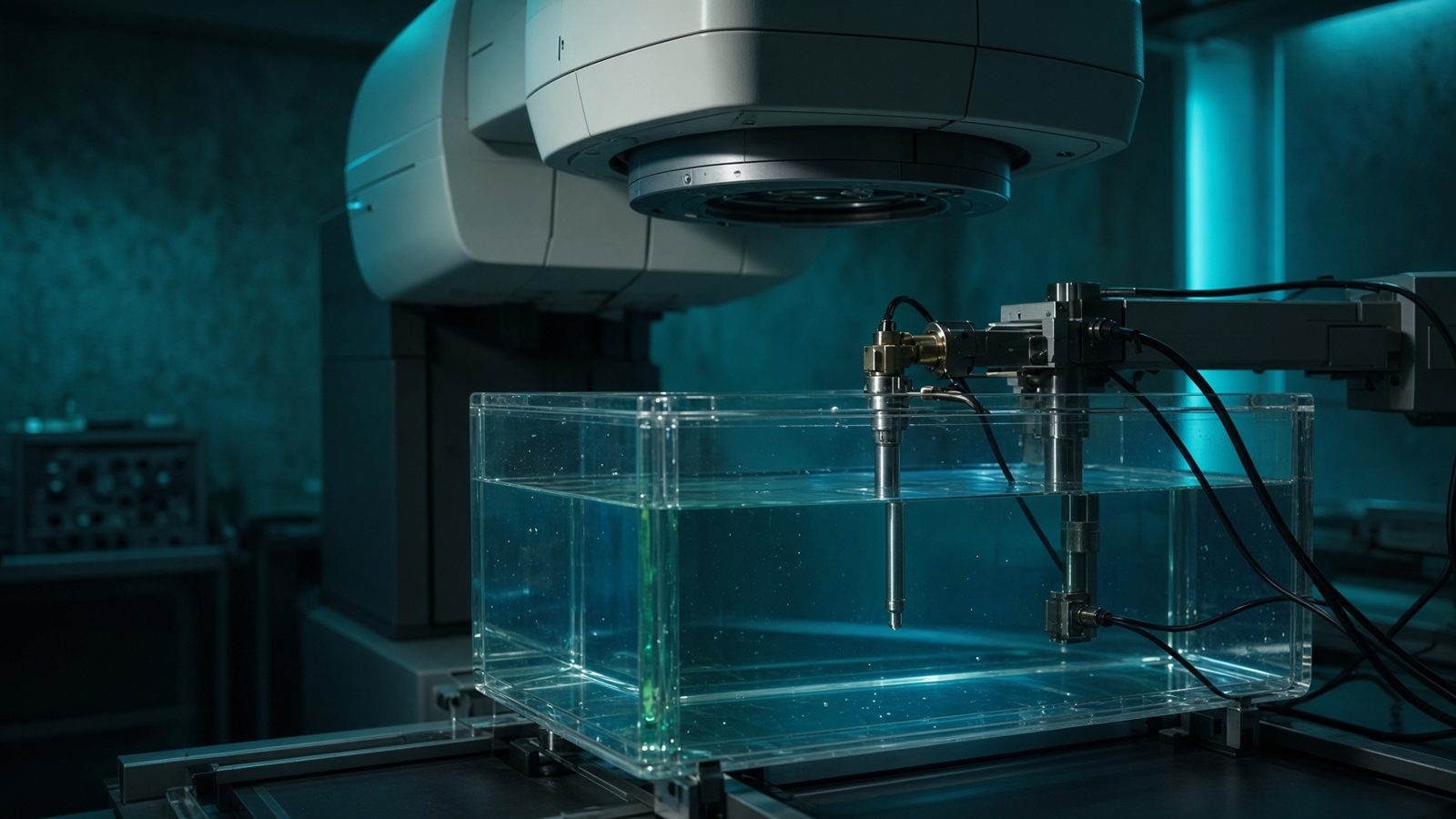
Ion chamber
In the water tank under the linac, at the ion chamber — reference dosimetry happens here.
Open this machineFormula
Variables
Results
R
CSDA-like range
4.664g/cm²
R_w
Range in water
4.664cm
E/2
Rule of thumb
4.5cm
Curve
Explanation
What it means
Electron CSDA range in water is nearly linear with energy above a few MeV: R ≈ 0.53E − 0.106 cm (Katz–Penfold style). Below 2.5 MeV a power law is used. The clinical ‘E/2 cm’ rule of thumb sits close to practical range Rp. This is a working relation in Dosimetry.
Where it is used
Clinically it sits on the Water phantom — Ion chamber. In the water tank under the linac, at the ion chamber — reference dosimetry happens here. Dosimetry is the chamber in water under the linac, or the well counter in the hot lab: TG-51, TRS-398, kerma, and recombination. These numbers are the calibration the rest of the department borrows.
Water phantom · Open this machineHow to use it
Use it to guess Rp and to choose a chamber depth. Clinical electron PDD (R90, R50) is in the radiotherapy electron-rules calculator — this one is the dosimetry/CSDA cousin. Change one input and watch the curve and the simulation follow.
Symbols
- EElectron energy9 MeV
Worked example
A typical case from the default values: E = 9 MeV (Electron energy). Substituting into the relation gives R = 4.664 g/cm²; R_w = 4.664 cm; E/2 = 4.5 cm. These are teaching numbers — align them with your machine.
Typical values give
- R = 4.664g/cm²
- R_w = 4.664cm
- E/2 = 4.5cm
Where it comes from
The displayed formula is the working relation. Approximate range: E/2 rule of thumb or Katz-Penfold by energy. Usual reference: Katz & Penfold / clinical rule of thumb. Derive it in the specialty lesson, then return here to pin the numbers.
Reference: Katz & Penfold / clinical rule of thumb
Assumptions & limits
Water (or g/cm² in unit-density medium). Not a substitute for measured PDD. Straggling means some electrons go beyond Rp.
Pitfalls
kQ is for that chamber and that beam quality — not a neighbour's value. Polarity and recombination are measured, not copied. A ⁶⁰Co N_D,w is not an MV calibration until kQ is applied. Water (or g/cm² in unit-density medium). Not a substitute for measured PDD. Straggling means some electrons go beyond Rp.
Keep this
For 0.01–2.5 MeV, R = 0.412 E^n g/cm² with n = 1.265 − 0.0954 ln E.
In this specialty