04 Protection
Patient scatter at 1 m
Scattered dose ≈ α (A/400) D / d² with α ~ 0.001 for MV photons.
Listen
Listen · English
Simulation
Patient scatter at 1 m — Change the numbers; the scene follows.
Where it works
Linear accelerator
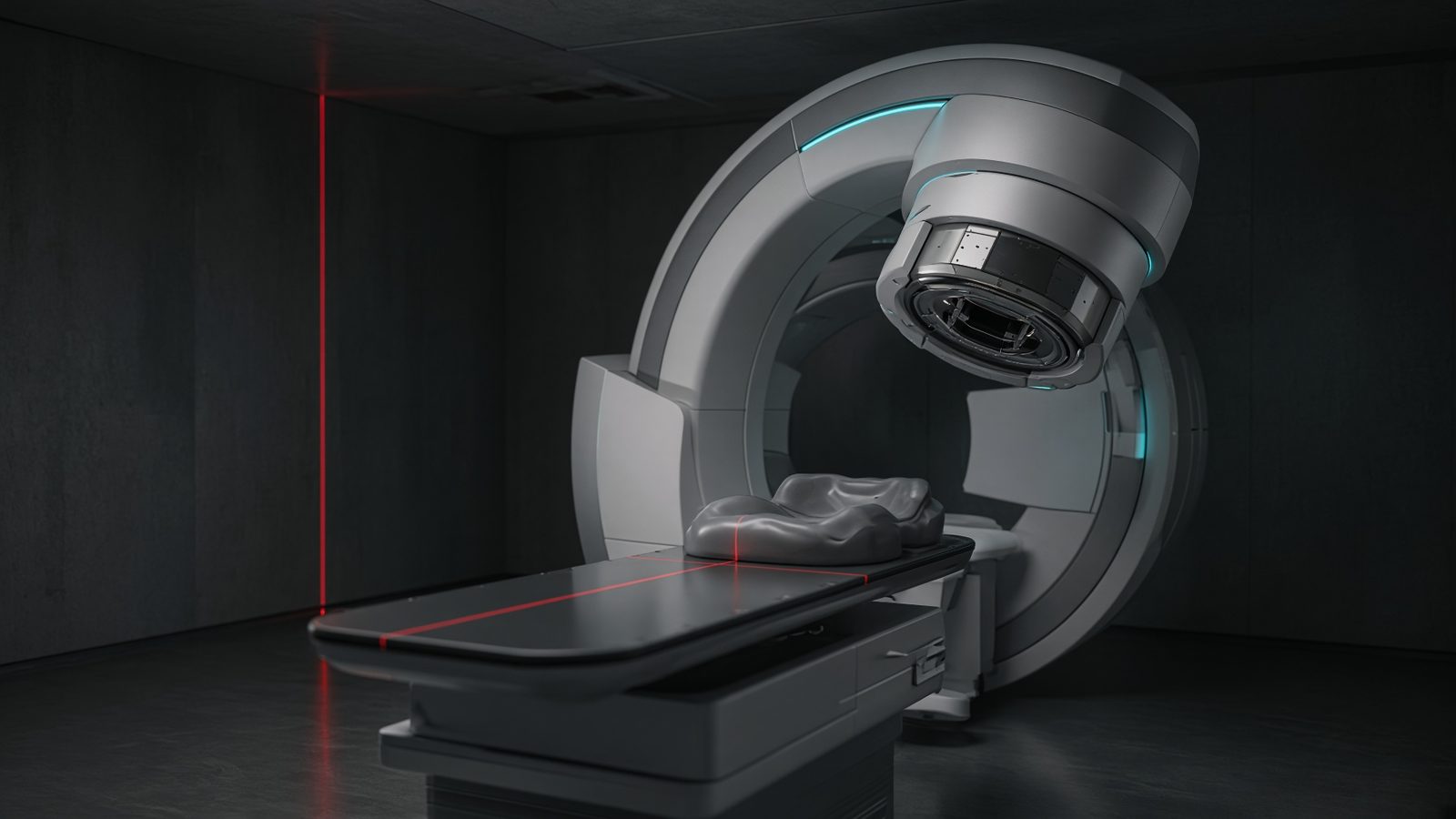
Isocenter
At isocenter, on the central axis through the patient (or a phantom in the same place).
Open this machineFormula
Variables
Results
D_s
Scattered dose
0.002Gy
D_s
Scattered dose
2mGy
Explanation
What it means
Patient scatter at 1 m is about 0.1% of the primary dose for a 400 cm² field (α ~ 10⁻³), scaling with field area and 1/d². It dominates secondary-barrier B for many walls beside the couch. This is a working relation in Radiation protection.
Where it is used
Clinically it sits on the Linear accelerator — Isocenter. At isocenter, on the central axis through the patient (or a phantom in the same place). Protection equations are the wall, the occupancy factor, and the badge: time, distance, shielding, and WUT. They turn a room into a legal design.
Linear accelerator · Open this machineHow to use it
α depends on energy (slightly lower at 18 MV than 6 MV at 90°). Area A is at isocentre. For IMRT use an increased effective W rather than inflating α. Change one input and watch the curve and the simulation follow.
Symbols
- DIsocenter dose2 Gy
- AField area at iso400 cm²
- dDistance from patient1 m
- αScatter fraction0.001
Worked example
A typical case from the default values: D = 2 Gy (Isocenter dose); A = 400 cm² (Field area at iso); d = 1 m (Distance from patient); α = 0.001 (Scatter fraction). Substituting into the relation gives D_s = 0.002 Gy; D_s = 2 mGy. These are teaching numbers — align them with your machine.
Typical values give
- D_s = 0.002Gy
- D_s = 2mGy
Where it comes from
The displayed formula is the working relation. Scattered dose ≈ α (A/400) D / d² with α ~ 0.001 for MV photons. Usual reference: NCRP 151. Derive it in the specialty lesson, then return here to pin the numbers.
Reference: NCRP 151
Assumptions & limits
Single-scatter, 90° typical NCRP value. Ceiling bounce, maze scatter, and Compton scatter from the wall itself are extra terms in a full report.
Pitfalls
Tenth-value layers are for the broad beam in that material and that energy — not a photocopy from another bunker. Occupancy T is not a guess; it is a use pattern. Inverse-square fails against a large scatter source. Single-scatter, 90° typical NCRP value. Ceiling bounce, maze scatter, and Compton scatter from the wall itself are extra terms in a full report.
Keep this
α is scatter fraction at 1 m from a 400 cm² field. Typical 0.00064–0.0014 depending on energy.
In this specialty